
Will AI Replace Designers — The Most Common Question Today
In recent years, one of the most frequently asked questions in both design and development communities has been this: “Will AI replace designers?” This question does not come from simple curiosity—it reflects a mixture of anxiety and expectation driven by real technological change. Tools are rapidly emerging that can generate web page layouts or automatically create simple UI screens from just a few lines of text. Until a few years ago, design was considered a field strongly shaped by human creativity and intuition, and therefore expected to be slower to automate. However, the situation has begun to change. With the rise of various generative AI models, we are now seeing more cases where layouts, style suggestions, and even interaction structures are automatically created. These changes naturally lead to a new question: “Will the role of the designer eventually become unnecessary?”
At first glance, this question seems intuitive and persuasive. But if we look more closely, it does not fully capture the essence of what is happening. Technological change does not often eliminate professions directly. More commonly, it reshapes the structure of work itself. History has shown this pattern repeatedly. When computer-aided design tools emerged, there were predictions that architects would disappear. When code autocomplete became widespread, similar claims were made about developers. Yet in reality, entire professions rarely vanished—instead, the center of their work shifted.
So the question this article raises is slightly different. Instead of asking “Will designers disappear?”, we should ask: “How is the role of design being restructured within the product development process?” AI tends not to simply replace individual roles, but to transform the entire production structure in which those roles exist. A similar shift is now beginning in the field of design. By examining what becomes more important than directly creating UI, and how the position of design within product development is changing, the essence of this debate becomes clearer.
To understand this question, we first need to look back at the product development structure that we have taken for granted over the past two decades.
The Product Development Structure We Have Taken for Granted
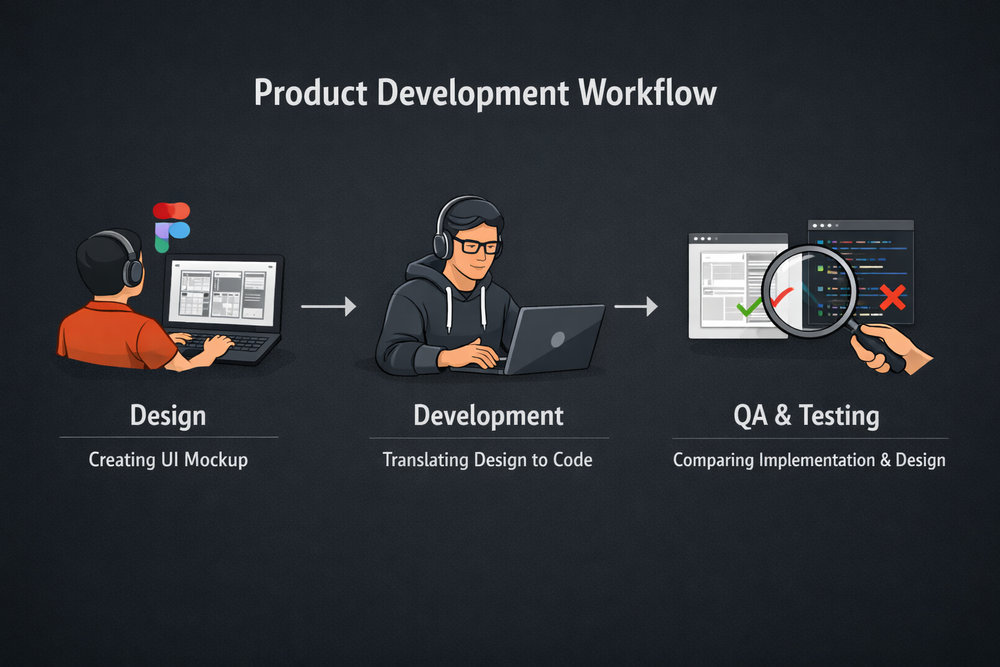
Over the past 20 years, most digital products have been built in a similar way. Designers create the screens first, and developers then implement those designs in code. Designers use tools like Figma or Sketch to build interfaces, arranging UI elements such as buttons, cards, and input forms. They then hand off the results to the development team, and developers recreate them using HTML, CSS, or frameworks like React. This structure has been used for so long that it now feels almost like a natural way of collaborating. But if we look at it from a slightly different perspective, there is an interesting characteristic hidden within it: the product we are building is software written in code, yet its design begins as image-based mockups.
This approach certainly had its advantages. Designers could experiment visually at high speed, and developers could maintain stable code structures. However, at the same time, this structure contained a fundamental problem: the medium of design and the medium of implementation are different. Design exists as images, while the product exists as code. As a result, product development always requires a kind of translation process. Developers must recreate what designers have produced, and in that process, small discrepancies inevitably occur. Spacing may be slightly off, typography may not match precisely, or component structures may differ from the original design. These issues are not just simple mistakes—they are structural in nature.
Scenes commonly observed in real product development clearly reflect this structure. A designer creates a screen. A developer implements it. During QA, the actual screen is compared with the design mockup. When small differences are found, revisions are made again. This cycle consumes a significant amount of time in product development. Many teams adopt design systems and component-based development precisely to reduce this friction. Yet even then, one fundamental issue remains: design is still created as images, while products are implemented as code.
This structure has long been the standard collaboration model in product development, but at the same time, it has also been an old bottleneck. And it is precisely this bottleneck that has begun to receive renewed attention with the emergence of AI tools.
Design Handoff — The Oldest Bottleneck in Product Development
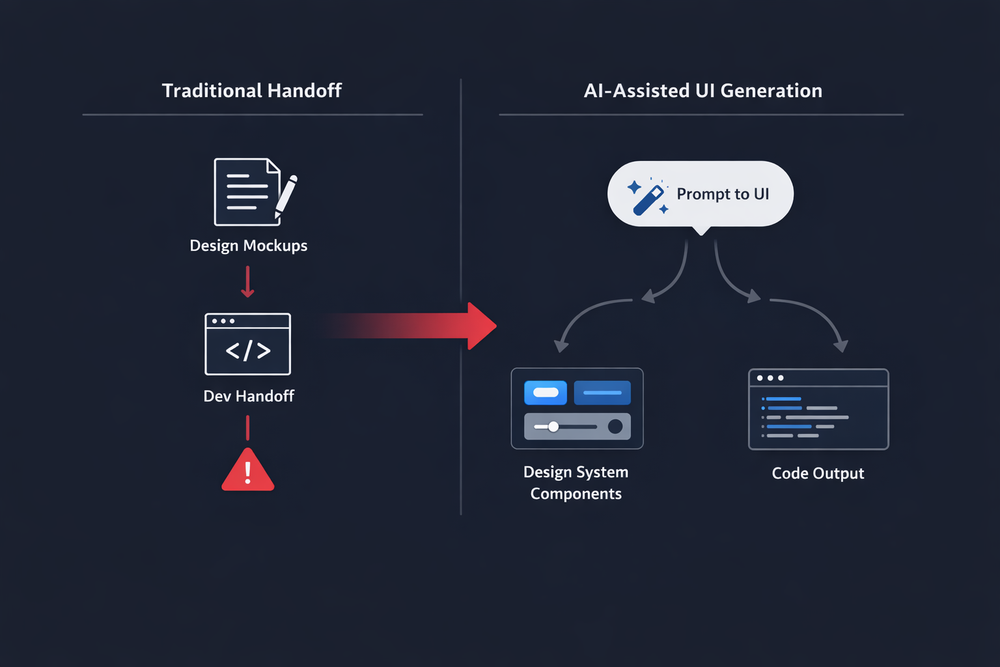
One of the most common sources of inefficiency in product development appears in the stage often referred to as design handoff. More time than expected is consumed in the process of developers implementing, in code, the screens created by designers. Although this may seem like a simple collaboration on the surface, it is in fact a complex process involving multiple layers of interpretation and judgment. Developers must reconstruct spacing, colors, typography, and interaction behaviors from design files into code, and small discrepancies inevitably arise. In some cases, component structures make it difficult to implement the design exactly. In others, layouts expressed in design tools behave differently in real responsive environments.
As a result, many teams repeatedly compare design and implementation during the QA phase. This is why so-called design QA—pixel-level comparison between mockups and actual screens—exists. If a button is a few pixels off, typography hierarchy is applied differently, or component spacing is inconsistent, revisions are made again. While these corrections are necessary for product quality, they also introduce significant cost. As products grow in scale, the problem becomes even more complex. Even with a design system in place, new components or patterns require ongoing coordination between design and implementation.
What makes this process particularly interesting is that it is not simply a collaboration issue, but a structural problem arising from the difference in design mediums. Designers work primarily with visual representations, while developers implement based on code structures. The two are closely connected, but not identical. As a result, translation is always required—and translation inevitably introduces loss. Many of the recurring inefficiencies in product development are, in fact, created within this translation process.
It is precisely at this point that AI enters the picture. Rather than replacing design itself, AI begins to disrupt this long-standing translation structure. In the next section, we will explore not how AI changes design directly, but how it is shifting the bottlenecks within product development.
AI Doesn’t Replace Designers — It Shifts the Bottleneck
As discussed earlier, there has long been a structural bottleneck between design and implementation in product development. This exists because designers create screens, and developers must then recreate them in code. While this process feels natural, it always incurs a translation cost due to the difference between the design medium and the implementation medium. For this reason, design handoff has been a recurring issue across many organizations. What is interesting is that with the emergence of AI, the nature of this bottleneck is beginning to change. Many people, upon seeing AI design tools, immediately ask whether designers will disappear. But the actual change taking place is different. Rather than eliminating specific roles, AI operates by shifting existing bottlenecks to new locations within the workflow.
This shift becomes clear when we look at recent AI tools. Systems are increasingly capable of generating UI layouts or automatically assembling component structures from prompts. In particular, tools connected to design systems are no longer limited to generating images—they can produce working UI code. What matters here is that AI is not simply creating visual mockups, but constructing interfaces based on component structures. In other words, parts of the work that previously required humans to manually assemble screens are now being automated. As a result, the central question in product development is gradually changing. In the past, the primary concern was “How do we implement this screen?” Now, the more important question is becoming “What screen should we build?”
This shift is not just about improving the convenience of design tools. Across the entire product development process, UI creation itself is becoming faster and cheaper. As AI becomes capable of generating layouts, assembling components, and even producing code, the cost of creating screens continues to decrease. Naturally, what becomes scarce is no longer the ability to build UI, but the ability to make product decisions. Questions such as what should be built, what experiences are meaningful to users, and which features align with product strategy become more critical. For this reason, AI is more likely to shift the center of design’s role within product development, rather than simply eliminate it.
From this perspective, the way AI is changing design becomes relatively clear. As the cost of directly creating UI decreases, what matters next is the rules and structures that define how UI is created. This is where design systems come into focus. And as we will see in the next section, this is precisely where the most significant changes are beginning to take place within many organizations.
UI Creation Is Less Creative Than We Think
When people talk about design, the first thing that often comes to mind is creativity. It is easy to assume that a designer’s core role is to create new screens, combine colors, and compose visually appealing interfaces. Of course, there are clearly creative elements involved in real design work. However, when repeatedly building UI in product development, another reality becomes apparent: most UI is not entirely new invention, but rather a variation of existing patterns. Login screens, settings pages, card-based layouts, and form interfaces tend to appear in similar forms across almost all services. This is because widely adopted interface patterns already exist across the industry.
This pattern-based structure is also a major advantage in product development. Users can understand familiar interfaces more quickly, and developers can rely on structures that have already been validated through repeated use. At the same time, it reveals another important insight: a large portion of UI creation is essentially the work of combining patterns. While entirely new screens are sometimes created, most product interfaces are built by assembling or modifying existing patterns. Elements such as buttons, cards, input forms, lists, and navigation are combined according to certain rules. As a result, the process of UI creation is more systematic than it might initially appear.
This characteristic is precisely why AI has been able to adapt relatively quickly to UI generation. AI excels not at inventing entirely new concepts, but at learning and recombining existing patterns. The internet already contains vast amounts of UI patterns and design examples—layouts, component structures, and interaction models across countless services. AI can learn from these patterns and reconstruct them to meet specific requirements. This is why even simple prompts can now produce basic structures such as login screens or dashboard UIs.
But this is where an important question emerges. If the process of creating UI itself becomes increasingly automated, what then becomes the most important aspect of design? As the value of directly building screens decreases, the core of design shifts elsewhere. And at the center of that shift are the rules and structures that define how UI is created—in other words, the design system. In the next section, we will explore this idea in greater depth.
What Matters Is Not Figma, but the Design System
In recent years, the concept of a design system has become increasingly important across many organizations. It often began as something simple—a style guide documenting button colors, typography rules, and spacing standards. However, as products grew in scale and multiple teams began working on the same service, the role of design systems gradually expanded. Component libraries were created, design tokens were defined, and interaction patterns were standardized. What emerged was no longer just a design document, but a core structure that maintains consistency across the entire product.
In the age of AI, the importance of design systems is likely to rise even further. Many people, when discussing AI design tools, ask questions like “Will Figma become unnecessary?” But the more important question is slightly different. When AI generates UI, what it needs most is not individual screen designs, but the rules of the system. Which button to use, how spacing should be applied, how components should be combined—these rules must exist for AI to produce consistent interfaces. In other words, AI can generate patterns, but it cannot define the product’s rules on its own.
For this reason, the center of competitiveness is likely to shift from the speed of UI creation to the quality of the design system. In organizations where the design system is well defined, AI can generate UI based on those rules, resulting in relatively consistent outputs. In contrast, in organizations without such systems, AI-generated UI is more likely to diverge from the overall product experience. This is why design systems are increasingly moving toward the role of product development infrastructure. What once appeared to be an internal asset of the design team is now becoming a structure that connects development and product strategy as a whole.
From this perspective, the question “Will Figma disappear?” is somewhat beside the point. Tools can always change, but systems become part of the product itself. Going forward, what matters in product design is not the ability to use a specific tool, but the ability to design product experience as a system. And it is precisely this shift that is beginning to redefine the role of designers. In the next section, we will explore in more detail what this change means for the designer as a profession.
How the Role of Designers Is Changing in the Age of AI
When we bring together the trends discussed so far, one clear direction emerges: the cost of creating UI itself is steadily decreasing. In the past, designing and implementing even a single screen required a significant amount of time. Designers had to create layouts, place components, and repeatedly adjust pixel-level alignment. Then developers would implement those designs in code, consuming additional time. However, as AI tools begin to integrate with design systems, this process is gradually changing. The generation of basic UI structures, the composition of components, and even the production of code are becoming increasingly automated. This shift naturally raises a question: what, then, becomes the role of the designer?
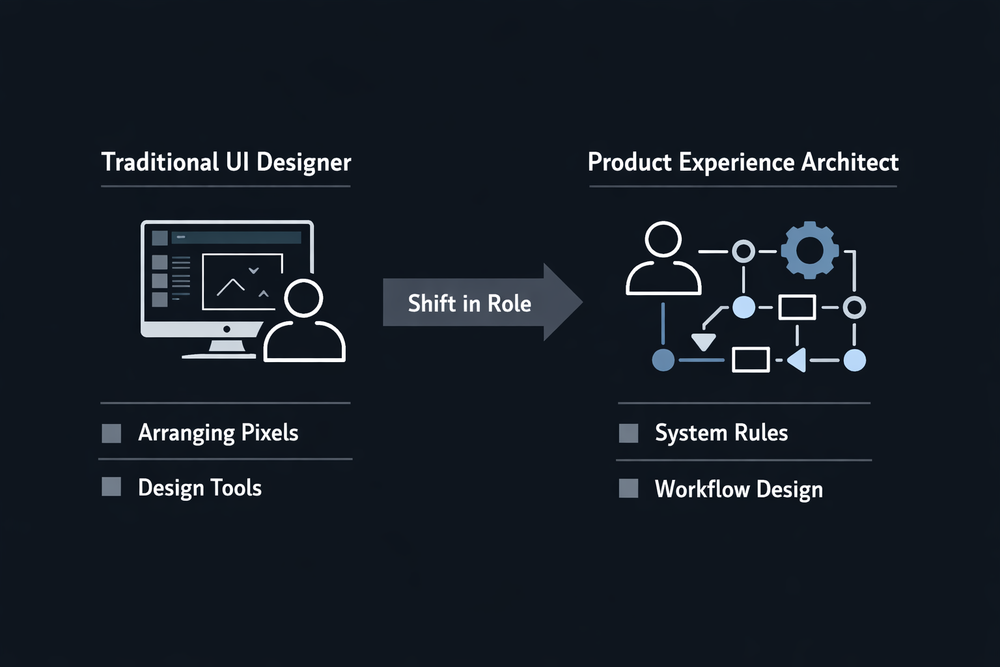
Many people instinctively arrive at an extreme answer—that designers will no longer be needed. But in reality, the change is likely to move in the opposite direction. As UI creation becomes automated, what becomes more important is not the UI itself, but the ability to design the structure of experiences. Deciding how features connect into flows, what kind of experience should be delivered to users, and what philosophy should guide a product’s interface still relies on human judgment. AI is strong at generating and combining patterns, but it does not determine the direction in which a product should evolve. For this reason, the role of designers is likely to shift from directly creating screens to designing the structure of product experiences.
This kind of change is not entirely new in the history of design. In the early days of web design, designers often wrote HTML themselves and constructed interfaces directly. Over time, as design tools evolved and frontend development became a distinct role, designers shifted their focus toward experience design and interface structure rather than implementation. The changes brought by AI follow a similar trajectory. The automation of UI creation does not eliminate the role of designers—it pushes it toward higher-level problems. What matters is no longer deciding where to place a button, but designing what experiences are meaningful to users.
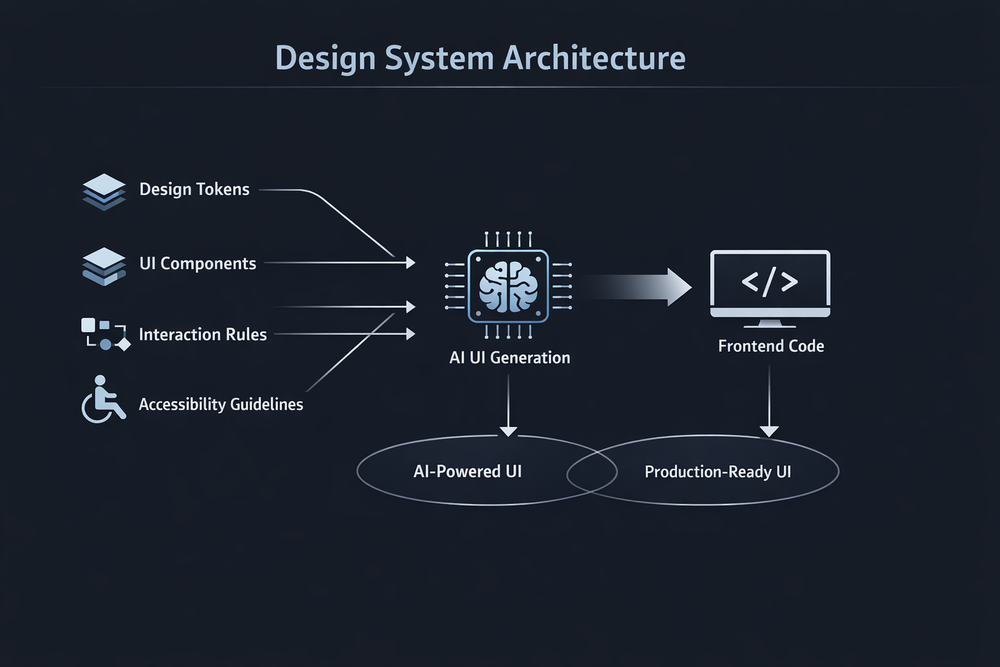
Another important shift is that the presence of design systems is expanding the role of designers. A design system is not just a style guide—it is a structure that defines the rules of product experience. Elements such as color, typography, component structure, interaction patterns, and accessibility standards are all defined within this system. The more well-designed the system is, the more consistent the UI generated by AI becomes. As a result, designers are increasingly moving beyond designing individual screens to designing product experience as a system.
From this perspective, the designer in the age of AI is no longer someone who arranges pixels, but someone closer to a product experience architect.
So the Real Question Is This
Following the discussion so far, we naturally arrive at a conclusion. The question many people ask—“Will tools like Figma disappear?”—may not actually be that important. Tools can always change. Over the past 20 years, design tools have continuously evolved. UI design moved from Photoshop to Sketch, and later to Figma, which introduced a more collaboration-centered design environment. New tools will continue to emerge. However, what sits at the center of product development is not the tool, but the rules on which the product is built.
With the emergence of AI, this structure is becoming clearer. The act of directly creating UI is becoming faster and cheaper. With just a few lines of prompts, basic layouts can be generated, components can be automatically arranged, and even code can be produced. In such an environment, the ability to create a single screen is no longer a scarce skill. Instead, what matters is the system on which that screen is built. In organizations with well-defined design systems, AI-generated UI follows consistent rules. In contrast, in organizations without such systems, screens may be created quickly, but the overall product experience easily loses consistency.
As a result, the real question takes a different form. Rather than asking “Which tool should we use for design?”, we begin to ask: “On what system should we build the product?” This question extends beyond design and connects to the entire product development process. Only when component structures, interaction rules, data flows, and accessibility standards are connected within a single system can product experience become stable. At this point, the design system is no longer just a supporting element of design tools—it becomes part of the product development structure itself.
Understanding this shift also changes how we see the current debate. The question “Will AI replace designers?” may only be looking at the surface of what is happening. The more important transformation is that the way products are built is moving toward a system-centered approach. And this change does not affect only the design role. It is beginning to reshape frontend development, product planning, and even software architecture as a whole.
Next — Will Frontend Developers Disappear?
In this article, we explored the direction in which design is evolving in the age of AI. More than changes in design tools or UI generation technologies, the key shift lies in the structure of product development itself. We examined how the cost of UI creation is decreasing, how design systems are becoming the central structure of product experience, and how the role of designers is moving from screen creation to experience design. However, this change is not limited to the design domain. With a slightly broader perspective, the same question begins to emerge in other roles as well.
In particular, this shift appears in a particularly interesting way within frontend development. Recent AI coding tools are showing increasingly strong performance in generating UI code. There are growing examples where a simple prompt can generate React components or produce styled layouts. These tools become even more powerful when connected to design systems. If AI understands a design system and generates components based on its rules, a significant portion of basic UI coding can be automated. This naturally leads to another question: if AI can generate UI code, how will the role of frontend developers change?
This is not simply a question about role changes. It is fundamentally connected to the entire structure of software production. As code generation becomes easier, what becomes scarce in development is no longer the ability to write code, but the ability to design systems and make sound judgments. Decisions about how to structure applications, what component models to use, and how data should flow become increasingly important.
In the next article, we will explore this question in greater depth. Will frontend developers disappear in the age of AI, or will their role be completely redefined? We will continue by examining how the changes that began in design are appearing in development, and how they are reshaping the structure of software production.