The Most Common Question in the Age of AI
In recent years, one question has appeared most frequently in developer communities: “Will developers disappear because of AI?” Since the emergence of generative AI, this question has spread even more rapidly. The ability of code generation models to create functions or parts of applications from just a few lines of prompts has left a strong impression on many people. Naturally, concerns have grown that the role of developers itself may be under threat. Some articles and conference talks even portray a future where developers will soon disappear. However, most of these discussions tend to be overly simplistic. Technological change does not always eliminate entire professions. More often, it reduces the value of certain tasks while making other kinds of work more important.
If we refine the question further, a much more interesting perspective emerges. Instead of considering developers as a whole, focusing on specific areas makes the structure of change clearer. Among them, one role draws particular attention: frontend developers. Frontend occupies a unique position compared to backend or infrastructure—it is responsible for the interface that users directly see and interact with, while also existing at the boundary between design and code. For this reason, many people assume that frontend will be one of the first roles to be affected by AI. In fact, code generation models can already produce simple UI code and layouts with relative ease. This has led to claims that the role of frontend developers may shrink rapidly. However, before arriving at such conclusions, it is necessary to first understand what frontend developers actually do, and how that role has evolved over time.
What Do Frontend Developers Actually Do?
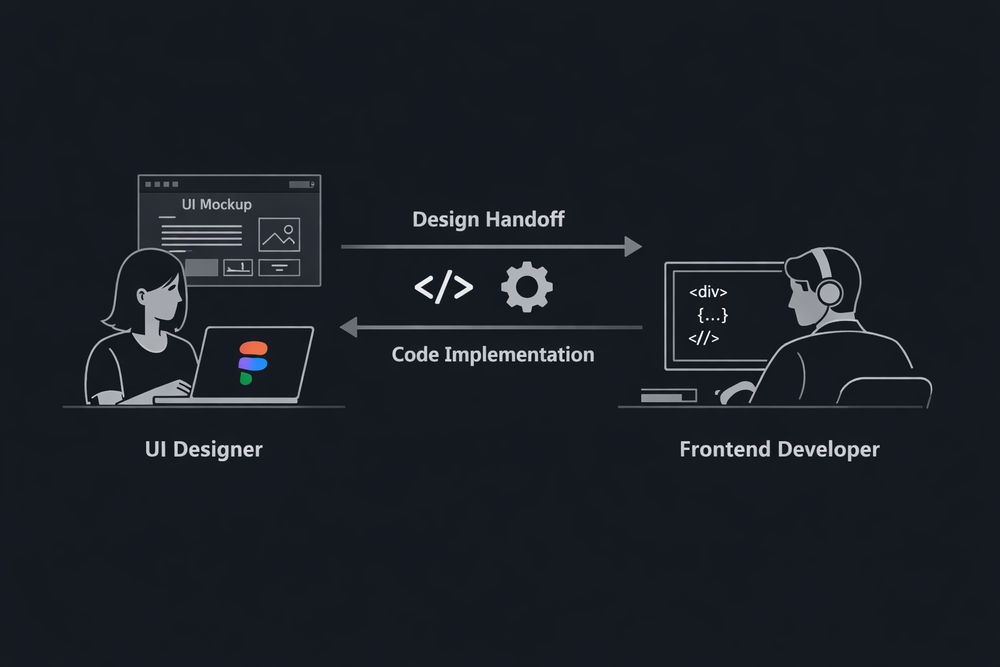
In most product development organizations, the overall structure is quite similar. Designers create user interfaces, frontend developers implement those interfaces in actual code, and backend developers handle data processing and server logic, connecting to the frontend through APIs. This structure is commonly found across nearly all software organizations, from startups to large enterprises. Of course, the details of role separation may vary depending on the size of the organization or the nature of the product. But at a high level, the flow from design to frontend to backend has remained consistent for a long time. Since web applications became widespread, this structure has remained largely unchanged for over 15 years. Frameworks have evolved and tools have improved, but the division of roles has remained almost the same.
Looking at this structure from a different perspective reveals an interesting insight. The core role of frontend developers has essentially been translating design into code. Designers create screens using tools like Figma or Sketch, and frontend developers take those designs and implement them using HTML, CSS, and JavaScript. Frameworks like React and Vue have made this process more systematic, but the underlying nature has not changed significantly. Recreating designer-made screens in code has been the primary responsibility of frontend developers. While tasks such as implementing interactions and managing state are also involved, in many cases, the most time-consuming work—especially in the early stages of development—has been building UI according to design specifications.
Thinking more deeply about this reveals an important question. We are building software, yet its design is created not as software, but as images. Designers visually design screens, and frontend developers write code based on those images. In other words, the same interface is being created twice, in two different mediums. This structure has long been accepted as natural, but in reality, it is quite unique. And it is precisely at this point that the role of frontend developers was formed.
Why Are We Building Software Twice?
If we look more closely at this structure, an interesting fact emerges. In most web application development processes, the interface is created twice. First, the designer builds the screen using design tools. Then, the frontend developer recreates the same screen in code. Because this process has been repeated for so long, many people accept it as natural. But fundamentally, it is the same output being produced twice in different ways. Designers construct screens at the pixel level, while developers reproduce that pixel structure in code. In this process, information is transformed once—and wherever transformation exists, errors and friction inevitably arise.
This situation is very common in real-world development. When designers review screens implemented by frontend developers, they often find slight differences—spacing that is slightly off, typography that does not exactly match, or component states that differ from the design. Colors may appear slightly different, or interactions may not behave exactly as intended. As a result, revisions are repeated. Pull requests are rejected, and small style changes are made multiple times. Many developers have likely heard the phrase: “This looks a bit different from Figma.” This is not just a communication issue—it is a structural problem caused by the fact that design and implementation exist in different mediums.
For a long time, this structure was not recognized as a major issue. Design tools and development tools belonged to different domains, and the division of labor—designers working with visual tools and developers working with code—was naturally accepted. However, as technology has evolved, this structure has begun to raise more questions. With the emergence of design systems and component-based UI architectures, the situation has started to change. Interfaces are increasingly composed of patterns and reusable components. This shift has brought back an important question: is the traditional “design → implementation” workflow really the optimal approach? And it is precisely at this point that a new factor—AI—enters the picture.
What AI Breaks First — The UI Translation Layer
Looking back at the structure discussed earlier, one characteristic becomes clear. In traditional product development, there has always been a translation layer between design and code. Designers create interfaces visually, and frontend developers reimplement those designs in code. While this process has long been accepted as natural, it is essentially a structure where the same interface is created twice in different ways. And this translation process introduces more cost than expected—subtle mismatches between design and implementation, repeated revisions, and ongoing communication to resolve small differences. These frictions have become a familiar part of most development teams, often accepted as unavoidable.
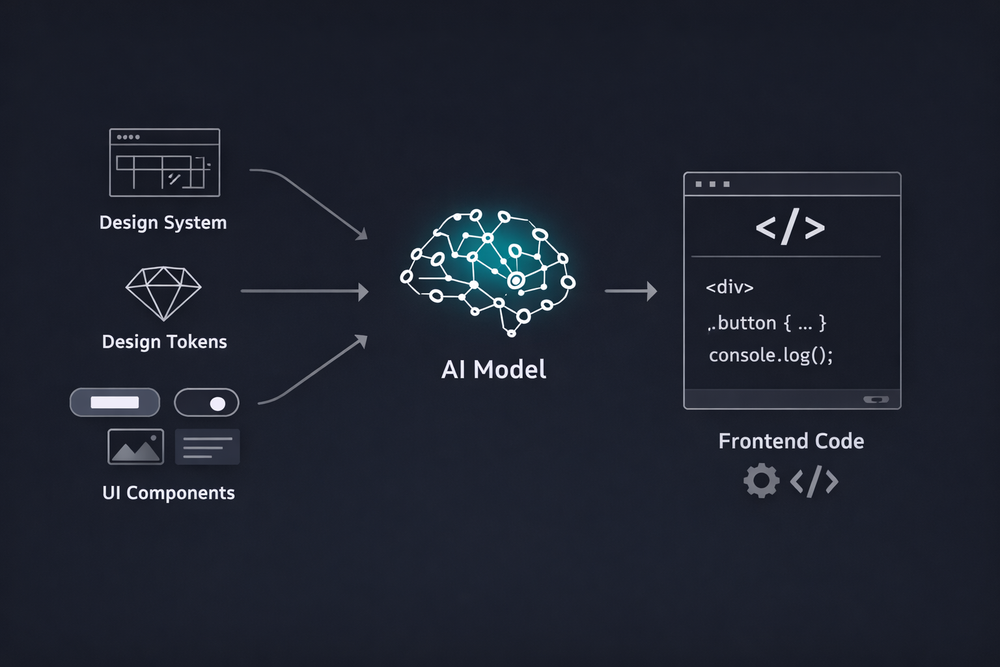
However, with the emergence of AI, this structure is beginning to crack. AI is particularly strong at recognizing and recombining patterns. And user interfaces are, in essence, collections of patterns. Login screens, card layouts, settings pages, list views, and dashboards are all structures that repeatedly appear across the industry. These patterns are becoming increasingly standardized through design systems and component libraries. When AI is given access to the components and rules of a design system, generating a specific screen becomes far less difficult than expected. For example, a prompt such as “Create a settings page using our design system” can lead AI to assemble the necessary components and produce working UI code. This is not merely about code generation—it suggests that the entire process of translating design into code may disappear.
This shift forces us to rethink the structure of frontend development. Until now, frontend developers have played a key role in translating design into code. But if design systems are sufficiently structured and AI can understand their rules, a significant portion of interface implementation can be automated. This does not mean frontend developers will no longer be needed. Rather, it means that some aspects of their role may no longer be central. In other words, the core of this change is not the disappearance of a role, but the shift in the structure of work itself. And at this point, a new question naturally arises: if UI implementation begins to be automated, what role will frontend developers play going forward?
So, Will Frontend Developers Disappear?
At this point, many people naturally arrive at a conclusion: if AI can generate UI, perhaps the need for frontend developers will significantly decrease. This argument does appear from time to time. If AI can automate code writing and generate interfaces, then the role of frontend developers may shrink considerably. This perspective is not entirely without merit, since a large portion of frontend work has traditionally focused on UI implementation. In many projects, frontend developers have spent significant time building screens based on design, adjusting styles, and adding interactions.
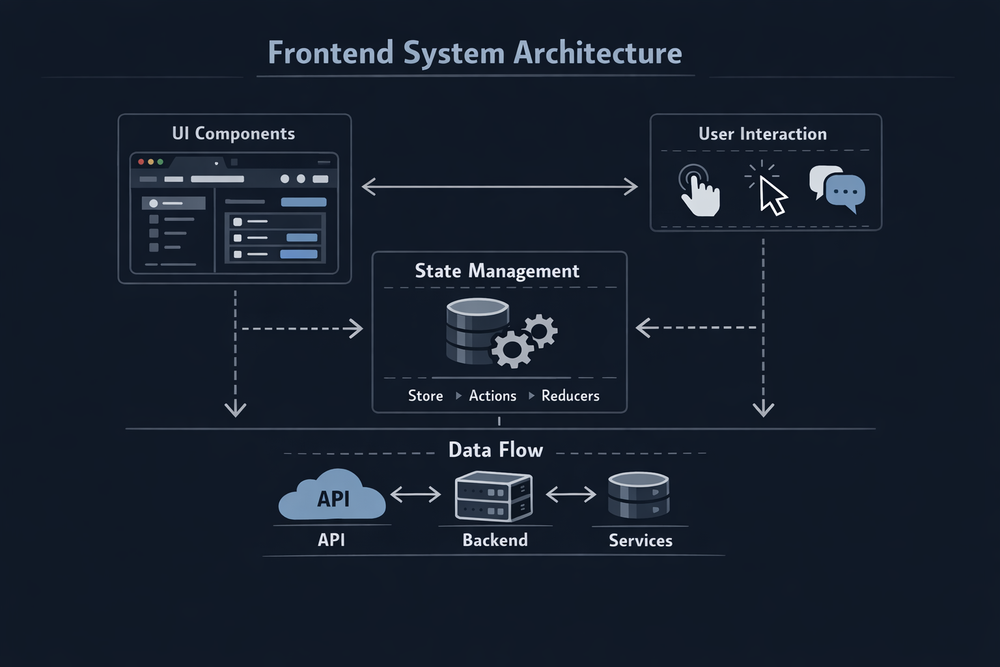
However, there is a critical misunderstanding here. UI implementation is not the entirety of frontend development. Developers who have worked on large-scale applications know that far more complex problems exist within the frontend. Consider state management alone: when multiple components share the same data, how should that state be structured? When asynchronous data requests occur simultaneously, how should data flow be controlled? These are fundamentally different from simple UI implementation. When additional factors such as interaction models, animations and transitions, behavior under network latency, and accessibility are included, the frontend application becomes a complex system.
These problems cannot be solved by code generation alone. AI may be able to generate interface code, but designing the overall data flow and user experience of an application still requires human judgment and architectural thinking. In large-scale services where multiple features are interconnected, the frontend structure directly impacts the stability and scalability of the entire product. Therefore, concluding that frontend developers will disappear simply because AI can generate UI is an oversimplification. Change is certainly happening, but its direction is not the disappearance of the role—it is the redefinition of that role.
The Real Problem in Frontend Is Not UI, but Systems
To understand the essence of frontend development, it is necessary to distinguish between building interfaces and structuring them. Rendering a screen is a task with a relatively clear goal—you can reference a design, construct a layout, apply styles, and immediately see the result. But designing a UI system is a completely different kind of problem. It involves how interfaces connect multiple features and data, how components relate to each other, and how the UI responds to state changes. These go beyond simple screen creation and require architectural thinking. As products grow, this structure becomes increasingly complex. A single button click can change the state of multiple components, trigger network requests, and even affect data across other screens.
To maintain such structures reliably, frontend developers have developed various design approaches. Concepts such as state management libraries, component architectures, and data flow patterns all emerged to address these challenges. In simple applications with only a few UI screens, complex structures may not be necessary. But in services with hundreds of screens and diverse user interactions, the interface itself behaves like a system. Designing and maintaining this system requires a level of technical judgment far beyond simply building UI. This is why experienced frontend developers often consider interface architecture more important than interface implementation.
With the emergence of AI, this distinction is becoming even clearer. AI is highly effective at generating UI based on patterns. However, designing the overall state flow and interaction model of an application cannot be easily solved through pattern generation alone. This is especially true in real-world environments where various user scenarios and edge cases must be considered. As a result, the center of frontend development is gradually shifting away from simple UI implementation toward UI system design and interface architecture.
In other words, frontend development is evolving from a role that builds screens into one that designs interfaces as systems. And this shift leads to an even larger trend, which will be explored in the next section: the transformation of frontend into a platform.
Frontend Is Becoming a Platform
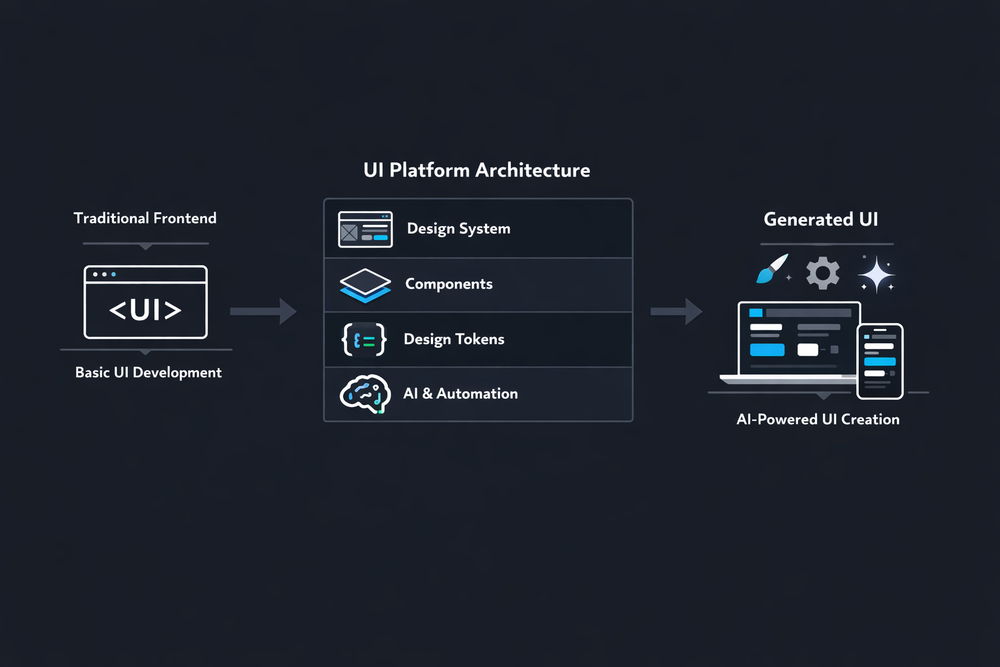
As discussed earlier, UI implementation itself is increasingly likely to be automated. If design systems are sufficiently structured and AI can understand their rules, a significant portion of screen creation can be generated by tools. This shift is not merely about increased speed. The more important change is that the role of frontend is moving from building screens to building systems. Until now, frontend developers in many organizations have been responsible for implementing designers’ work in code. But as interface implementation becomes automated, frontend developers will need to design the environment in which interfaces are created and operate.
This change is already visible across various technological trends. Design systems and component libraries are no longer just collections of UI elements—they are beginning to function as interface platforms. Organizations no longer manage components like buttons, cards, and modals as simple code snippets. Instead, they manage them as a structured system that includes design tokens, accessibility rules, state management approaches, and interaction patterns. This system ensures that dozens or even hundreds of screens operate under consistent rules. As a result, frontend developers are no longer just implementing individual screens—they are building the platform on which interfaces are generated and run.
This shift is also reflected in organizational structures. In some companies, frontend teams and design system teams exist separately, focusing on designing the foundational structure of the entire product UI. In others, new roles such as Design Engineer have emerged, bridging the gap between designers and developers while building design system and UI component infrastructure. These changes indicate that frontend development is evolving beyond simple UI implementation into the domain of building product interface platforms.
Looking ahead, this trend is likely to accelerate—especially in environments where AI generates UI. For AI to function effectively, it requires clear rules and structured systems. When design systems are expressed in code and component rules are well defined, AI can generate UI reliably. Without such structures, AI will produce inconsistent styles and quickly break interface coherence. For this reason, one of the core responsibilities of frontend developers in the future will likely be designing the interface rules that AI can operate on.
The Frontend That Becomes Less Valuable—and the Frontend That Becomes More Important
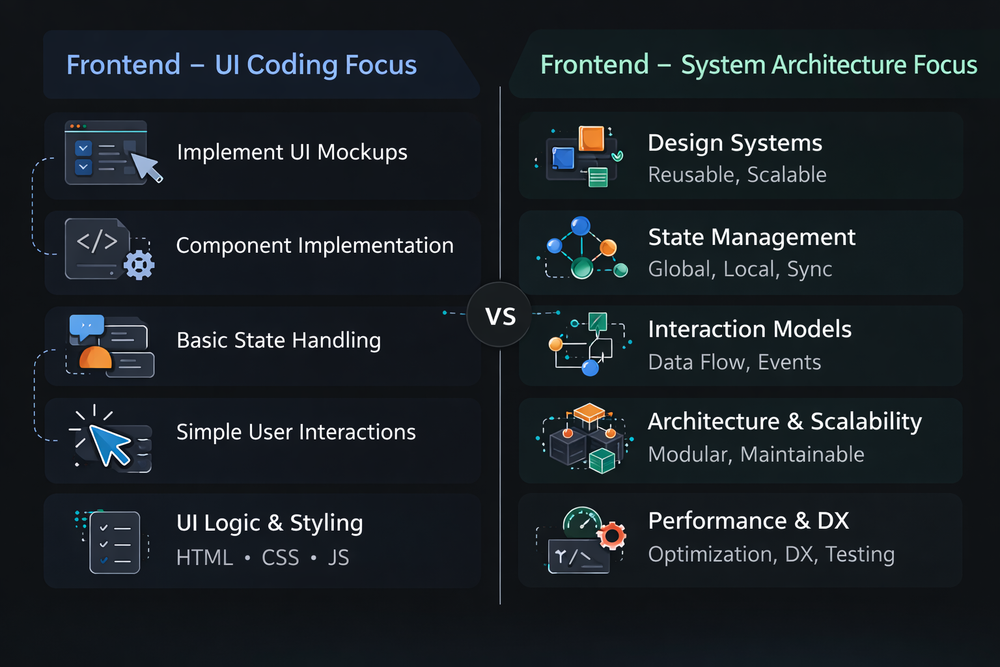
Whenever technological change occurs, the value of roles within a field tends to shift. A similar transformation is likely to happen in frontend development. Until now, a significant portion of frontend work has focused on UI implementation—building layouts from design, applying styles, and adding interactions. These tasks have played a major role in most projects. However, if AI can generate UI code based on design systems, a large part of this work can gradually be automated. In other words, the role of simply implementing screens from design may become less valuable over time.
But this does not mean that the value of frontend developers will decrease. In fact, the opposite may occur. As interface implementation becomes automated, the importance of system design capabilities increases. Designing a design system and defining component structures require a much deeper level of understanding than writing code alone. Ensuring that interfaces behave reliably across various scenarios is far more complex than building individual UI elements. In large-scale services where many features are interconnected, the UI structure itself becomes a form of architecture.
As a result, we may begin to see a divergence within frontend roles. On one side, the need for simple UI implementation may decrease as it becomes automated. On the other, the importance of designing and maintaining interface systems will grow. This difference is not merely about technical skill—it reflects a difference in perspective. Developers who can move beyond building screens and instead view the entire interface as a system will likely become increasingly valuable.
This shift is already visible across multiple technological trends. Concepts such as component-based architecture, design systems, and state management patterns have all pushed frontend development beyond simple UI implementation into the realm of system design. AI is likely to accelerate this transition even further. Ultimately, the future of frontend developers will be determined not by their ability to build UI, but by their ability to understand and design interface systems.
What Disappears Is Not the Role, but the Work
In discussions about technological change, one of the most common claims is that certain jobs will disappear. Historically, this prediction has been repeated many times. Whenever automation technologies emerge, people tend to believe that new technologies will completely replace human work. In reality, however, change more often occurs through a transformation of work structures rather than the disappearance of entire professions. Some tasks are automated, others become more important, and as a result, roles are redefined.
A similar shift is likely to occur in frontend development. AI can certainly automate parts of UI implementation. Technologies that generate interface code based on design systems have already emerged and will continue to evolve. But this does not mean that the role of frontend developers will disappear. Instead, some of the tasks they have traditionally handled will decrease, while other types of work will become more important.
In particular, the role of structurally designing user experience is likely to grow in importance. An interface is not simply a collection of screens—it is a space where users and systems interact. How this space behaves, how data flows, and how interactions are connected all determine the overall product experience. These are not problems that can easily be replaced by code generation. In fact, as interface creation becomes easier, the importance of these design capabilities may increase even further.
Therefore, what is likely to disappear in the age of AI is not the frontend developer as a role, but the relative weight of specific tasks such as UI implementation. Taking its place is a higher-level responsibility: designing interface structures and building systems. In the future, frontend developers may be understood not as people who build screens, but as those who design the language and structure of product interfaces.
And this leads to the next question. If the speed of code generation continues to increase, why does the actual speed of development not improve as much as expected? This is a key topic that will be explored in the next article.
The Next Question — If Code Is Faster, Why Isn’t Development?
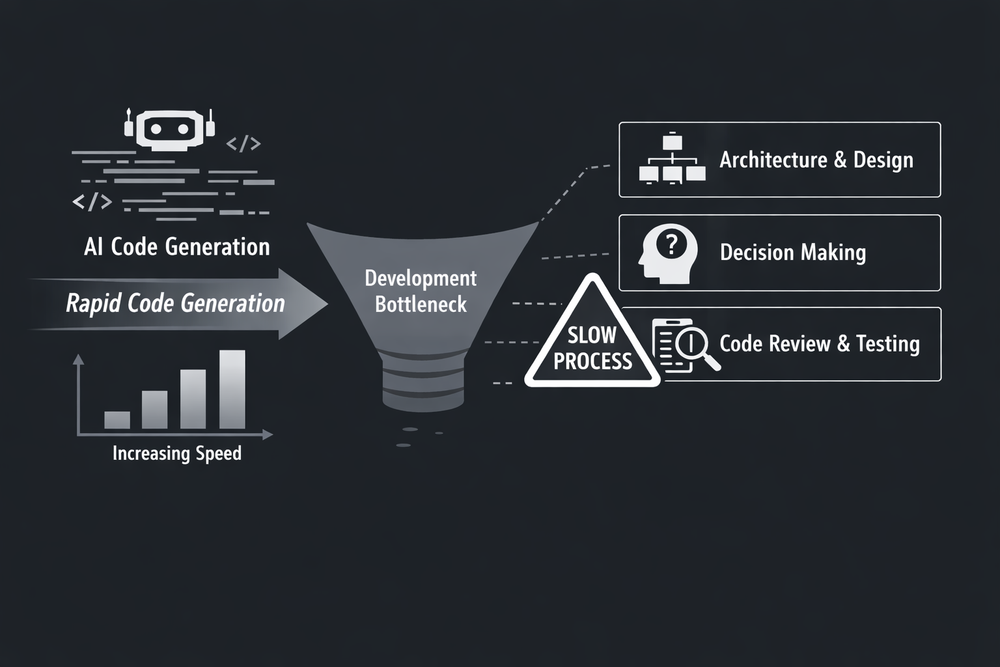
The changes we have examined so far point in a clear direction. AI is rapidly improving its ability to generate code. Not only simple functions and components, but even interfaces with recurring patterns can now be created much faster. Just a few years ago, implementing a single UI screen could take hours; now, in many cases, a basic structure can be generated from just a few lines of prompts. From this alone, it is natural to expect that if code is created faster, the overall speed of software development should also increase.
However, when we look more closely at real-world practice, the situation is not so simple. Despite faster code generation, many development teams do not feel that their overall development speed has improved significantly. In some cases, teams even feel that the development process has become more complex. At first glance, this seems contradictory. If code is being produced faster, why doesn’t development feel proportionally faster? This question cannot be explained simply by the performance of AI tools. It is fundamentally related to where the true bottlenecks exist within the software development process.
Writing code is certainly an important part of development, but it does not account for most of the process. In many projects, more time is spent defining requirements, designing system structures, and verifying that code behaves correctly. AI is highly capable of generating code, but deciding what code should be written still relies heavily on human judgment. Likewise, ensuring that generated code works reliably in real production environments is not easily automated. For these reasons, even as code generation becomes faster, the overall speed of development does not increase at the same rate.
To understand this, we need to reconsider where time is actually spent in development. In many organizations, significant time is devoted to code reviews, testing, quality assurance, architectural design, and communication with various stakeholders. Even if AI can generate code, these processes remain essential. In fact, as code generation becomes easier, their importance may increase. The more code that is produced, the more there is to validate. Ultimately, development speed is determined not only by the ability to write code, but by the efficiency of decision-making and validation processes.
From this perspective, the question of productivity in the AI era leads to a deeper inquiry: when tools make code easier to write, where does the real bottleneck move? Just as UI automation shifts the focus of frontend development toward system design, easier code generation brings other stages of development to the forefront. The ability to define requirements clearly, to understand problems precisely, to design complex systems reliably, and to judge whether code behaves correctly across various scenarios are all difficult to automate. These capabilities may, in fact, become even more critical in the age of AI.
For this reason, many development organizations are placing increasing importance on judgment and design capabilities over pure coding ability. AI can generate code, but deciding what to build—and choosing the most appropriate approach among many possibilities—remains a human responsibility. As a result, even though AI can improve certain aspects of productivity, the overall speed of development does not change as simply as expected. Instead, the bottleneck shifts from writing code to decision-making and validation.
At this point, a natural next question arises. If code generation continues to become easier and technical implementation becomes faster, how will the structure of development organizations change? How will teams divide work, and which roles will become more important? In the next article, we will explore this question in depth—examining how development organizations are evolving in the age of AI, and why judgment and problem definition are becoming increasingly scarce and valuable compared to code itself.