The Era When AI Started Writing Code
Until just a few years ago, writing code was a task that felt close to physical labor. Developers had to search through documentation, refer to existing code, and check how to use libraries, writing code line by line. Especially in projects using a new tech stack, even building the basic structure could take a significant amount of time. For example, when creating a web service, it often took days just to establish the fundamental skeleton—authentication structures, data models, API design, and exception handling. These tasks were often less about creative problem-solving and more about repeatedly implementing established patterns.
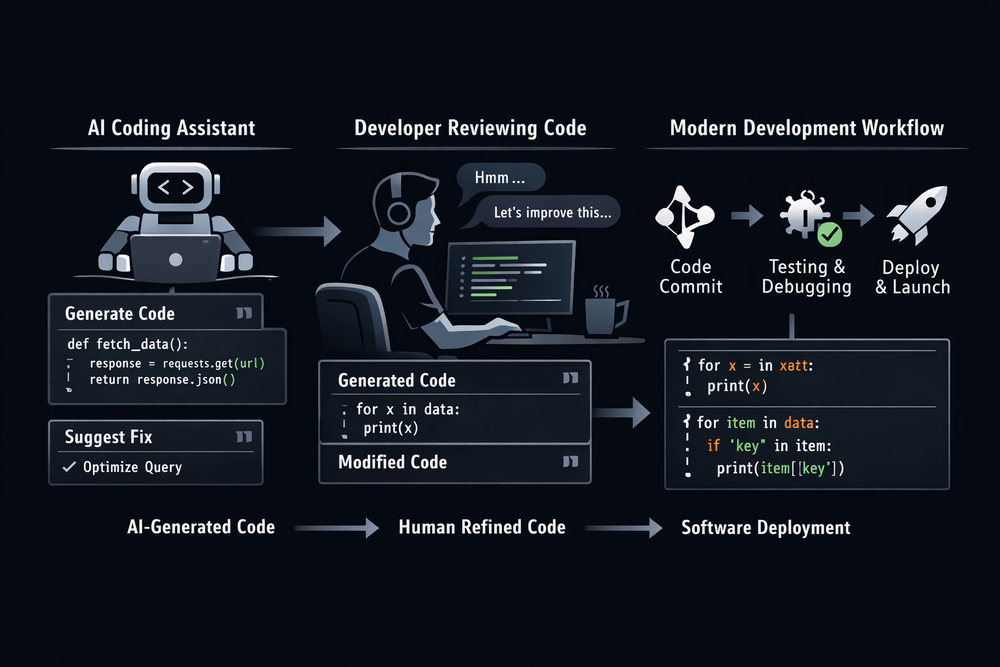
However, in recent years, this landscape has been changing rapidly. With the emergence of AI-powered coding tools such as Copilot, Cursor, and ChatGPT, the very way code is written has shifted. Instead of starting from a completely blank screen, developers now often describe their intent to AI, generate a draft, and then refine the result. Code that once took hours to write can now be generated in seconds. This transformation is especially pronounced in repetitive patterns and boilerplate code. Structural components such as authentication logic, data model definitions, and test code can now be produced by AI with a high level of accuracy.
This shift is not merely about making developers’ work more convenient. It also means that code generation itself is no longer a scarce skill. AI can produce new code at any time and can even propose multiple implementation approaches for the same problem simultaneously. Developers are no longer primarily the ones who create code, but increasingly the ones who decide which code generated by AI should be selected. While this transition is not yet fully settled, it has already begun to establish itself as a standard way of working in many development teams.
What is particularly interesting is the new question that emerges here. If AI can generate code this quickly, then software development speed should naturally increase significantly. Yet, in practice, the perceived speed in real-world development environments does not always improve in such a straightforward way. In fact, some teams report a rather counterintuitive experience: code generation has become much faster, but the overall complexity of projects has not decreased. In some cases, the amount of code is even growing faster than before. At this point, we are led to a critical question: if we can produce code more quickly, why does development not feel proportionally faster?
This question is not just a subjective impression—it points to a meaningful structural shift. The change brought by AI is not simply about writing code faster, but about redefining what the most important resource in software development actually is. And this shift is beginning to extend beyond the technical act of coding, influencing the very structure and roles within development organizations.
The Code Productivity Revolution: Has Development Productivity Really Exploded?
Since the emergence of AI coding tools, one of the most common claims is that “development productivity is increasing explosively.” It is true that many developers are now able to write code much faster than before by leveraging AI. Simple utility functions, data processing logic, and test code can now be generated into fairly complete drafts with just a few lines of description. Developers may use this code as-is or modify it slightly to fit their projects. The assistance of AI feels especially powerful when working with a new framework for the first time.
Because of these experiences, many people naturally arrive at a conclusion: software development speed will increase dramatically compared to the past. However, when we take a closer look at the actual flow of product development, the situation is not as simple as it seems. While code writing itself has become faster, the overall development speed of a project often does not change as dramatically. In some teams, although the speed of feature implementation has increased, the overall complexity of the system is growing even faster.
To understand this phenomenon, we must avoid equating code writing with product development. Writing code is only one part of the development process. The creation of real software products involves multiple stages, including problem definition, system design, implementation, testing, and operations. Code writing is just one of these stages, and the speed of the entire process is determined by multiple factors working together. While AI has significantly accelerated the coding phase, other stages have not improved at the same rate.
Consider system design, for example. To implement a feature, it is not enough to simply write code; the system structure must first be defined. Decisions such as how to structure the data model, what API architecture to use, and which technologies to adopt still rely heavily on human judgment. And these decisions often have a far greater impact than the act of writing code itself. A flawed design can lead to situations where the entire system must be reworked later.
Another example is the process of code validation. Code generated by AI may appear to work convincingly on the surface, but it does not always perfectly align with the context of a given project. As a result, developers must go through a process of reviewing and refining the code produced by AI. This process can take more time than expected. In complex systems, it is not enough for code to simply function; it must also integrate well with the overall architecture of the system.
At this point, we arrive at an important realization. AI has undeniably increased code productivity. However, the speed of software development as a whole is not determined solely by how fast code can be written. In fact, as code generation speed increases rapidly, other stages are becoming relatively more critical. And this shift is beginning to redefine where the true bottlenecks in the development process lie.
Bottlenecks Do Not Disappear: They Simply Move
When we look at software development from a broader perspective, we can see that it resembles a production system. Just as multiple processes are connected in a factory to produce goods, software development is also a flow composed of interconnected stages. Requirements definition, system design, coding, testing, and deployment are sequentially linked to create a product. And within this flow, there is always a recurring concept: the bottleneck.
In any production system, the overall speed is determined by the slowest stage. If one process is significantly slower than the others, it limits the total output. The same phenomenon appears in software development. The speed of an entire project is determined by which stage consumes the most time. In the past, coding was often the primary bottleneck. Implementing new features required developers to write code manually, and this process demanded considerable time.
However, with the emergence of AI coding tools, the situation has begun to change. Coding itself is no longer the slowest stage. AI can generate dozens of lines of code in seconds and can even propose multiple implementation approaches simultaneously. Tasks that once took days can now be completed in minutes. At first glance, this shift suggests that development speed should increase dramatically.
But bottlenecks do not disappear—they simply move elsewhere. As coding becomes faster, other stages begin to appear relatively slower. In particular, stages such as code understanding, code review, and system design are becoming increasingly critical. Code generated by AI cannot simply be used as-is. Developers must evaluate whether the code is correct, whether it conflicts with the system architecture, and whether it is maintainable in the long term.
This process is more complex than it may seem. In many cases, understanding existing code is harder than writing a single line of code. AI-generated code often lacks context. While the code itself may appear logically sound, it may not explain why it was written in that particular way. As a result, developers must not only verify whether the code works but also understand what role it plays within the overall system.
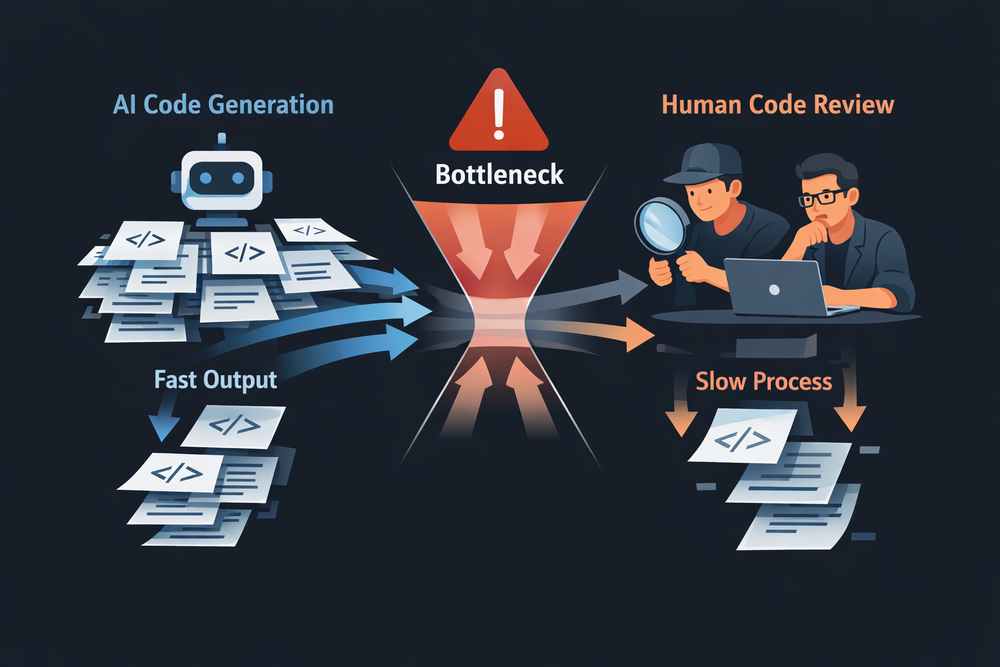
At this point, a new bottleneck begins to emerge in the development process: the speed of human understanding. While AI can generate code extremely quickly, the speed at which humans can comprehend and evaluate that code does not increase at the same rate. This creates a widening gap between code generation speed and code comprehension speed. And this gap becomes the starting point of a new structural challenge in software development in the age of AI.
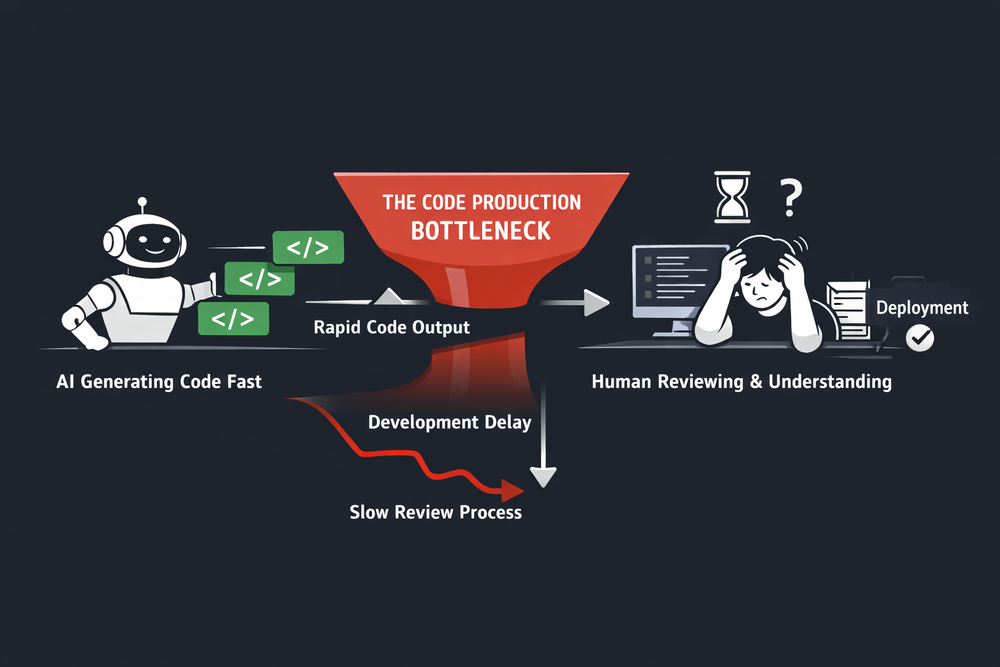
New Bottlenecks: Understanding, Review, and Design
As the speed of code generation increases dramatically, other stages of the development process naturally become more visible. In particular, areas such as code comprehension, code review, and system design remain domains that AI cannot easily replace. While AI can generate code quickly, it does not inherently explain why the code is structured the way it is. Developers must still read the code and determine the intent behind it. This process requires more time than one might expect. In some cases, understanding existing code can be more difficult than writing it from scratch.
This issue becomes even more pronounced with AI-generated code. Code written by human developers often contains a certain level of context. Elements such as variable names, code structure, and comments tend to reveal the author’s intent to some degree. However, AI-generated code often lacks this level of contextual clarity. While the code may appear logically correct, it frequently provides little explanation for why it was written in a particular way. As a result, developers must go beyond simply verifying whether the code works—they must understand how that code connects to the overall system architecture.
In this context, the role of code review becomes far more important than before. In the past, code reviews were primarily focused on finding bugs or ensuring consistent coding style. Now, they are evolving into a process closer to validating system design. Because AI-generated code can be implemented in multiple ways, developers must determine which approach is most appropriate in the long term. During the review process, factors such as performance, maintainability, and scalability are considered together. As a result, code review is no longer just a verification step—it is becoming an extension of design decision-making.
These changes also impact how development teams operate. While the speed of code generation continues to increase, the speed of code review remains heavily dependent on human comprehension. As a result, in many organizations, code review is emerging as a new and significant bottleneck. The faster code is generated, the more code there is to review. Ultimately, development teams must find a new balance. Rather than simply maximizing code generation speed, the focus is shifting toward how to perform code comprehension and design judgment more effectively.
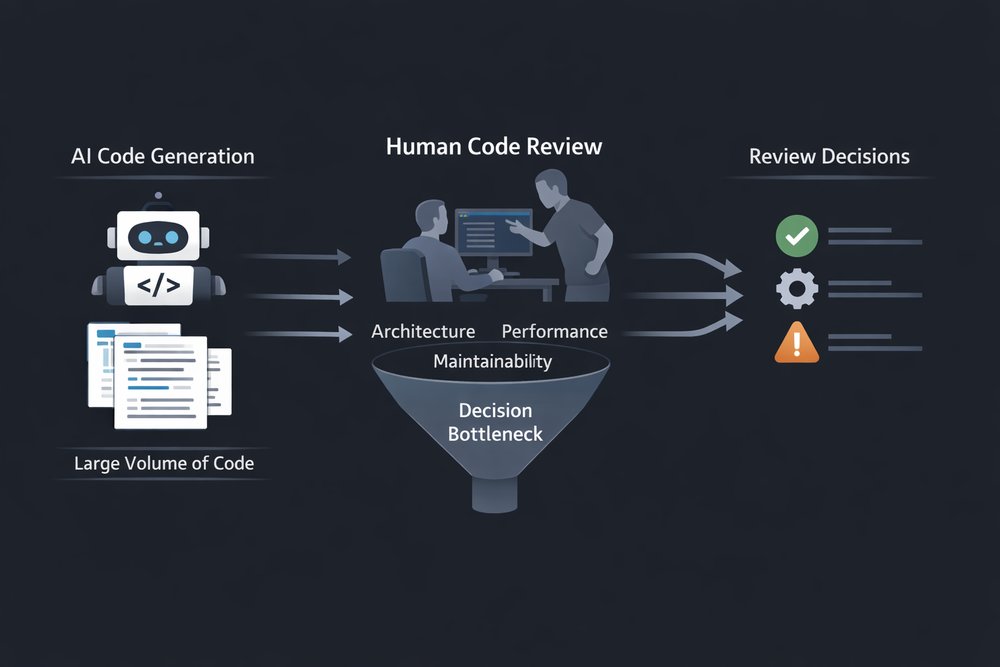
The Scarce Resource: Not Code, but Judgment
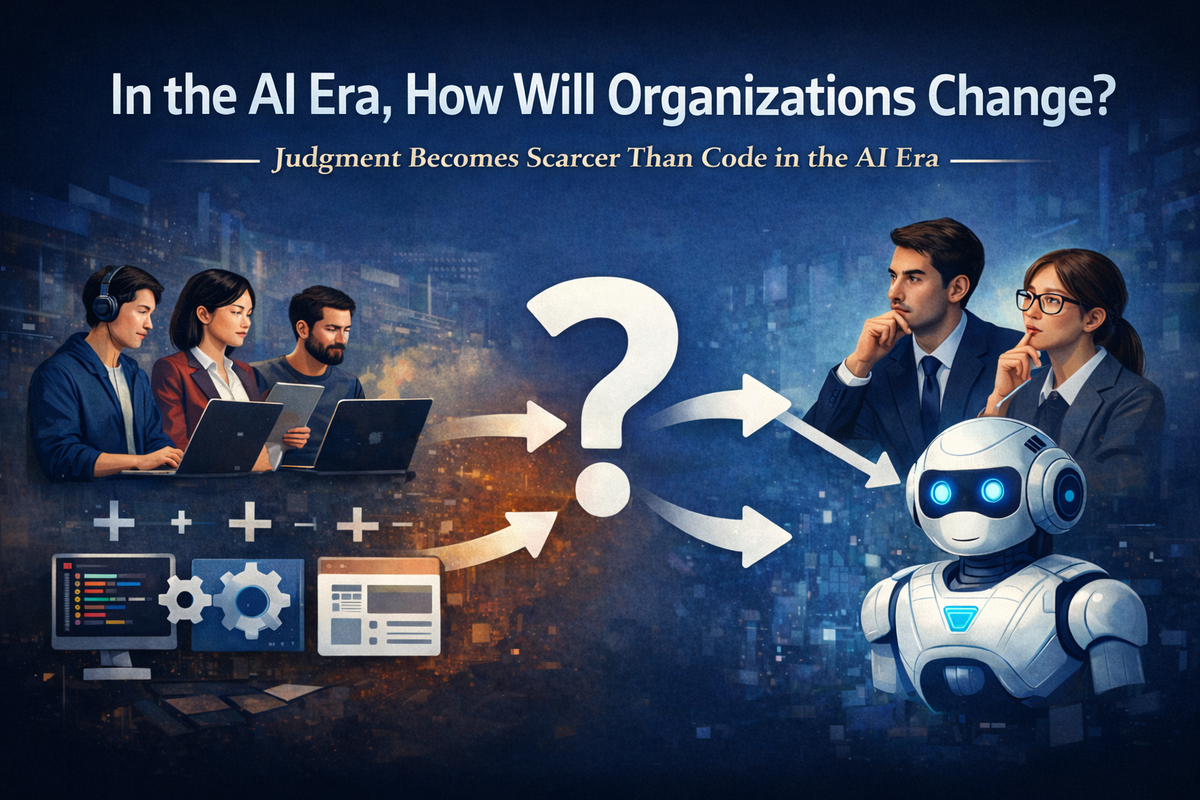
As code generation becomes easier, an interesting phenomenon begins to emerge. The value of code itself decreases relatively, while the value of judgment above the code starts to rise. This is a natural outcome even from an economic perspective. When a resource begins to be produced in large quantities, its scarcity diminishes, and other factors take on greater importance. A similar shift is happening in software development in the age of AI. The ability to write code is becoming increasingly common, but the ability to decide what should be built remains scarce.
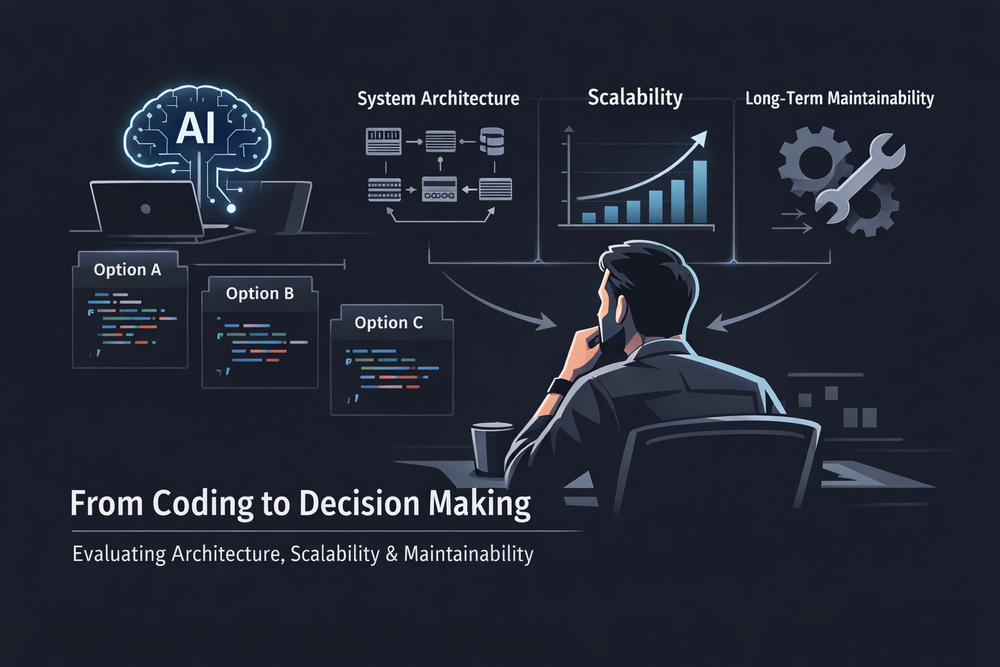
Consider implementing a single feature. AI can propose multiple ways to implement it, even generating code with different architectural approaches for the same problem. Some implementations may be quick to build but lack scalability, while others may be structurally robust but more complex to implement. Determining which option is most appropriate is not something AI can fully decide—it requires human judgment. This decision is not just a technical choice; it is closely tied to the overall direction of the system.
This importance becomes even more pronounced in large-scale systems. In smaller projects, a slightly inefficient code structure may not cause significant issues. However, in systems where dozens of developers collaborate, even a single design decision can have a substantial impact on long-term maintenance costs. Choices such as which technologies to adopt, what architecture to use, and which conventions to establish become critical factors that can determine the success or failure of a project.
At this point, we are compelled to reconsider what constitutes a key resource in a development organization. In the past, the ability to write code quickly was highly valued. Now, the situation is shifting. Code itself can be generated at any time. But the ability to decide which code to choose and how the system should evolve remains concentrated among a limited group of people. As a result, in the age of AI, the most important resource in a development organization is no longer code—it is judgment and design capability.
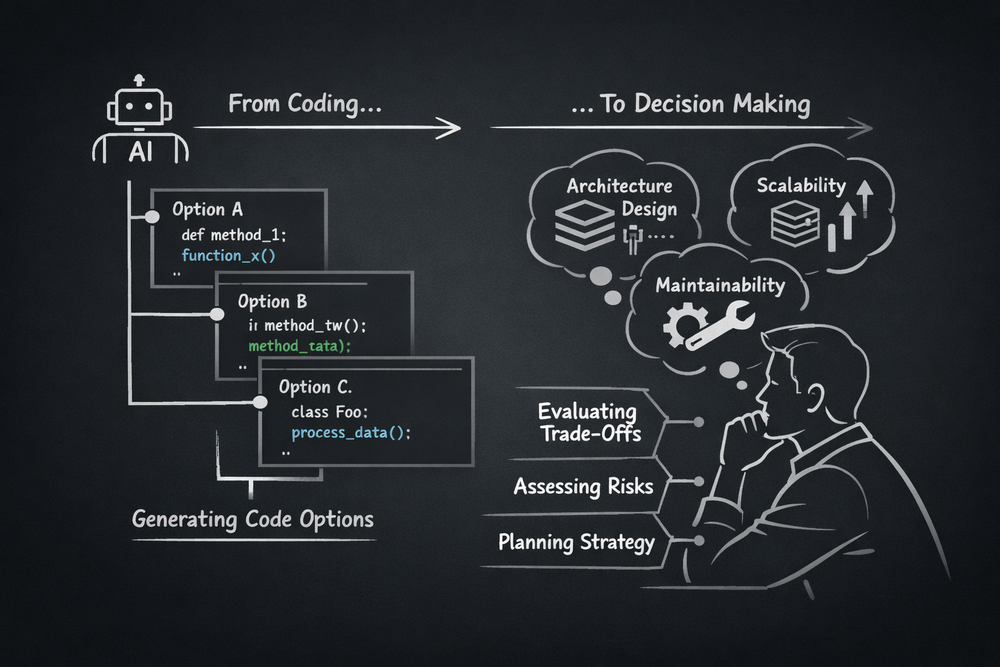
The Changing Role of Developers: From Code Writers to System Designers
These changes are naturally influencing the role of developers as well. In the past, developers were primarily seen as people who write code. When a new feature was needed, developers would implement it by writing code themselves. While areas such as design and architecture were certainly important, in many cases, the ability to write code efficiently was considered the key factor determining a developer’s productivity. Especially in large organizations, developers who could produce a high volume of code were often evaluated as highly productive contributors.
However, with the emergence of AI coding tools, this structure is gradually beginning to shift. Code writing itself is becoming increasingly automated. AI can generate code quickly based on repetitive patterns and can even analyze existing project structures to produce similar implementations. As a result, developers are now more likely to review and refine code generated by AI rather than writing everything from scratch. In this process, the role of the developer naturally evolves.
The developer’s primary responsibility is becoming less about writing code and more about understanding systems and making decisions about direction. Choices such as how to structure a feature, which data model to use, and which technology stack best fits the project still firmly belong to human developers. These decisions often have a far greater impact than the act of coding itself. A single architectural choice can determine the complexity of an entire system.
This shift is also affecting the skill model expected of developers. In the future, the ability to write code quickly alone is unlikely to be sufficient. Instead, greater importance will be placed on the ability to understand systems holistically, compare multiple technical options, and make design decisions from a long-term perspective. While AI can generate code, the ability to understand the broader context of a project and align with organizational goals remains largely within the human domain.
As a result, developers in the age of AI are gradually moving from the role of code writers toward that of system designers. Of course, not every developer will become an architect. However, it is clear that the center of a developer’s work is shifting—from writing code to making design and judgment decisions. And this transformation is becoming a key driver in rethinking not only individual roles but also the structure of entire development organizations.
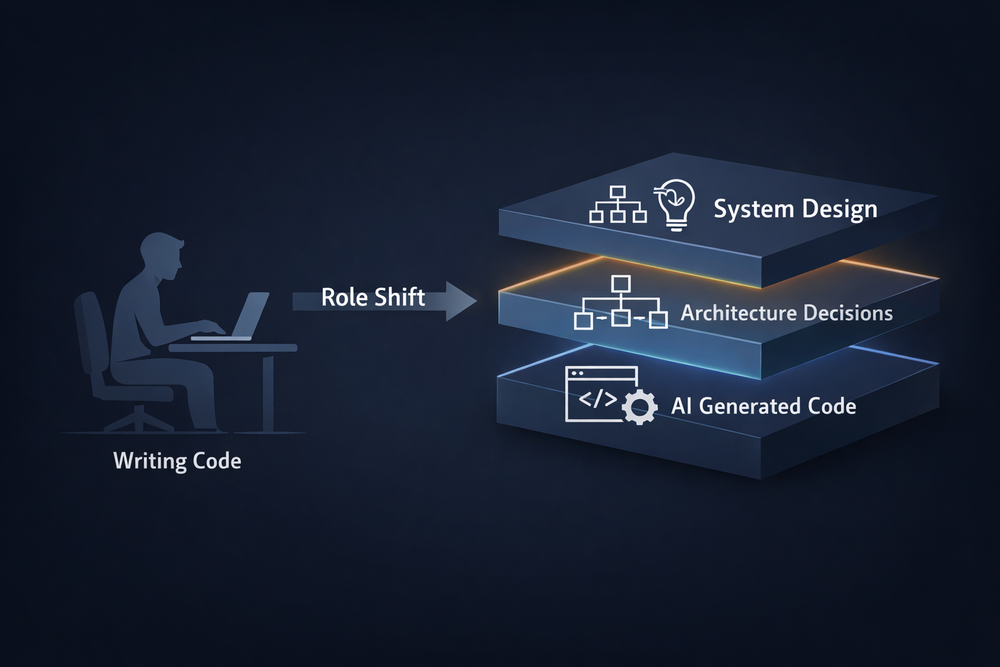
Changes in Development Organization Structure
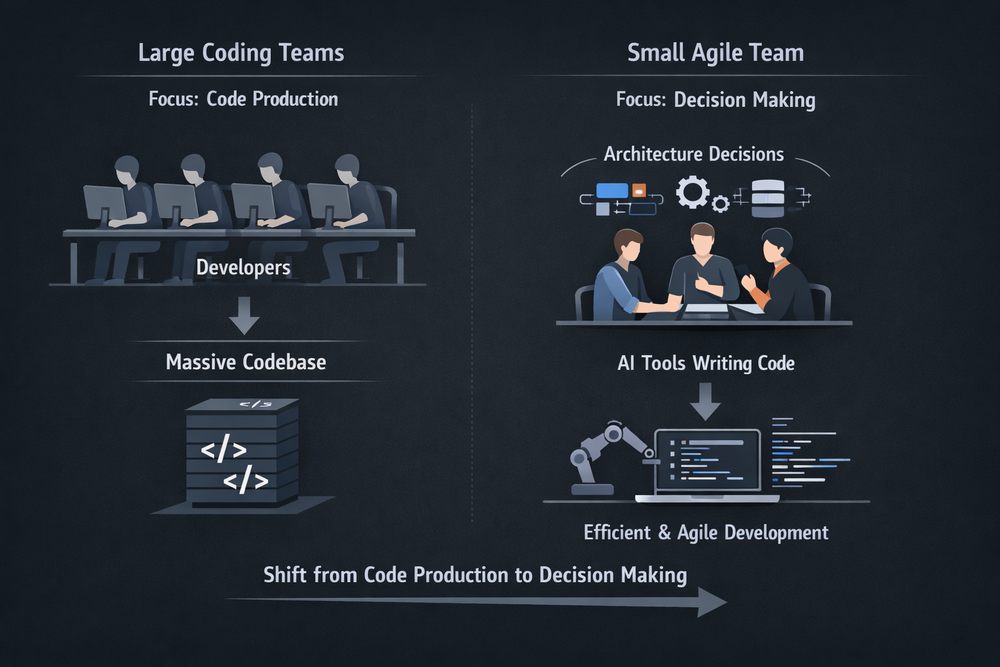
As the role of developers shifts from code writing toward design and judgment, the structure of development organizations naturally begins to change as well. In the past, development organizations had relatively clear structures. Teams were divided by functional areas, and each team focused on writing code and implementing features with a set number of developers. Organizational productivity was closely tied to how many developers were involved and how much code they could produce. As a result, as projects grew in scale, adding more developers was often seen as the natural solution.
However, as AI coding tools significantly reduce the cost of code production, this structure begins to shift. Adding more developers no longer necessarily leads to producing more results. AI can already generate large amounts of code quickly, and developers increasingly focus on reviewing and refining that code. In such an environment, organizational productivity is often determined less by the number of people and more by the quality and speed of decision-making.
This shift leads organizations to rethink their size and structure. In the past, it was commonly assumed that large projects required large teams. But as code production becomes automated, the situation may change. Smaller teams with clear direction and the ability to make rapid decisions can become more efficient. In fact, some technology organizations are already seeing cases where small teams, actively leveraging AI tools, are delivering features much faster than before.
At the same time, the distribution of roles within organizations is also evolving. While code writing becomes increasingly automated, responsibilities such as designing system architecture and determining technical direction remain in the human domain. As a result, roles such as architects, technical leads, and platform engineers are likely to become more important. These roles go beyond writing code—they involve setting the overall direction of the system and aligning technical decisions across teams.
In this process, the factors that determine organizational productivity are also shifting. In the past, the speed of code production was a key metric. Now, what matters more is how quickly the right decisions can be made. This change is not merely about new development tools—it represents a structural transformation that compels organizations to rethink how they operate.
New Capabilities Required in AI-Era Development Organizations
As the structure of development organizations begins to change, the capabilities those organizations require naturally evolve as well. In the past, the core competency in development organizations was the ability to write code quickly and solve problems. While design skills and system understanding were certainly important, actual productivity was often strongly tied to coding ability. Especially in the early stages of a project, rapidly producing large amounts of code was often a primary goal.
However, as AI begins to automate a significant portion of code production, the situation is changing. Code itself can now be generated at any time. AI can create new code based on repetitive patterns and even propose similar implementations by analyzing existing code structures. In this environment, the ability to decide how to use code becomes more important than simply writing a large amount of it.
Consider implementing a feature. AI can propose multiple code structures for the same functionality at once. Some approaches may be simple to implement but lack scalability, while others may be more structurally robust but more complex. Determining which option is best suited for the project ultimately depends on human judgment. And this decision is often not just a technical choice—it is closely tied to the overall direction of the system.
In addition, in AI-driven development environments, the ability to define problems clearly becomes increasingly important. AI produces better results when it understands the question well. Therefore, developers must go beyond writing code and be able to clearly define problems and articulate solution directions. This capability cannot be achieved through programming skills alone. It requires a combination of systems thinking, domain understanding, and collaboration skills.
These changes are also likely to influence how developers learn. In the past, mastering the syntax of a specific language or framework was a key learning objective. Going forward, areas such as system design, architectural patterns, and criteria for technology selection are likely to become more important. In other words, a developer’s expertise is gradually shifting from coding skills to the ability to understand systems and design their direction.
Series Conclusion: What Mattered More Than Code Was Ultimately Structure and Judgment
This series began with a single question: how will the profession of software development change with the emergence of AI? Many discussions focus on whether AI will replace developers or eliminate certain roles. However, when we look more closely, the core of this transformation is not about the existence of specific roles, but rather a shift in the structure of software production itself.
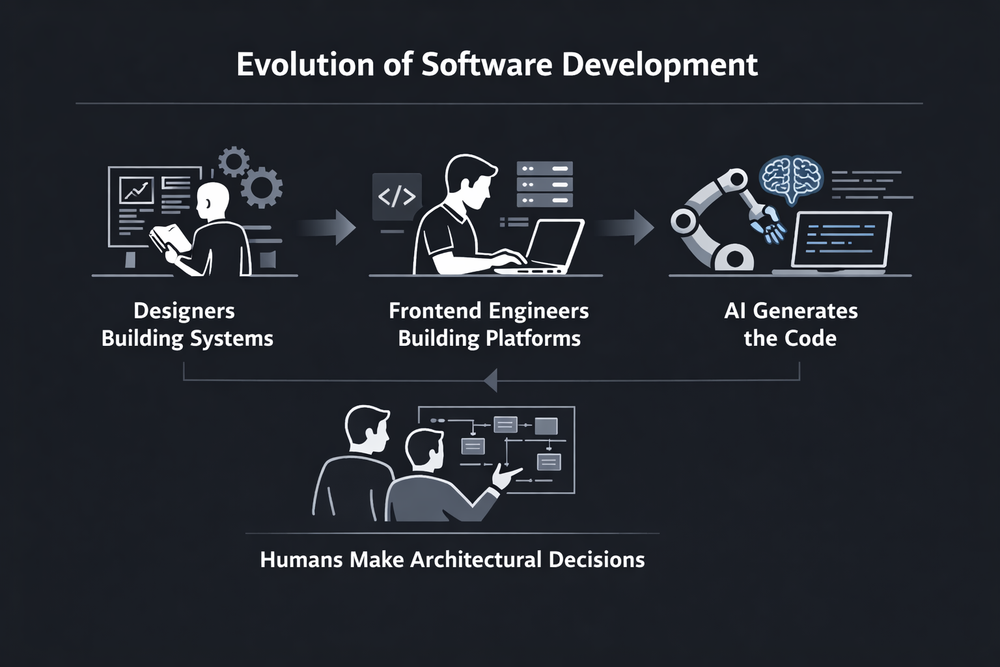
In the first article, we explored changes in the role of designers. Many people ask whether AI can replace design, but the real transformation was not about design tools—it was about design systems as a structure. As a result, the role of designing the rules and systems that generate UI is becoming more important than directly creating UI elements.
In the second article, we examined the changing role of frontend developers. Frontend development is also moving beyond simply implementing interfaces toward designing platforms and systems. As elements such as state management, data flow, and design systems become core structures, the role now demands more than just building UI.
In the third article, we looked at why development speed does not increase as much as expected, even though AI has significantly accelerated code generation. As coding becomes faster, other stages begin to emerge as bottlenecks. In particular, human-centered tasks such as code understanding, review, and design are becoming key factors that determine development speed.
In this article, we examined how these changes are ultimately influencing the structure of development organizations. As code production becomes automated, organizational productivity is no longer determined by the amount of code, but by the quality of decisions. Questions such as what problems to solve, which structures to choose, and how systems should evolve are becoming increasingly important.
AI is clearly transforming the way software is developed. However, the core of this transformation is not code writing itself. Rather, as code becomes easier to produce, more fundamental questions begin to emerge: what should be built, how it should be structured, and what long-term impact those decisions will have.
From this series, one consistent conclusion becomes clear. In the age of AI, the most important capability in software development is not the ability to produce more code. What matters far more is the ability to understand systems and make the right decisions. And perhaps this will become the most scarce resource in future development organizations.