

The Era Where AI Begins to Write Code
Over the past few years, the software development environment has changed quite rapidly. In particular, since the emergence of AI coding tools, the way developers work has shifted in ways that are hard to compare with the past. Previously, implementing a new feature required searching through documentation, learning how to use libraries step by step, and looking up similar problems to manually assemble the necessary code. This process took more time than expected, and especially in unfamiliar technologies or domains, writing code itself often became the biggest barrier. Many developers spent a significant portion of their day simply writing code, and most efforts to improve productivity focused on how quickly and accurately this task could be performed.
However, with the arrival of AI coding tools, the situation has changed significantly. Anyone who has used tools like Copilot or Cursor has likely had a similar experience. By entering just a few lines of description, AI generates a draft of the code—and in some cases, even includes test cases and exception handling. Code that once required hours of effort can now appear on the screen in seconds. This experience is quite striking when encountered for the first time. Many developers arrive at the same realization: writing code itself may no longer be the primary challenge. Naturally, this leads to a new expectation—if AI can generate code this quickly, shouldn’t overall development speed also increase dramatically?
In fact, this expectation has a reasonable basis. AI is highly effective at generating code based on repetitive patterns. Tasks such as basic CRUD logic in web applications, API calls, and data model definitions can be generated with relatively high accuracy. Developers now often begin their work not by writing code from scratch, but by reviewing and modifying code generated by AI. On the surface, this makes it seem as though developer productivity has increased significantly. However, as more time passes and real project experience accumulates, an interesting question begins to emerge. Even though the speed of writing code has clearly increased, why does the overall pace of development not feel as fast as expected? This question is not just a matter of perception—it is deeply connected to the structure of the development process itself.
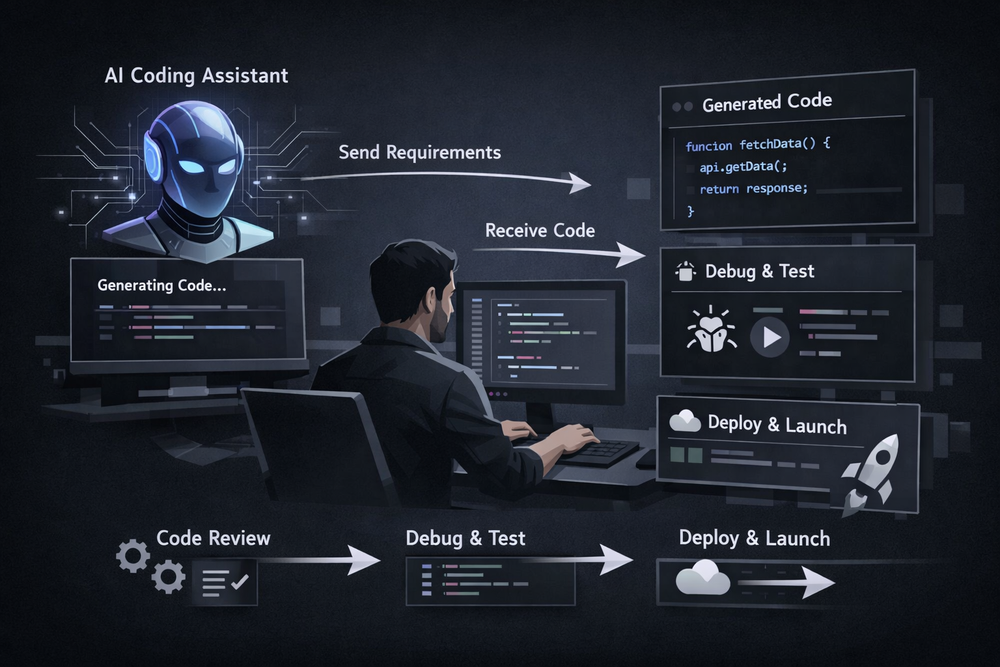
Where Was the “Bottleneck” in Software Development?
To understand this question, we need to view software development as a production system. Every system has a point that determines its overall speed—commonly referred to as a bottleneck. This is true in manufacturing, and it is equally true in logistics. Even if some parts of a process operate very quickly, the overall throughput is ultimately constrained by the slowest stage. Software development is no different. The development process consists of multiple stages—design, implementation, testing, review, and deployment—and if any one of these slows down, the entire project naturally slows as well.
Before the emergence of AI coding tools, the bottleneck in most development organizations was relatively clear: writing code. To implement a new feature, developers had to design the logic themselves and write the code manually, and this process often required significant time. In cases involving complex business logic or the adoption of new technology stacks, coding itself frequently became the most costly part of the process. As a result, a developer’s level of expertise was closely tied to their ability to write code. Experienced developers could understand problems more quickly and produce more stable code, and this difference directly impacted project productivity.
Within this structure, most efforts to improve development productivity were focused on the coding phase. The creation of better programming languages, the adoption of more efficient frameworks, and the development of advanced code autocomplete tools all followed this same direction. The goal of these improvements was ultimately one thing: to help developers write code faster and more accurately. For a long time, the most important skill in software development was considered to be how much code one could write, and how quickly. However, with the emergence of AI coding tools, this assumption is beginning to shift.
The Productivity Illusion Created by AI Coding Tools
Developers who use AI coding tools for the first time often describe a similar experience: writing code feels significantly lighter. In the past, implementing a single feature required writing dozens of lines of code manually. Now, AI generates an initial version, and developers begin by modifying it. Seeing code appear instantly on the screen, along with automatically generated function structures, naturally creates the impression that productivity has increased dramatically. Many developers feel a strong sense of speed when first using these tools, as if development itself is moving much faster.
However, this experience involves a kind of productivity illusion. While the speed of writing code has clearly increased, it does not raise the speed of the entire development process in the same way. Most AI-generated code is closer to a draft. Even if it is syntactically correct, it often does not fully align with the actual structure of the project or the existing system. As a result, developers still need to read, understand, and modify the code. In some cases, understanding the intent behind AI-generated code can take more time than expected. As project complexity increases, this process becomes even more involved.
In addition, while AI is excellent at generating individual code fragments, it does not fully understand the broader system context. It can generate code for a specific feature, but it cannot reliably determine how that code integrates with the existing architecture or how it will affect long-term maintainability. Therefore, developers cannot simply use AI-generated code as is—they must verify whether it fits the system. In this process, time saved during code generation shifts into validation and revision. In the end, developers still spend a significant amount of time working with code, but the nature of that work has changed.
At this point, an important question reappears. If AI has significantly increased the speed of writing code, why does the overall development process not feel proportionally faster? To answer this, we need to take a closer look at what is actually changing within the development process. In the next section, we will examine real research cases to understand how AI coding tools have impacted development speed, and analyze the unexpected outcomes that have emerged.
Real-World Evidence: Development Didn’t Get Faster with AI
The expectation that AI coding tools would significantly improve developer productivity was strong. Many tech companies and research institutions conducted experiments to measure how much AI could accelerate development. However, an interesting pattern emerged: some results did not align with developers’ intuitive expectations. In several studies published in recent years, the use of AI tools did not significantly reduce task completion time—and in some cases, certain tasks even took longer.
One frequently cited example is the METR (Model Evaluation & Threat Research) study. In this research, developers were asked to complete real software development tasks, with one group given access to AI coding tools and another group not. The results were quite revealing. Developers using AI were indeed faster at generating code, but the total time required to complete the task did not decrease as much as expected. In some cases, it actually increased. This was because AI-generated code was not perfect, requiring additional time for developers to review, verify, and modify it.
These findings point to something deeper than just the performance of AI tools—they reflect the structure of the development process itself. AI can generate code quickly, but ensuring that the code works correctly within a real system remains a human responsibility. And this validation process takes more time than expected. Developers must read the generated code, check that it integrates correctly with existing systems, and account for potential edge cases and unexpected failures. As a result, time saved during code generation often reappears as additional cost in the review and validation stages. This effect becomes even more pronounced in large-scale codebases.
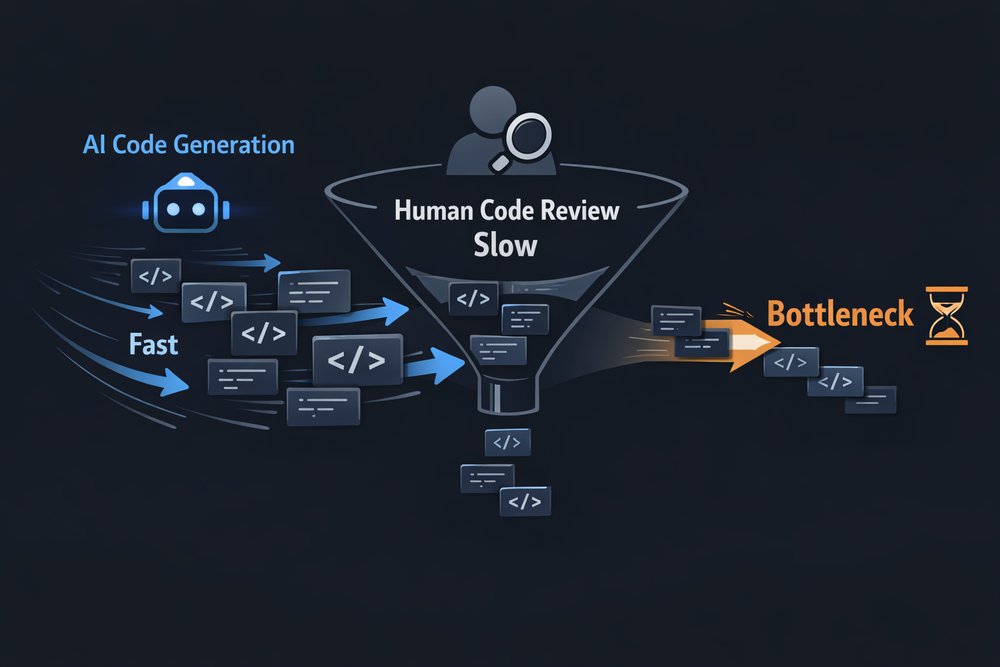
The importance of this research is not that it reveals the limitations of AI coding tools. Rather, the more significant message is that the speed of development is not determined simply by how fast code is written. Even if code generation becomes faster, it does not mean that the entire development process accelerates at the same rate. Development involves many stages beyond coding, and some of these are not easily automated by AI. As a result, after the emergence of AI, the bottlenecks in the development process have begun to shift in unexpected ways.
A New Bottleneck: Code Review and Code Comprehension
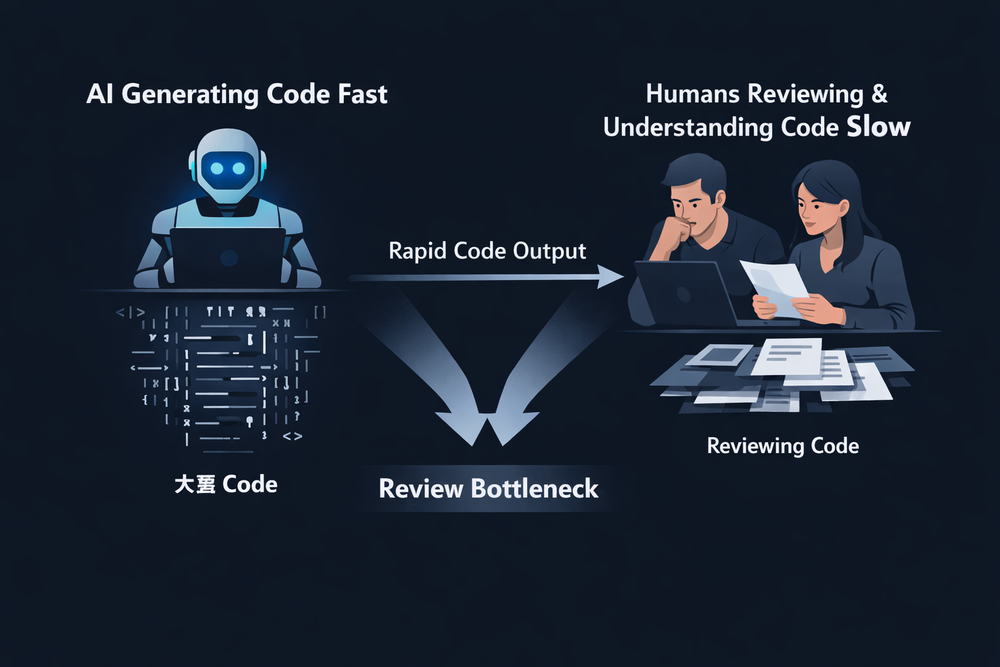
One of the most significant changes brought by AI coding tools is the speed of code generation. AI can produce dozens or even hundreds of lines of code in seconds, including structures, function definitions, and exception handling that developers previously had to write manually. This speed far exceeds that of human developers. However, this introduces a critical issue: the speed of generating code and the speed of understanding code are fundamentally different problems.
While AI can generate code extremely quickly, the speed at which humans understand that code has not changed much. Developers still need to read code line by line and determine what it does. In particular, understanding how AI-generated code fits into the existing structure of a project requires significant focus. As code length increases, this task becomes even more difficult. AI can improve code generation speed by orders of magnitude, but human comprehension does not scale in the same way.
As a result, a new bottleneck emerges in the development process: code review and code comprehension. In the past, developers reviewed code they or their teammates had written, making it relatively easier to understand the intent behind it. However, AI-generated code is not transparent in the same way. Developers must first analyze what the code does, often without clear insight into how it was produced. This leads to a process where developers effectively reverse-engineer the intent of the generated code, which can impose a greater cognitive load than traditional code review.
Additionally, new challenges arise in the review process itself. Because AI can generate large amounts of code quickly, the total volume of code requiring review increases. Developers are now placed in a situation where they must review more code in less time. As a result, time saved during code generation may be offset—or even exceeded—by time spent in later stages. This shift forces us to reconsider where the true drivers of development productivity lie. In the age of AI, development speed is no longer determined solely by the ability to write code.
Another Problem with AI-Generated Code: Lack of Context
AI-generated code has another important characteristic. While AI is highly effective at learning code patterns, it does not fully understand the broader context of a project. This is tied to the structural limitations of AI models. AI learns from vast amounts of code data and generates outputs based on patterns that match a given prompt. This approach is very effective for implementing specific features. However, real software systems are not just collections of code snippets—they are complex systems shaped by many intertwined structures and rules.
Consider, for example, implementing a simple API. AI can generate an HTTP handler, write database queries, and return responses. But whether that code aligns with the architectural rules of a given project is a different matter. One project may follow a strict layered architecture, while another may require specific error-handling patterns or logging conventions. AI can learn some of these patterns, but it struggles to fully capture the many implicit design principles that vary from project to project.
As a result, AI-generated code may appear correct at first glance but can subtly misalign with the actual system. The code style may not match, the data flow may diverge from the existing structure, or certain performance considerations may be missing. These issues are not necessarily errors in the code itself—they arise from a mismatch with system context. Ultimately, developers must go beyond simply reviewing AI-generated code and determine how well it fits within the system as a whole.
In this process, the role of the developer shifts from being a code writer to something closer to a system editor. Developers must adapt and restructure AI-generated code so that it aligns with the architecture of the project. This task requires more time and focus than it might initially appear. While AI has clearly accelerated code generation, it has also increased the amount of judgment developers must apply. For this reason, the question of productivity in the age of AI is not just about technology—it is about how the structure of the development process itself is changing.
At this point, another important question emerges. As AI reduces the burden of writing code, in what direction is the role of the developer shifting? And how will this transformation affect developer skill sets and the structure of development organizations? In the next section, we will explore how these changes are redefining the role of developers in practice.
The Developer’s Role Is Shifting from Coding to Judgment
Bringing together the changes we have explored so far, a clear pattern begins to emerge. AI has significantly expanded the ability to generate code, but at the same time, it is changing the nature of the work that humans perform in the development process. In the past, developers primarily wrote code themselves. They designed the logic needed to implement features, selected algorithms, and translated those decisions into actual code. As a result, a developer’s capability was closely tied to how accurately and efficiently they could write code.
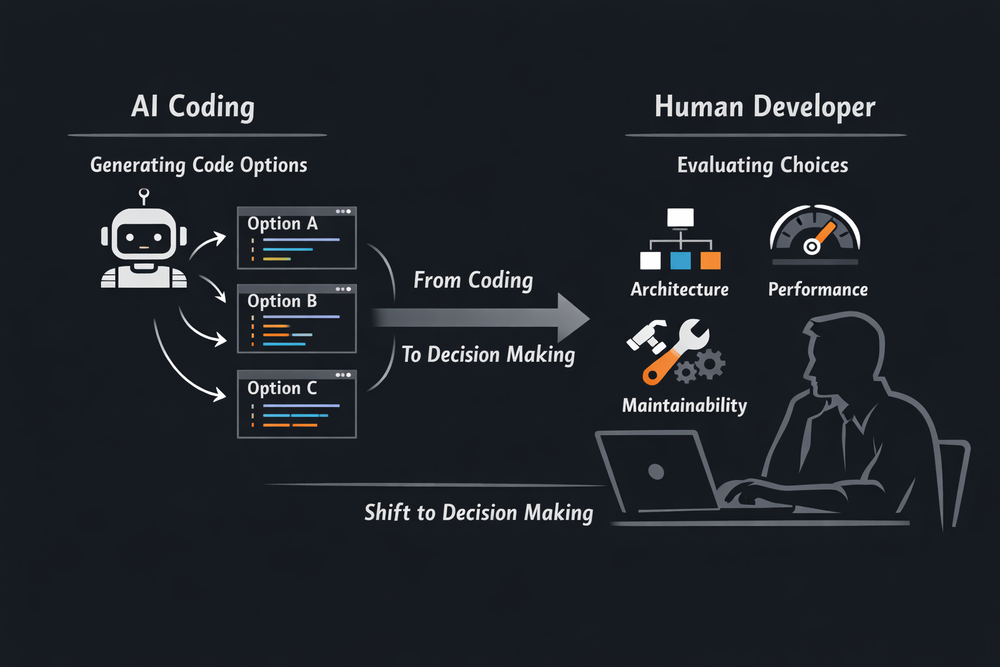
However, with the rise of AI coding tools, this structure is gradually changing. AI can quickly generate basic code structures, and in many cases, the quality of that code is quite high. As a result, developers are becoming less like people who write code from scratch, and more like people who select, evaluate, and modify code. This shift is not just a change in workflow—it signals a deeper transformation in the role of the developer. Developers must now judge which of the AI-generated options best fits the system, and redesign the structure when necessary.
In this process, the most important skill becomes not code writing, but the ability to understand systems and make informed judgments. Even when implementing the same functionality, different approaches may be more suitable depending on the system’s architecture. Some solutions may be better for performance, while others may be more maintainable. AI cannot fully make these decisions. Ultimately, developers must choose the best option among the possibilities generated by AI. This is why developers in the AI era are becoming less like code producers and more like code curators.
This transformation also affects the structure of developer skills. In the past, knowing the syntax of a specific language or how to use a framework was a key competitive advantage. Going forward, however, the ability to design systems, structure problems, select technologies, and plan for long-term maintainability will likely become more important. AI can generate code, but judging which system has the better structure remains a human responsibility. As AI accelerates code production, the role of developers shifts toward higher-level judgment.
How Will Development Organizations Change in the Age of AI?
The shift in the developer’s role does not only affect individual workflows—it ultimately reshapes the structure of development organizations as well. In traditional software organizations, the core production activity was writing code and implementing features through a certain number of developers. As projects grew, more developers were needed, and productivity was often measured by how much code could be written, and how quickly. As a result, many teams were built around developers with strong coding skills.
However, as AI coding tools significantly expand code generation capabilities, the balance of required skills within organizations is beginning to change. While code creation itself can increasingly be automated, deciding system direction and making technical choices still remain human responsibilities. This may shift organizational priorities—from simply increasing coding capacity to emphasizing roles focused on system design and technical judgment. Such changes are likely to be reflected in organizational structures.
For example, some organizations are already strengthening architecture-driven development practices. Instead of focusing on writing code first, they define system structures upfront and allow code to be generated on top of that foundation. This approach aligns well with AI tools, since AI produces more reliable results when clear structures and rules are in place. Conversely, in environments where system structure is unclear, AI-generated code is more likely to conflict with the overall direction of the project.
Code review culture may also evolve. In the past, reviews often focused on code quality and style. Going forward, questions at the design level—such as how well code aligns with system architecture and what impact it has on long-term maintainability—are likely to become more important. This signals a broader transition: development organizations are moving from being primarily code-producing entities to becoming organizations centered on system design and judgment. And this shift has the potential to reshape not only developer roles, but the structure of the software industry as a whole.
The Era of Building Systems, Not Just Code
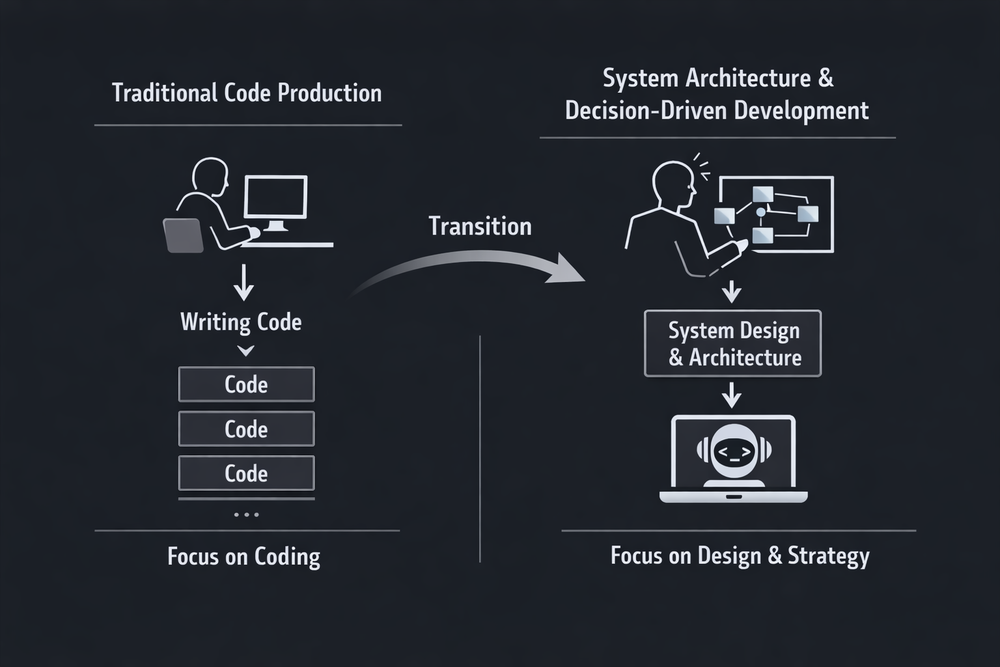
We can now return to the original question. AI coding tools have clearly accelerated the speed of writing code. However, the overall pace of development has not increased at the same rate. The reason is that development is not simply the act of writing code—it is a far more complex process of decision-making and design. AI has greatly improved the speed of code generation, but stages such as system design and technical judgment still remain the responsibility of humans. As a result, the bottleneck in development is shifting from writing code to areas of judgment and design.
This shift forces us to rethink the nature of software development itself. For a long time, we have understood developers as people who write code. But in reality, the most important work in software development may not be the code itself, but the process of designing systems and structuring problems. Code is merely a means of implementing that structure, while the direction of the system is ultimately determined by human judgment. As AI expands the ability to produce code, this reality becomes even more apparent.
In the age of AI, developers are likely to be defined not by how quickly they can produce large amounts of code, but by how well they can design better systems and make stronger technical decisions. As code generation capabilities expand, the importance of these judgment skills will only increase. This transformation will affect not only individual developers but also the structure of software organizations as a whole. In future development environments, the quality of decisions may become a more important competitive advantage than the quantity of code.
At this point, a natural next question follows. If the core role of developers is shifting from writing code to making decisions, what kind of structure will development organizations take in the age of AI? And in an environment where code production is greatly expanded, how will responsibilities within development teams be redefined? In the next article, we will explore how these changes are reshaping development organizations and what new forms of team structure may emerge.