“Notepad++ Was Hacked” — A Headline That Shook the Developer Community
In early 2026, a piece of news began to spread rapidly across both the security and developer communities. The headline was simple: “Notepad++ was hacked.” This single sentence was more shocking than it might seem at first glance. Notepad++ is more than just a text editor. For decades, it has been one of the most widely used developer tools in the Windows environment—a lightweight, fast editor supporting multiple languages, effectively serving as a default tool for many developers. Even in situations where an IDE is not used, Notepad++ is often the program that naturally opens to check log files or edit configuration files. That is why this news felt less like a single software incident and more like something that could affect the entire developer ecosystem.
When many people first heard the news, a few assumptions immediately came to mind. Had the GitHub repository been compromised? Had a developer’s account been hijacked, allowing malicious code to be inserted into the source? Or had the build process itself been attacked, resulting in a backdoored release? These were all realistic possibilities, especially given how similar incidents have repeatedly occurred in recent years. After the SolarWinds incident in particular, software supply chain attacks were no longer seen as theoretical risks but as real threats capable of shaking entire industries. As a result, many developers initially assumed this incident would be another large-scale supply chain compromise of a similar nature.
However, a closer look at the incident reveals something far more interesting. The actual point of attack was completely different from what people first expected. The source code was not compromised. Developer accounts were not breached. The build system was not attacked. And yet, the attacker still managed to deliver malicious code into real user environments. In other words, the attack was very real, but its entry point lay outside the conventional boundaries of software security as we usually understand them. That is precisely what makes this case so compelling.
At the core of this incident was not the program itself, but the distribution process—more specifically, the update system. The automatic update feature that users rely on every day without much thought became the very channel of attack. Once this is understood, a natural question emerges: if the software itself was not compromised, how was the attacker able to deliver malicious code to users’ machines? To answer that, we first need to correct the biggest misunderstanding people had about this incident.
The Core of the Incident — Notepad++ Was Not Hacked
To understand this incident, there is one crucial point that must be clarified first. Contrary to what many initially assumed, the Notepad++ program itself was not hacked. This is not just a matter of wording—it is a key distinction for understanding the true nature of the event. When we typically say that a program has been “hacked,” we imagine specific scenarios: the source code being compromised, a developer’s account being hijacked and used to inject malicious code into the repository, or the build system being manipulated so that the distributed program itself is altered. In fact, many past supply chain attacks have followed exactly these patterns.
But none of those things happened in the Notepad++ case. The project’s source code was not compromised, and the GitHub repository was not breached. No developer accounts were taken over, and the official build process was not manipulated. In other words, there was no issue in the development process of the program itself. And yet, some users ended up downloading a version of the program that contained malicious code, and the attack was successfully carried out. This clearly indicates that the core of the incident was not the program itself, but the process through which the software was delivered to users.
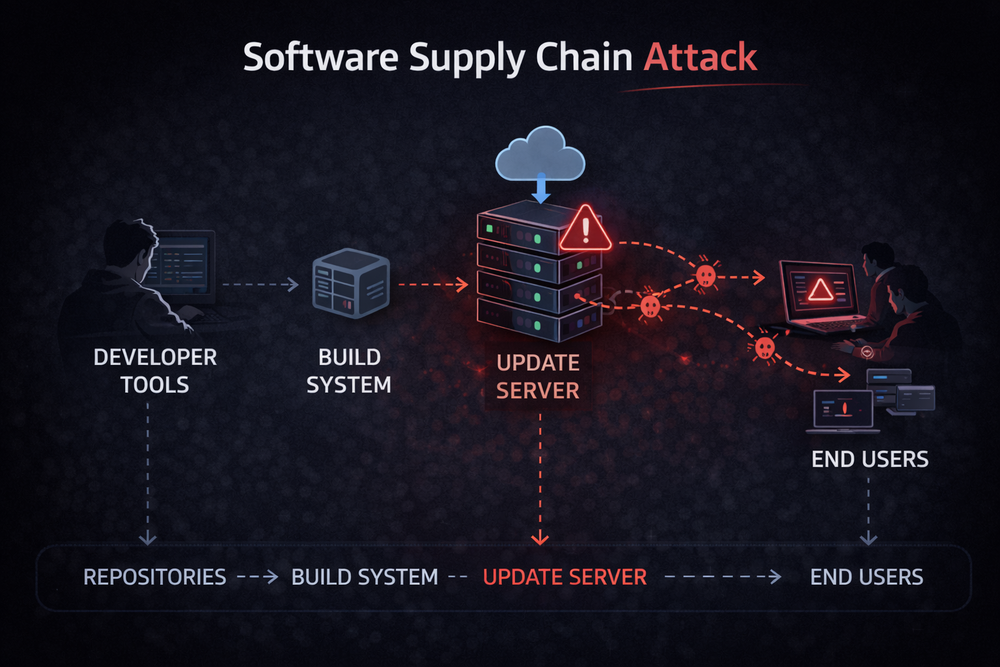
In modern software security, this type of attack is known as a Supply Chain Attack. The essence of this approach is not to attack the program directly, but to target the path through which the program reaches users. Attackers do not interfere with the development process; instead, they intervene in the distribution process to deliver malicious code. The danger of this method lies in the fact that it exploits trusted channels. Users trust the software vendor and routinely install updates or downloads provided by them without suspicion. Attackers take advantage of precisely this trust model.
The same pattern unfolded in this incident. The attacker did not need to create or modify the Notepad++ program itself. Instead, by taking control of one point in the distribution process, they were able to deliver malicious code to users. Once this is understood, the structure of the incident begins to become clearer. At the same time, another question naturally arises: if it was not the program itself but the distribution process that was attacked, then where exactly in that process did the attack occur?
The answer lies in one of the features we use every day without much thought: software updates.
A Feature We Trust Too Easily — Software Updates
In modern software environments, automatic updates have become a given. When a program runs, it checks for new versions, and if an update is available, it asks the user whether to install it. Most users do not think much about this process. In fact, many consider not updating to be more dangerous. Because security advisories repeatedly emphasize “update to the latest version,” updates have come to be seen as part of security itself. As a result, clicking the update button has become almost an automatic habit.
However, with a slight shift in perspective, it becomes clear how powerful the update system really is. Software updates are the official channel through which a software vendor can deliver new code to a user’s computer. In other words, the update system grants the vendor the ability to send code that will be executed on the user’s machine. If this channel is taken over by an attacker, the situation changes completely. The attacker can deliver malicious code while making it appear as a legitimate update. The user, unaware of being attacked, ends up executing code created by the attacker.
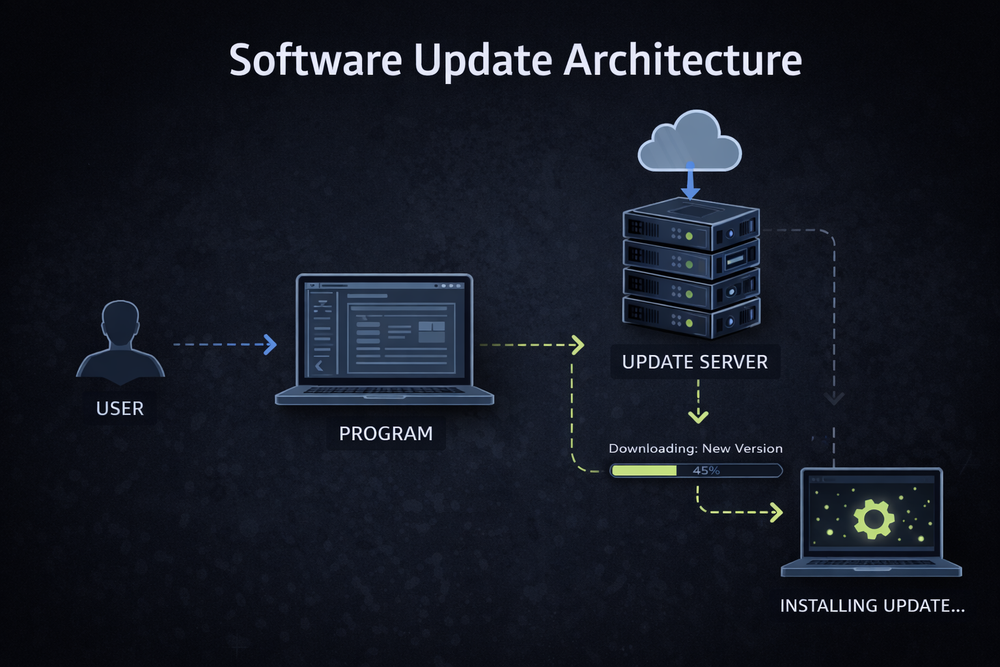
The basic structure of an update system is simpler than it might seem. Most programs include a small updater module that periodically connects to an update server to check for new versions. When a new version is found, the program downloads the update file and proceeds with installation. To the user, this appears as a simple notification window, but behind the scenes, a sequence of steps unfolds: server communication, file download, verification, and installation. Because this process is largely invisible, most users never even consider how it works internally.
And this is precisely where the problem lies. Since the update system is a normal part of the program, users do not question it. If an attacker distributes malicious files through email or websites, users tend to be cautious. But files delivered through a program’s official update mechanism are almost always trusted. This trust model is essential for maintaining the software ecosystem, yet it also becomes a highly powerful attack surface. That is why, in recent years, many attackers have shifted their focus from the program itself to the update infrastructure.
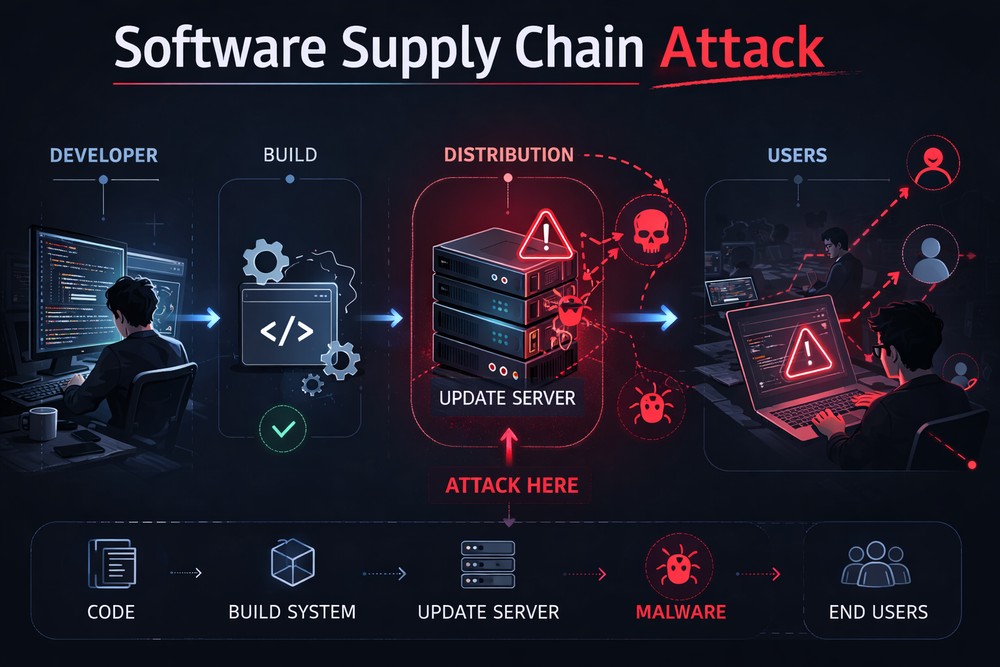
The Notepad++ incident targeted exactly this point. The attacker did not need to modify the program or compromise the developers. Instead, by taking control of the system that delivers updates to users, they achieved the same result. Once this is understood, the structure of the incident becomes much clearer. One question remains: what exactly was the structure of Notepad++’s update system, and which part of that structure did the attacker exploit? To answer this, we need to take a closer look at the update mechanism itself.
The Structure of the Notepad++ Update System
As discussed earlier, to understand this incident, we need to focus not on the Notepad++ program itself, but on its update mechanism. Like many modern applications, Notepad++ includes an automatic update feature that checks for new versions when the program is launched. From the user’s perspective, the process is simple: the program checks whether it is up to date, and if a new version exists, it displays an update notification. However, behind this seemingly simple behavior lies a more complex structure—a sequence of steps: update check → version information retrieval → download → verification → installation.
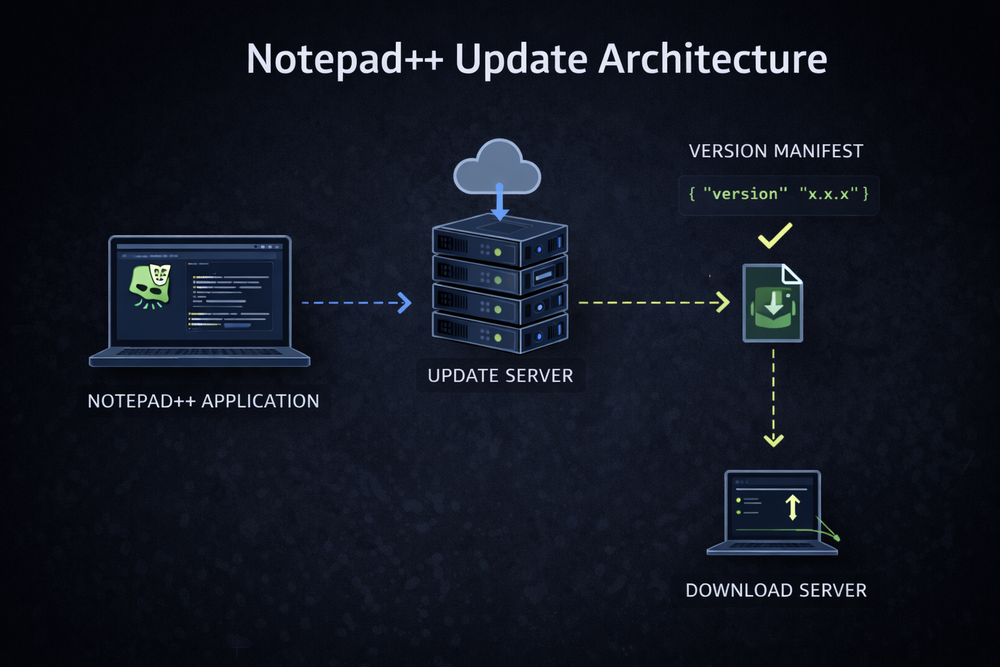
Notepad++ uses an updater module called WinGup (Windows GUP) for this process. WinGup operates within the program and communicates with the update server to check for the latest version. Looking at the general flow in more detail, when the program starts, it first connects to the update server and downloads an XML or manifest file containing version information. This file includes details such as the current release version number, the download location, and the hash value of the update file. Based on this information, the program compares the installed version with the server version, and if a newer version exists, it prompts the user to proceed with the update.
An important point here is that the program does not immediately download the actual update file. Instead, it first retrieves a file containing update information. In other words, the update system consists of at least two critical components: a server that provides version information and a separate location where the actual installation file is hosted. The program references these two elements in sequence during the update process. Therefore, if an attacker can manipulate even one part of this process, users may unknowingly download a file provided by the attacker while believing it to be a legitimate update.
This is exactly where the Notepad++ incident becomes significant. The program itself was functioning normally, and the update feature was operating as designed. However, once the infrastructure providing update information came under the attacker’s control, the situation changed entirely. From the user’s perspective, nothing appeared different—they saw the same update dialog and clicked the same button. But the download location behind that button had already been altered by the attacker. In the end, this incident demonstrates that the attack surface was not the program code, but the update infrastructure itself. Once this structure is understood, it becomes clear why the attack method that follows was possible.
Where the Attack Occurred — The Update Server Infrastructure
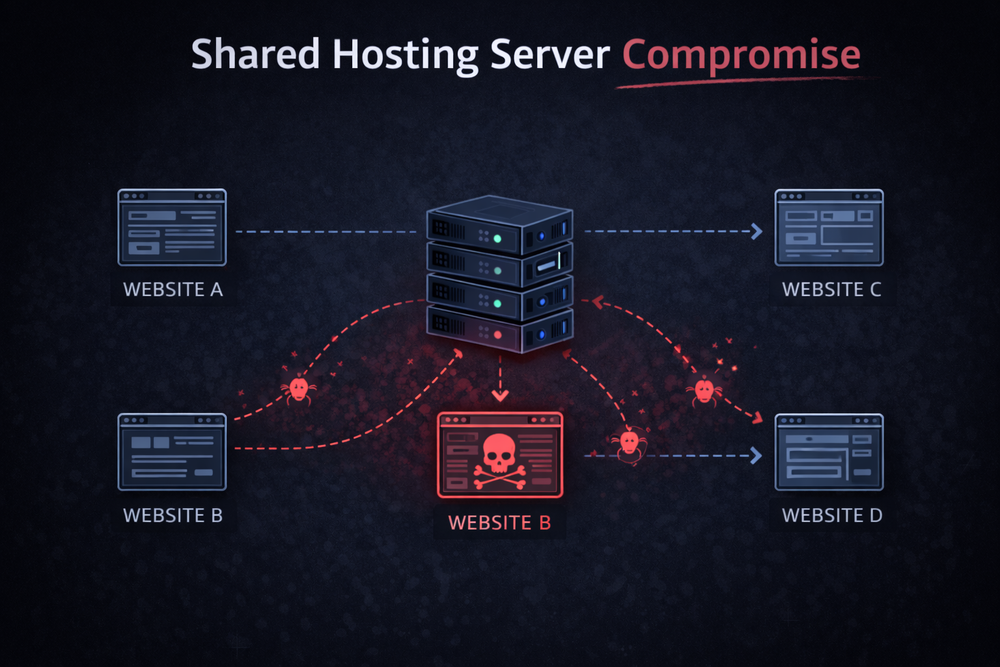
In the Notepad++ incident, the attacker did not target the program’s internal code but the update infrastructure itself. The automatic update feature was functioning normally, but once the server environment it depended on fell under the attacker’s control, the entire trust model of the system collapsed. A key factor in this case was the shared hosting environment. Many open-source projects use shared hosting services for cost efficiency and ease of management. In such environments, multiple websites and projects coexist on a single physical server.
While shared hosting is not inherently unsafe, it can present security risks when proper isolation is not fully enforced. In particular, if an attacker gains access to the server and can interact with the file system, there is a possibility of manipulating files across multiple projects simultaneously. This exact structure became the attack point in the Notepad++ case. After gaining server access, the attacker reached locations where update-related files could be modified. As a result, elements such as update version information files and download locations came under the attacker’s control.
In this situation, the attacker could execute a simple yet highly effective attack. By modifying the update information file to change the download path, or by replacing the existing update file with a malicious one prepared in advance, the attacker could hijack the update process. Since the program continued to follow its normal update procedure, users had no reason to suspect anything. When a user clicked the update button, the program downloaded and installed the file based on the server-provided information. However, the file being downloaded could already have been replaced with a malicious program by the attacker.
What makes this attack particularly dangerous is that it leverages the existing trust model of users. Users may be cautious when opening email attachments or downloading files from suspicious websites, but they almost always trust the official update mechanism of the software they use. The attacker exploited precisely this psychological trust as the attack vector. In the end, the Notepad++ incident became a representative case demonstrating that the security of software distribution infrastructure is just as critical as the security of the program itself. And at this point, a natural question arises: if the update files were tampered with, why was the program unable to verify them?
Why the Verification System Failed to Stop the Attack
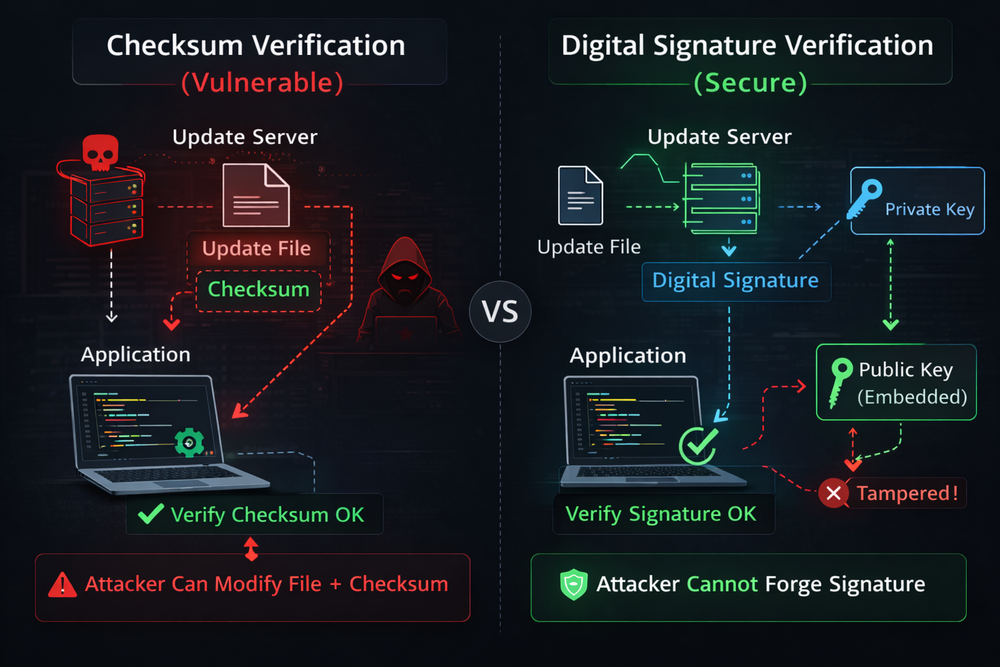
Software update processes typically include a verification step. Programs perform various checks to confirm that a downloaded file was actually distributed by a legitimate publisher. The most widely used method is digital signature verification. The publisher signs the program with a certificate, and the user’s system verifies this signature to ensure the file truly comes from the original source. If this mechanism is properly implemented, any tampered file would be blocked during verification.
However, the Notepad++ update system used a different approach. The WinGup updater relied primarily on checksum-based verification. A checksum is used to verify file integrity by computing a hash of the file’s contents and comparing it to a known value. If the hash of the downloaded file matches the value provided by the server, the file is considered unchanged. This method is highly effective for detecting transmission errors or data corruption during storage.
The problem is that this approach is not sufficient for security verification. Checksum validation only confirms that a file was not altered during transfer—it does not guarantee that the file was created by a trusted publisher. The issue becomes far more serious if the server itself is under the attacker’s control. In that case, the attacker can upload a malicious file and also update the corresponding checksum value. The program calculates the hash of the downloaded file and compares it with the server-provided value. If they match, the file is accepted as a legitimate update.
In this structure, the moment the attacker controls the server, the verification system itself is effectively neutralized. The program believes it is performing validation, but in reality, it is merely comparing attacker-provided data against attacker-provided data. In this sense, checksum verification is useful for ensuring integrity, but insufficient for establishing trust. That is why modern software distribution systems increasingly rely on digital signatures and code signing instead of simple checksums.
The Notepad++ incident clearly illustrates this distinction. The attack succeeded despite the presence of a verification mechanism because that mechanism depended on an environment controlled by the attacker. This leads to an important lesson in software security: verification is not meaningful unless its trust anchor lies outside the attacker’s control.
At this point, another question naturally arises. Why did the attacker choose such a complex method? And why was a developer tool like Notepad++ specifically targeted? These questions can be explored further in the next section, from a broader perspective.
Why Was This Not an Indiscriminate Attack?
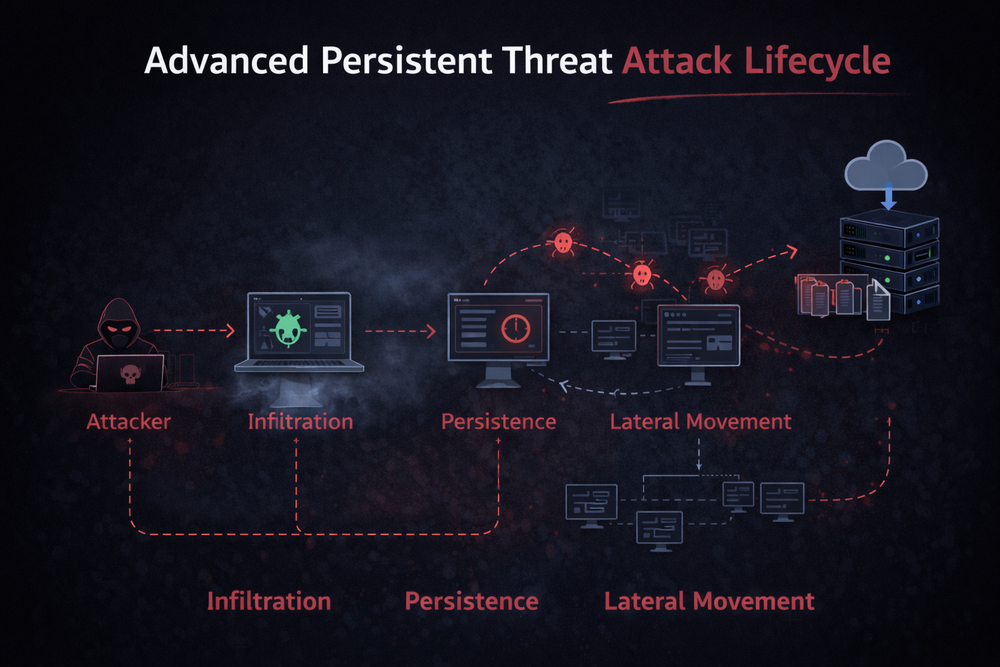
Based on what we have examined so far, the Notepad++ incident reveals some technically intriguing characteristics. The attacker had control over the update infrastructure and, in theory, was in a position to distribute malicious code to a vast number of users. However, when analyzing the actual attack patterns, this case looks quite different from the large-scale malware campaigns we typically imagine. The attack did not occur simultaneously for all users and was only observed in specific environments. In other words, the attacker did not aim to infect as many systems as possible. Instead, the pattern suggests a selective attack, where malicious updates were delivered only to particular targets.
This pattern is familiar to security researchers. It resembles an APT (Advanced Persistent Threat) attack. Unlike typical cybercrime, APT attacks are often not driven by direct financial gain. Instead, they focus on long-term information gathering from specific organizations, companies, or government entities. As a result, attackers prioritize stealth and persistence. If malicious code were distributed to all users, it would quickly attract the attention of security firms and researchers, increasing the likelihood of detection. In contrast, targeting only specific victims allows attackers to remain undetected within systems for a much longer period.
The malicious code discovered in the Notepad++ incident was also not a simple Trojan. During security analysis, a backdoor known as Chrysalis was identified, featuring capabilities far more sophisticated than typical malware. This backdoor could execute remote commands on infected systems, collect system information, and transmit it to external servers. It also had the ability to download additional payloads and move laterally within internal networks. These capabilities are more commonly associated with information-gathering operations than with large-scale ransomware campaigns.
This provides an important clue for understanding the nature of the incident. If the goal had been purely financial, the attacker would likely have attempted to infect as many systems as possible. But the observed pattern tells a different story. The attack was carried out quietly and appeared only in specific environments. This strongly suggests that the Notepad++ incident was not merely a broad malware distribution campaign, but a targeted operation with precise objectives.
At this point, another question naturally arises. What exactly was the attacker aiming for, given the effort to execute such a complex method? And why was a developer tool like Notepad++ chosen as the channel for the attack?
Why Developer Tools Become Targets
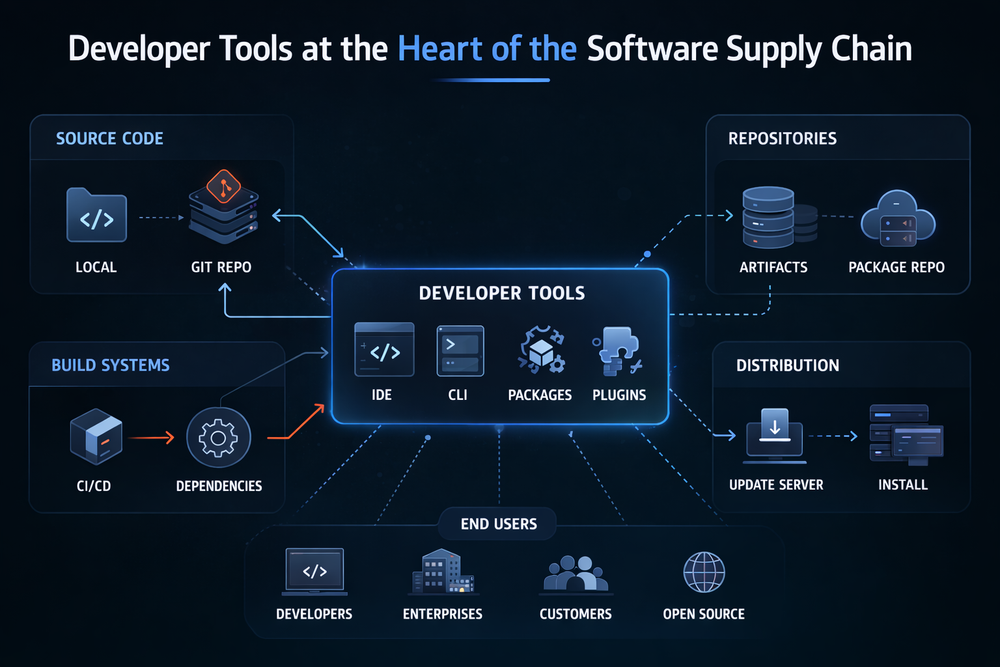
Looking at the Notepad++ incident from a broader perspective makes it clearer why this attack is so interesting. On the surface, the target appears to be a simple text editor. To a general user, it may not seem like a particularly critical piece of software. But from a developer’s perspective, the story is entirely different. For developers, a text editor or IDE is not just a tool—it is the central environment where software is created. It is where code is written and modified, and where most projects begin.
If an attacker can take control of a developer tool, the impact can be far greater than it first appears. Once the tools a developer uses are compromised, the code they produce may also be affected. For example, if an attacker can manipulate files within the development environment or inject malicious code into the build process, the resulting software will carry that influence. In such a scenario, the attacker is not merely infecting a single machine—they are potentially affecting software that will be distributed to countless users.
For this reason, in recent years, multiple security incidents have repeatedly targeted developer tools. A well-known example is the SolarWinds incident, where the update system of network management software was compromised, impacting numerous companies and government organizations. Another case is XcodeGhost, where a tampered version of Apple’s developer tool Xcode was distributed, leading developers to unknowingly ship applications containing malicious code.
These cases reveal a common pattern. Rather than attacking end users directly, attackers first target those who create software. By compromising the developer’s environment, the software they produce becomes a new attack vector. The Notepad++ incident can be understood in this same context. While Notepad++ may appear to be just a text editor, it is widely used by developers, giving it significant influence. If an attacker can take control of its update chain, it becomes possible to infiltrate specific developer environments.
In this sense, the Notepad++ incident carries implications beyond a simple security breach. It demonstrates once again that developer tools themselves can become attack surfaces. And this trend is likely to continue. As software is increasingly built and distributed across complex supply chains, developer tools will remain a critical pathway for future attacks.
What This Incident Reveals About Modern Software Security
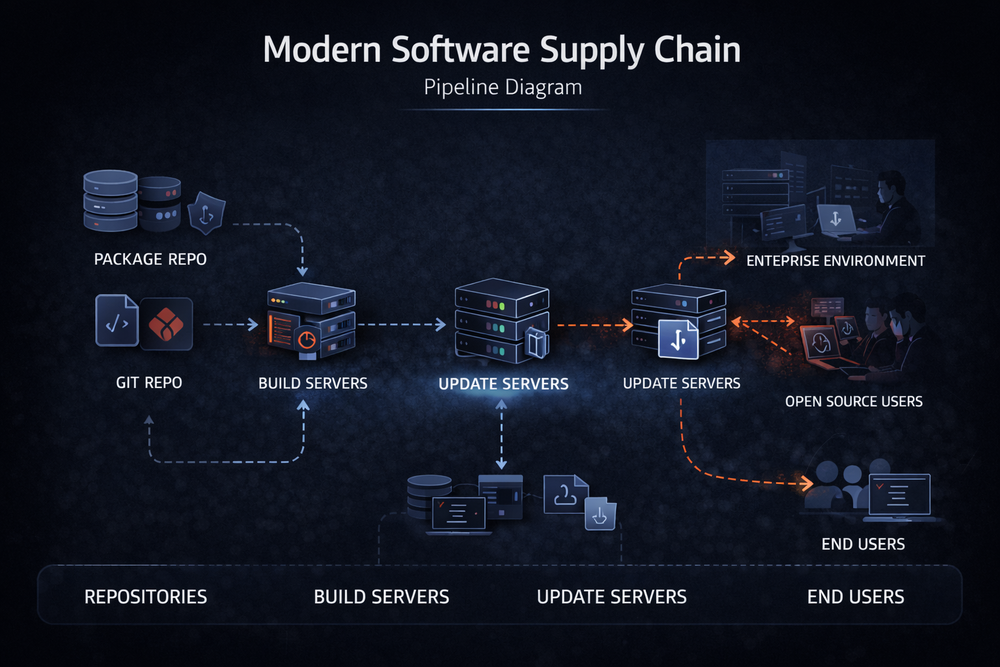
The Notepad++ incident does not end as a simple security breach in a single project. Rather, it serves as a case that reveals how modern software ecosystems rely on complex layers of trust. Today, most software is connected to a wide range of external components. Source code is managed in repositories like GitHub, builds are handled by automated systems, and distribution takes place through CDNs or update servers. Users download and run programs with little awareness of this entire process. All of it operates on trust.
However, with the rise of supply chain attacks, this trust structure is increasingly exposing its weaknesses. Attackers no longer need to directly compromise the program itself. Instead, they can achieve the same outcome by taking control of a single point along the path through which the software is delivered to users. Update systems, in particular, are highly attractive targets. Users do not question updates, and programs automatically download files from update servers. In such a structure, compromising just one server can impact a vast number of users.
Another important point is that open-source projects are not inherently more secure. Many people assume that because the code is publicly available, open-source software must be safer. Indeed, transparency does provide clear security advantages. But in this case, the attacker did not need to touch the source code at all. By targeting the infrastructure through which the software was distributed, they achieved the same result. This demonstrates that software security cannot be viewed solely as a problem of code.
Ultimately, the Notepad++ incident leaves an important lesson. The security of modern software is not determined only by the code within a program. Instead, the security of the entire supply chain through which that code reaches users can be even more critical. And at this point, we return to the original question: why would attackers choose such a complex method? The answer lies in the fact that developer tools are not just programs—they sit at the very core of the software production ecosystem. And for this reason, developer tools will likely continue to attract the attention of attackers in the future.
Conclusion — It Was the Supply Chain, Not the Program, That Was Attacked
Looking back at the Notepad++ incident from the beginning, one interesting fact becomes clear. When the news first broke, many people naturally assumed that the program itself had been hacked. There were speculations that the source code had been tampered with, that a developer’s account had been compromised, or that the build system had been attacked. These reactions were not unreasonable. Many past security incidents had indeed followed such patterns. However, when we examine the structure of this case step by step, it reveals something quite different from the conventional idea of “program hacking.” The attacker did not need to modify the program itself, nor did they need to compromise the developer environment. Instead, they chose to take control of the path through which the program is delivered to users.
In this sense, the Notepad++ incident clearly demonstrates how the modern software security landscape is evolving. Today, most software is not a single isolated program but is created and distributed across a complex supply chain. Source code is managed in repositories, builds are performed by automated systems, and final distribution happens through update servers and download infrastructure. From the user’s perspective, this entire process is invisible. It is experienced simply as running a program and clicking an update button. But behind the scenes, numerous systems are interconnected, and each of these points can become a potential attack surface.
The Notepad++ incident exposed precisely this structural weakness. The program itself remained secure, yet the infrastructure used to distribute it fell under the attacker’s control, resulting in users downloading malicious code. This is less a technical flaw and more a problem of trust. Users trust the software vendor and trust the updates provided by that vendor. Attackers exploit exactly this trust. Since the update system is the most powerful channel for delivering new code to users, once an attacker controls that channel, they can achieve the same outcome without ever modifying the program itself.
What makes this incident particularly important is that it is not an isolated case. Over the past few years, similar patterns have repeatedly appeared. In the SolarWinds incident, the update process of network management software was compromised, affecting numerous companies and government institutions. In the XcodeGhost incident, a tampered version of Apple’s developer tool led developers to unknowingly distribute apps containing malicious code. The Notepad++ case fits squarely within this same trend. It is not the program itself, but the software supply chain that has become the primary target of attacks.
This reality fundamentally changes how we must think about software security. In the past, the primary focus was on vulnerabilities within the program and the security of its code. These concerns are still important. However, as supply chain attacks become increasingly real threats, the scope of security must expand. It now includes not only code, but also build systems, update servers, download infrastructure, and even developer tools. Software is no longer a single entity—it is a network of interconnected systems.
At this point, we can summarize the core lesson of this incident once again. The Notepad++ case is not simply “a text editor being hacked.” Rather, it is a demonstration of how modern software ecosystems depend on complex structures of trust. The program itself was secure, yet the path through which it reached users was compromised, collapsing the trust of the entire system. The most important message left by this incident is this: it was not the program that was hacked, but the supply chain that was attacked.
And here, we are naturally led to the next question. Why did the attacker choose such a complex method? Why target tools used by developers? Was there a larger objective beyond simply infecting a single program? These questions offer critical clues for understanding the broader strategies of modern cyberattacks.
In the next article, we will explore these questions in depth. We will examine what happens when developer tools are compromised, and why environments such as IDEs and editors are becoming increasingly important targets. To understand why attacking developer tools can mean attacking the world itself.