
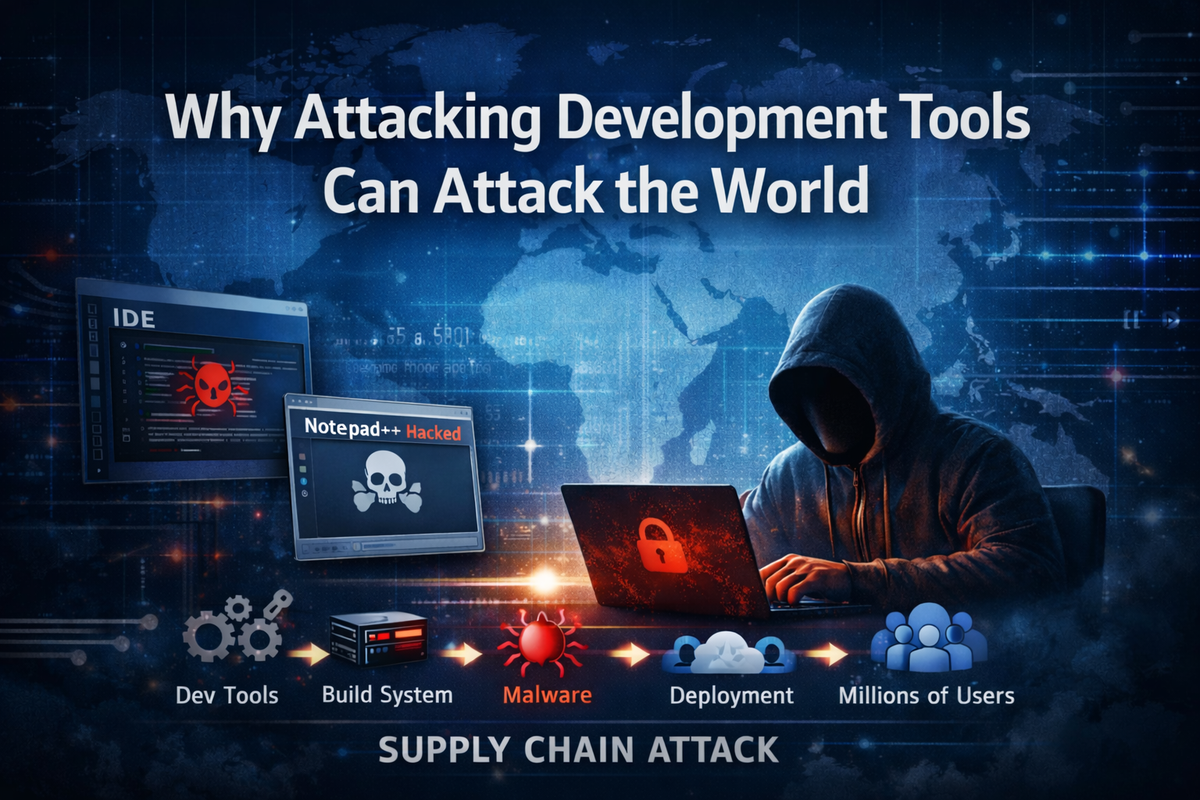
Why Hackers Target Text Editors
When the Notepad++ supply chain attack was first revealed to the security community, many people reacted in a similar way. What surprised them was not the attack itself, but the target. A text editor does not typically appear to be a critical security system. It is not an operating system, not a database server, and not a core service in enterprise infrastructure. For most people, a text editor is simply a tool for opening and editing files. So the question naturally arises: why would hackers target such a program? When people think of hacking incidents, they usually imagine financial systems, corporate servers, or services that store user data.
However, when this question is viewed from a different perspective, the situation changes completely. Attackers always aim for the most valuable point. Here, value does not simply refer to the importance of the program itself. Rather, it refers to the potential impact an attacker can achieve. What matters more is how many users can be affected, how wide a network can be accessed, and how long the attack can persist. From this perspective, developer tools such as text editors and IDEs become far more attractive targets than they might initially appear.
For developers, a text editor is not just another program. Developers spend most of their day working with code, and the environment where that code is written and modified is the editor or IDE. Some developers open the same editor dozens of times a day—opening projects, modifying code, and running builds. In other words, developer tools sit at the center of the developer’s working environment. And the code created through these tools ultimately becomes products distributed to countless users.
Viewed from an attacker’s perspective, this creates a very compelling opportunity. If an attacker can gain access to the tools used by developers, they can do far more than simply infect a single machine. The developer’s code, the programs they build, and the software they distribute can all become part of the attack chain. In other words, even if the immediate target is just an editor, the ecosystem connected to that editor is far larger.
For this reason, security researchers often say that in the modern software ecosystem, the most critical system is not the server, but the development environment. A server is where software runs after it is built, but the development environment is where that software is created in the first place. If an attacker compromises a server, they may take control of a single system. But if they compromise a development environment, they may influence every piece of software produced by that developer. This difference goes beyond a technical detail—it fundamentally reshapes attack strategy.
Ultimately, attacking a text editor is not about targeting a simple application. It is about attacking the starting point of the software production process. And once this is understood, it becomes clear why a program like Notepad++ can become a target. Attackers always look for shortcuts—and developer tools often provide exactly that.
Where Is Software Created?
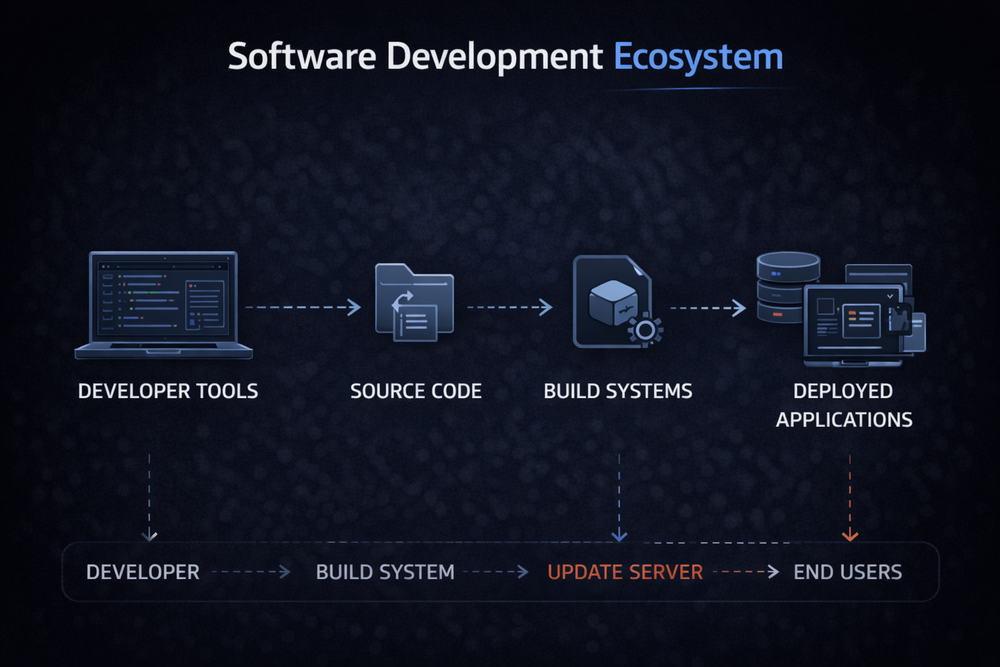
If we take a moment to think about the path software takes before it reaches users, it becomes clearer why developer tools occupy such an important position. Most people only think about the moment they download or run a program, but in reality, a much longer process exists beforehand. Every piece of software begins on a developer’s computer. Developers write code, modify it, test it, and build it repeatedly until a program is produced. This process is largely invisible, yet it is the core production mechanism that drives the entire software industry.
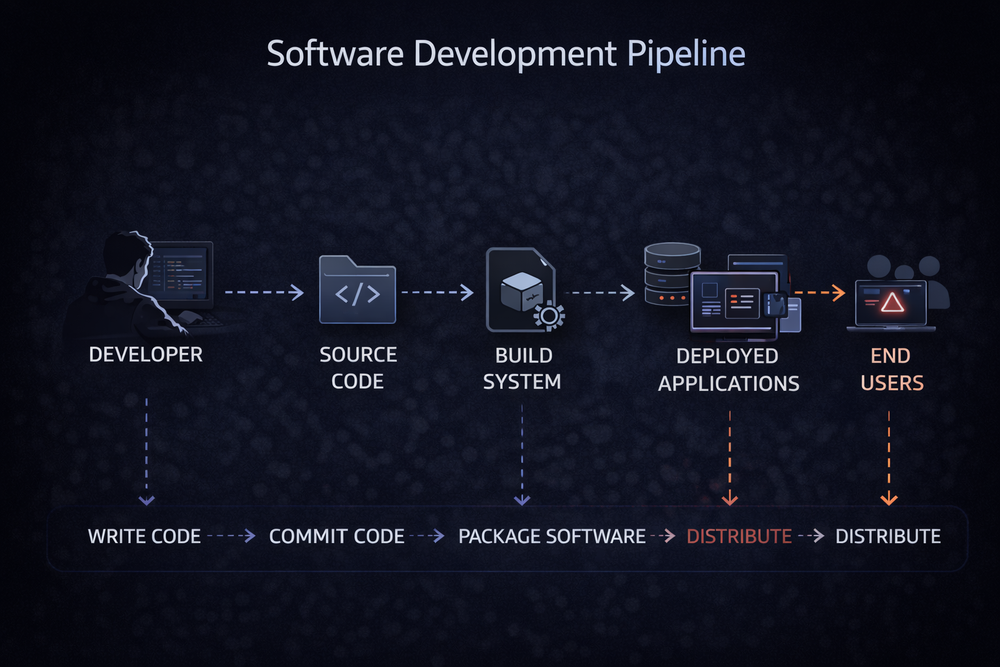
This process can be simplified into a single flow. A developer first writes code using an editor or IDE. The code is then compiled or packaged through a build system. The resulting artifact is delivered to a package repository or distribution server, and finally distributed to users. This flow is repeated in almost every software project.
Developer → Developer Tools → Build System → Package → Distribution → UserLooking more closely at this structure reveals an important characteristic. The very first point that all code passes through is the developer tool. From the moment a developer writes code, it moves through the development environment. Every subsequent step is built on top of that code. In other words, developer tools are not merely programs for editing text—they are the front line of the software production chain.
This fact is so familiar to developers that it often goes unnoticed. Opening an editor and writing code is a natural action. But from a security perspective, this point becomes extremely interesting. Developer tools perform a wide range of functions—code editing, file access, project management, and build execution—while holding extensive permissions. Most IDEs have full access to project files, can freely interact with the file system, and often include network communication and package download capabilities.
Ultimately, developer tools act not just as simple applications but as hubs that connect code and systems. The code developers write, the build process, the testing environment, and the deployment system are all connected through this environment. Therefore, compromising the development environment is far more significant than infecting a single program—it is equivalent to gaining access to the starting point of the entire software production chain.
At this point, the attacker’s strategy becomes clear once again. Instead of directly attacking countless user systems, an attacker can achieve far greater efficiency by targeting the tools used by developers. While a developer tool may appear to be just a single program, it is in fact the origin point connected to vast amounts of software. This is why the development environment is increasingly recognized by security researchers as a critical attack surface.
What Becomes Possible When You Attack Developers
Now let’s shift the perspective slightly to that of the attacker. Anyone designing a cyberattack asks the same fundamental question: where can the greatest impact be achieved? The simplest answer is to target users. In fact, many attacks rely on phishing emails, malicious files, and social engineering to infect individual user systems. These methods are relatively simple and have high success rates, which is why they have been used for so long.
However, attacking users has clear limitations. Compromising a single user typically provides access to only one system. While further attacks can be launched from there, the overall impact remains relatively constrained. To gain control over multiple systems, the attacker must repeat the same effort again and again.
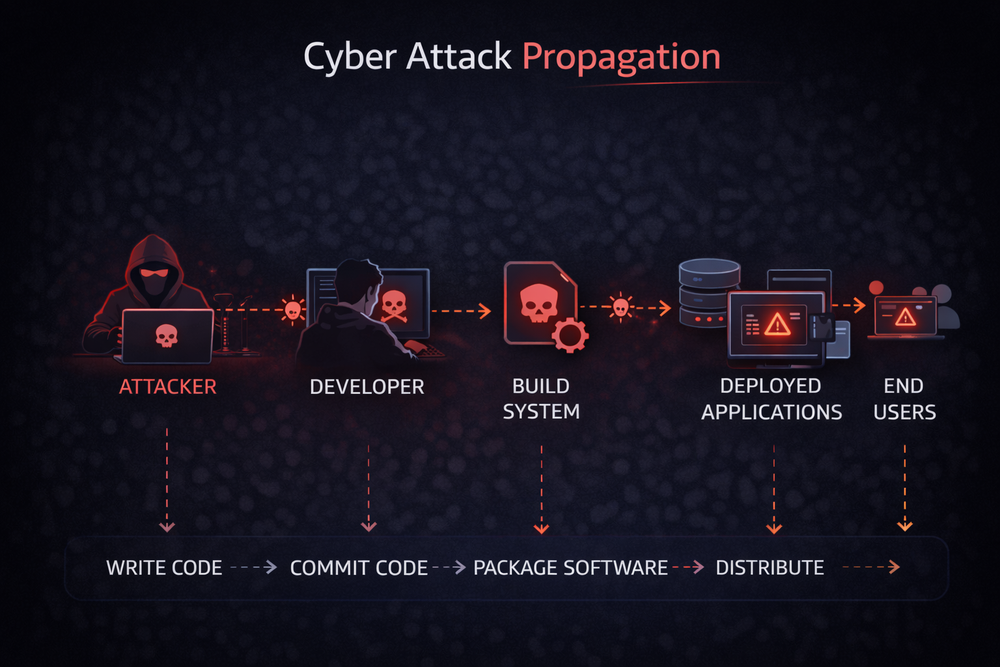
Targeting developers, on the other hand, leads to a completely different outcome. Developers are not just users—they are the ones who produce software. The programs they create can be distributed to hundreds, thousands, or even millions of users. In other words, a developer’s environment is not just a single machine; it is a starting point connected to vast numbers of users.
For this reason, security researchers have long used a simple expression: “Attack one developer, and you can attack countless users.” This is not merely a metaphor—it has been proven repeatedly through real-world incidents. Once an attacker gains access to a developer’s environment, they may also gain access to code repositories, build servers, package registries, and internal APIs. By leveraging these connections, an attacker can move within an organization, interfere with the software distribution process, or even manipulate the software delivered to end users.
Another critical factor is the level of access within development environments. Developers typically have permissions that span entire projects and are often connected to build systems or deployment servers. This makes the environment highly attractive to attackers. Privileges that are difficult to obtain on a regular user’s machine can often be accessed much more easily within a development environment.
As a result, in recent years, security researchers have begun to view the development environment as a new battlefield. Positioned somewhere between servers and end-user systems, this space is broader than it appears, holds extensive privileges, and, most importantly, sits at the center of software production. If an attacker can take control of this point, they are no longer just infecting a single machine—they are potentially influencing the entire software ecosystem.
This is exactly why developer tools have become a focus of attacker interest. Attackers always seek the most efficient path, and the development environment often provides that path. In the next section, we will examine how these attack strategies have appeared in real-world scenarios and how the concept of supply chain attacks has evolved over time.
The Strategy of Supply Chain Attacks
As discussed in the previous section, the development environment is not just a personal workspace—it is the starting point where software is created. From an attacker’s perspective, this makes it a highly attractive attack surface. But this strategy does not stop at targeting individual developers. In modern cyberattacks, it has evolved into a more organized and strategic form known as a Supply Chain Attack.
As the name suggests, a supply chain attack targets the entire process through which software is delivered to users—the software supply chain itself. Traditional hacking typically involves directly penetrating a specific server or system. For example, exploiting a vulnerability in a company’s web server to access its internal network, or installing malicious files on a user’s machine. Supply chain attacks, however, do not rely on this kind of direct intrusion. Instead, attackers intervene in the process by which software is created and distributed.
Software is not delivered directly from a developer’s computer to users. It passes through multiple stages—code repositories, build servers, package registries, and update servers—before reaching its final form. This process forms a kind of production chain shared across the entire software industry. By taking control of just one point in this chain, attackers can achieve a far greater impact. A single breach can allow them to distribute malicious code to a vast number of users at once.
What makes this strategy particularly dangerous is that the attack occurs within the normal software distribution process. Users do not question installation or updates. In fact, updates are often seen as essential for maintaining security. As a result, if attackers compromise an update server or build system, users will unknowingly download and execute malicious code themselves. Because everything appears to be a legitimate update, detecting the attack becomes extremely difficult.
This is why security experts often describe supply chain attacks as the “shortcut” of modern cyberattacks. Attackers do not need to compromise individual systems one by one. Instead, they only need to take control of a single point in the software production process. Every program produced from that point becomes influenced by the attacker, and every user who installs those programs falls within the attack’s reach.
The development environment we discussed earlier is also part of this supply chain. Editors, IDEs, and the build processes that occur within them sit at the very front of this chain. Therefore, targeting developer tools is not merely an attempt to compromise individual systems—it is an effort to take control of the software supply chain itself. And as multiple real-world incidents have already shown, this strategy can have far-reaching consequences.
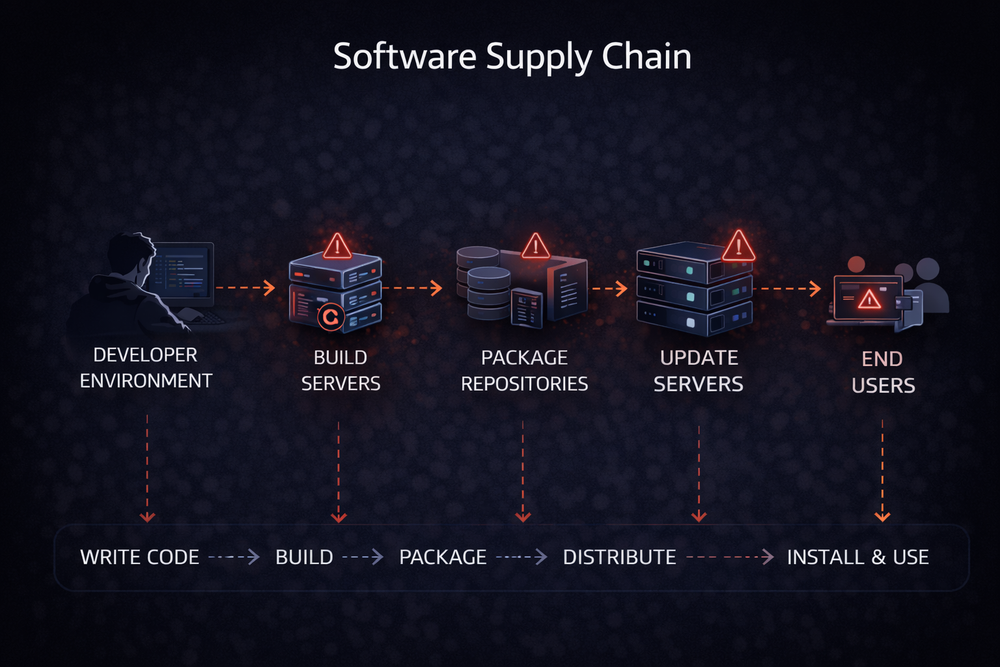
Why Developer Tools Are the Most Dangerous Point in the Supply Chain
There are more potential attack points in the supply chain than one might expect. Attackers can target code repositories, infiltrate build servers, manipulate package registries, or compromise update servers. But among these, one point stands out as particularly critical: developer tools. Programs such as IDEs, text editors, and compilers sit at the very beginning of the software production process, making them highly attractive targets for attackers.
One reason developer tools are so risky is that they are almost always running. Many developers launch their IDE or editor as soon as they turn on their computer and work within that environment all day. Code editing, testing, building, and log analysis all take place inside these tools. From an attacker’s perspective, this makes developer tools an ideal place to remain inside a system for long periods. Unlike typical backdoor programs, developer tools continue running as legitimate applications, making them far less likely to raise suspicion.
Another reason is the extensive level of access these tools possess. IDEs typically have full access to project directories and can freely read and write files across the file system. Many also include package download capabilities, network communication features, and support for external plugins. While these capabilities are designed to improve developer productivity, they also significantly expand the attack surface available to an attacker.
An even more critical issue is that development environments are connected to multiple internal systems within an organization. Developers often have access to code repositories, build servers, and test environments, and in some cases, even internal APIs or databases. This means a developer’s machine is not just a personal device—it is a key connection point within the organization’s internal network. If an attacker gains control of the development environment, they can leverage these connections to move laterally across systems.
For these reasons, developer tools become an ideal foothold for attackers. Once inside, they can operate stealthily over long periods, move across multiple systems, and even interfere with the software production process itself. This is why, in recent years, security researchers have begun to view IDEs, build tools, and package managers as emerging security threats.
When combined with the supply chain attack strategies discussed earlier, the problem becomes even clearer. Developer tools are not just individual programs—they represent the first stage of the software supply chain. And when an attack occurs at this stage, its impact can naturally propagate through every subsequent step. This is not just a theoretical risk—it has been clearly demonstrated through real-world incidents.
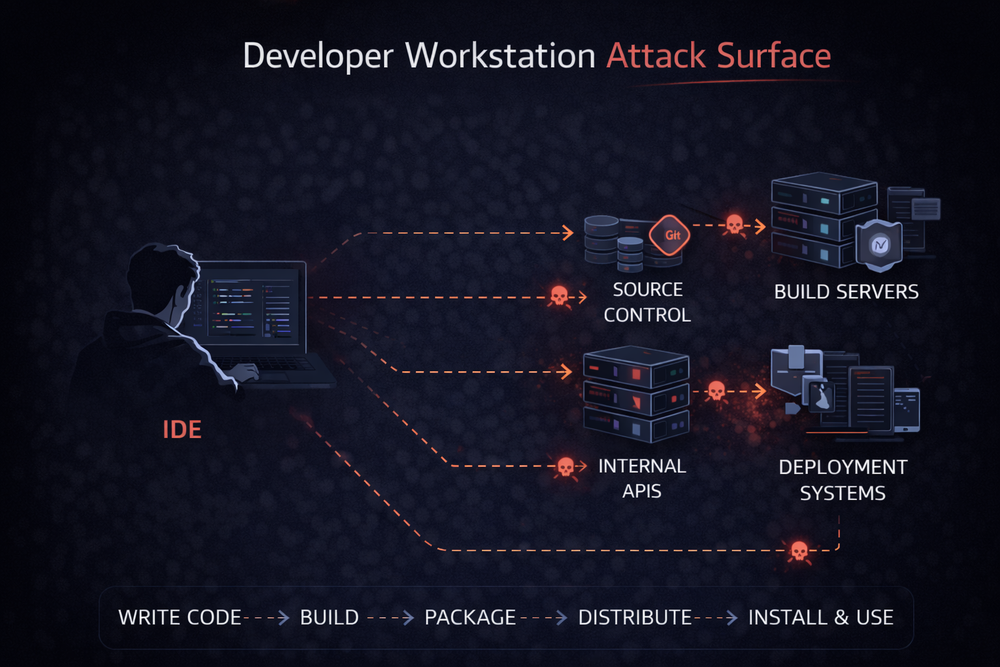
Case Study 1 — The XcodeGhost Incident
One of the most representative cases demonstrating the impact of developer tool attacks is the XcodeGhost incident. This event occurred in 2015 and had a significant impact on the entire iOS application ecosystem. Xcode is Apple’s official iOS development tool and is an essential program that every iPhone app developer must use. In other words, almost all iOS apps are built using Xcode.
The issue originated from the download environment in China at the time. Many developers were downloading Xcode installation files from alternative sources instead of Apple’s official servers, and some of these files had already been tampered with by attackers. The attackers injected malicious code into the Xcode installer, and developers installed and used it without suspicion. In effect, the development environment itself was already compromised.
What followed was highly alarming. When developers used the modified Xcode to build their apps, malicious code was automatically embedded into the applications. Developers believed they were creating legitimate apps, but in reality, they were producing apps that contained hidden malicious code. These apps were then uploaded to the App Store as usual.
As a result, hundreds of iOS apps were distributed in an infected state with XcodeGhost malware. Some of these apps had millions of users, making the scope of impact extremely wide. Users trusted that the apps they installed were legitimate, but in reality, code inserted by attackers was running alongside them.
This incident clearly demonstrates how dangerous developer tool attacks can be. The attackers did not directly target individual user devices. Instead, they manipulated the tools used by developers. As a result, countless apps and user devices were affected simultaneously. A single attack propagated across the entire software ecosystem.
After the XcodeGhost incident, security researchers began to view development environment security from a new perspective. It became clear that tools like IDEs and compilers are not just development utilities—they are critical points in the software supply chain. This perspective has since become an essential framework for understanding many subsequent supply chain attacks.
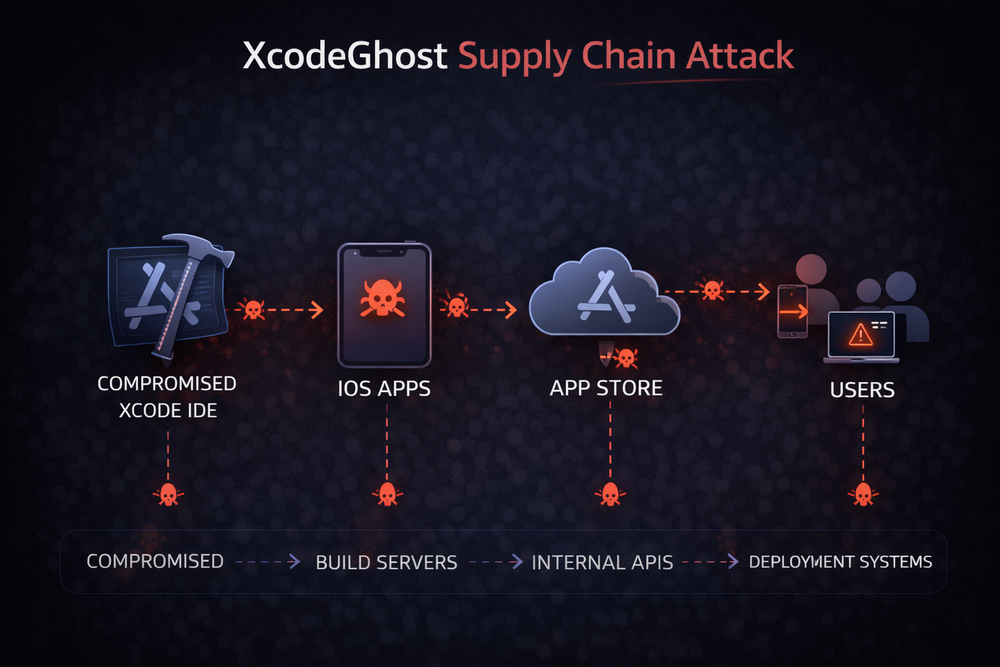
Case Study 2 — The SolarWinds Incident
The XcodeGhost case discussed earlier demonstrated what can happen when developer tools are compromised. However, there is another incident that reveals the full destructive potential of supply chain attacks: the SolarWinds supply chain attack, disclosed in 2020. This case went beyond a typical security breach and became a defining example of how state-level cyberattack strategies can exploit the software supply chain.
SolarWinds is a company that develops network management software, providing the Orion platform used to manage infrastructure in enterprises and government organizations. This software was widely deployed across organizations worldwide and served as a core tool for monitoring networks and managing servers. In other words, Orion was not just an application—it was a management system deeply embedded within organizational IT infrastructure. If an attacker could gain access to this software, the impact could extend far beyond a single system and spread across entire organizations.
This is exactly the point the attackers targeted. Instead of directly attacking individual organizations, they infiltrated SolarWinds’ build system. The build system compiles and packages code written by developers into a form that can be distributed to users. By compromising this system, attackers could insert malicious code into otherwise legitimate software updates, which would then be delivered to users through normal channels.
That is precisely what happened in the SolarWinds case. The attackers embedded a backdoor into the Orion update package, and the update was distributed with a valid digital signature. From the user’s perspective, it appeared to be a completely legitimate update. Enterprises and government agencies installed the software, believing it to be a security update. In reality, they were executing code inserted by the attacker.
The scale of the attack was massive. It is estimated that around 18,000 organizations downloaded and installed the compromised update, including U.S. government agencies and major technology companies. With a single supply chain breach, the attackers established a foothold across thousands of organizations simultaneously.
The SolarWinds incident clearly demonstrates that supply chain attacks are not merely technical exploits but strategic attack methods. Attackers no longer focus solely on compromising individual servers. Instead, they target the entire process through which software is created and distributed, aiming to gain far greater influence by controlling a single point in that process.
If XcodeGhost revealed the possibility of supply chain attacks through developer tools, SolarWinds showed how such strategies can be executed at a massive scale. Together, these incidents deliver a consistent message: attackers always seek the most efficient path, and the software supply chain often provides exactly that path.
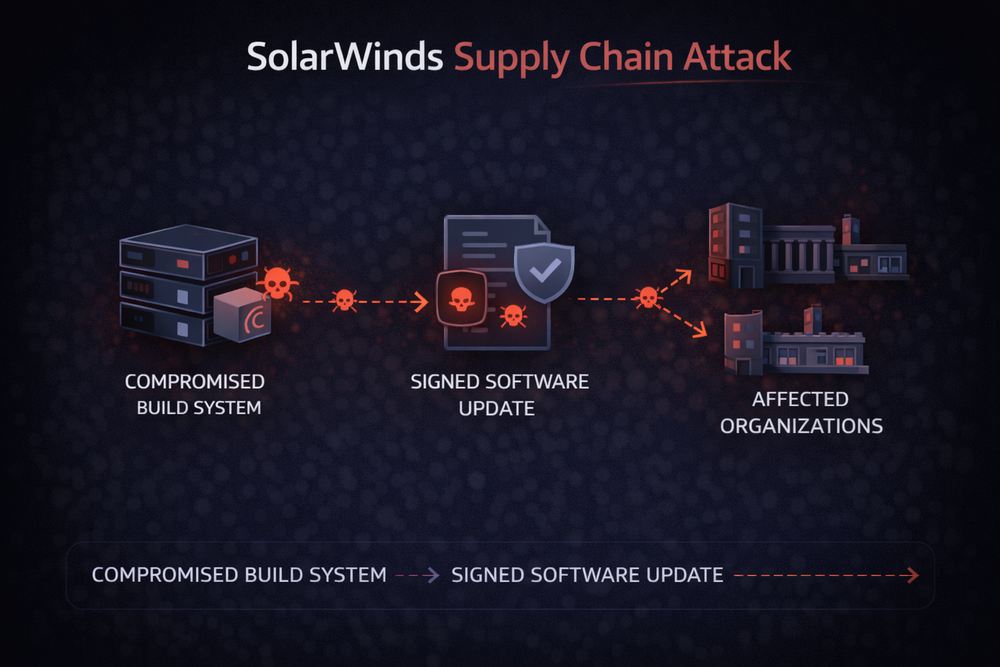
Revisiting the Notepad++ Incident
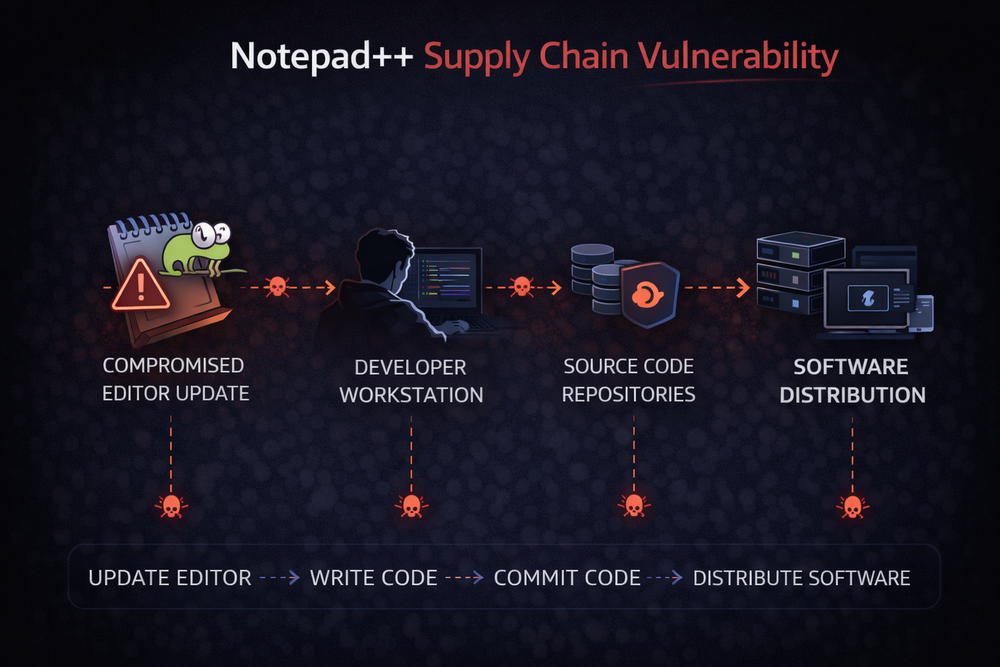
Looking back at the Notepad++ incident through the lens of the cases discussed so far, its significance becomes much clearer. When the news first broke, many people simply saw it as “a text editor being hacked.” However, from the perspective of supply chain attacks, this incident can be interpreted not as a simple program compromise, but as an attempt to target the developer environment itself.
Notepad++ is a widely used text editor around the world. In particular, many developers working in Windows environments rely on it as a basic code editing tool. It is also used by a range of technical professionals, including system administrators and data analysts. While it may appear to be a simple editor on the surface, in reality, it plays a critical role within countless development environments.
If an attacker can manipulate the update system of such a program, the situation changes dramatically. The moment a developer updates the program, code inserted by the attacker can be executed. Once that code runs within the development environment, it can enable activities such as accessing code repositories or initiating network communication. In other words, the attacker is not merely infecting a single program—they are gaining a pathway into the development environment itself.
At this point, the meaning of the Notepad++ incident becomes clearer. While the immediate target appeared to be a simple editor, the true objective may have been the broader developer ecosystem. Tools used by developers are tightly connected to the software production process. Therefore, attacking the update system of a developer tool is not just a case of program tampering—it can be understood as part of a broader supply chain attack strategy.
This incident also highlights another important lesson. Many developers tend to view open-source software as relatively safe. Indeed, open-source projects benefit from transparency, as their code is publicly available. However, software security is not determined by code alone. Elements such as update servers, build systems, and distribution infrastructure play equally critical roles.
Ultimately, the Notepad++ incident leads to a fundamental question: how secure are the developer tools we use every day? And how trustworthy is the software produced through those tools? These questions go beyond the security of a single program—they compel us to reconsider the structure of the entire modern software ecosystem.
Conclusion — Developer Tools Have Become a New Battlefield
The cases examined so far all deliver a common message. In modern cyberattacks, what matters is not simply finding vulnerable systems, but identifying the most efficient attack path. As security environments grow more complex, attackers are increasingly choosing indirect approaches rather than direct intrusion. In this process, the software supply chain becomes an especially attractive attack surface.
Developer tools sit at the very beginning of this supply chain. Developers perform all stages—code writing, building, testing, and deployment—within the development environment. If this environment falls under an attacker’s control, the impact goes far beyond a single compromised machine. It can affect every piece of software produced by that developer. This highlights that developer tools are not merely production utilities—they are central nodes connecting the entire software ecosystem.
The SolarWinds incident demonstrated what can happen when a build system is compromised. The XcodeGhost case showed the consequences of tampering with developer tools themselves. And the Notepad++ incident revealed that even relatively small tools can serve as entry points for supply chain attacks. While these cases occurred in different contexts, they all exploited the same underlying structure: the software supply chain.
This trend is likely to continue. The software industry is evolving into an increasingly complex ecosystem, where developer tools, build systems, package registries, and update servers are tightly interconnected. This interconnected structure improves development productivity, but at the same time, it creates new pathways for attacks.
As a result, modern security research is placing growing emphasis on the security of development environments. Elements such as IDE plugins, package managers, build tools, and update systems are now being recognized as new attack surfaces. A single tool used by developers can be connected to countless software systems.
In the next article of this series, we will examine in greater detail how these supply chain attacks are actually carried out. In particular, we will focus on the SolarWinds incident, analyzing how attackers infiltrated the build system and what consequences followed. This case stands as a representative example of how supply chain attacks can impact the real world far beyond a typical security breach.