
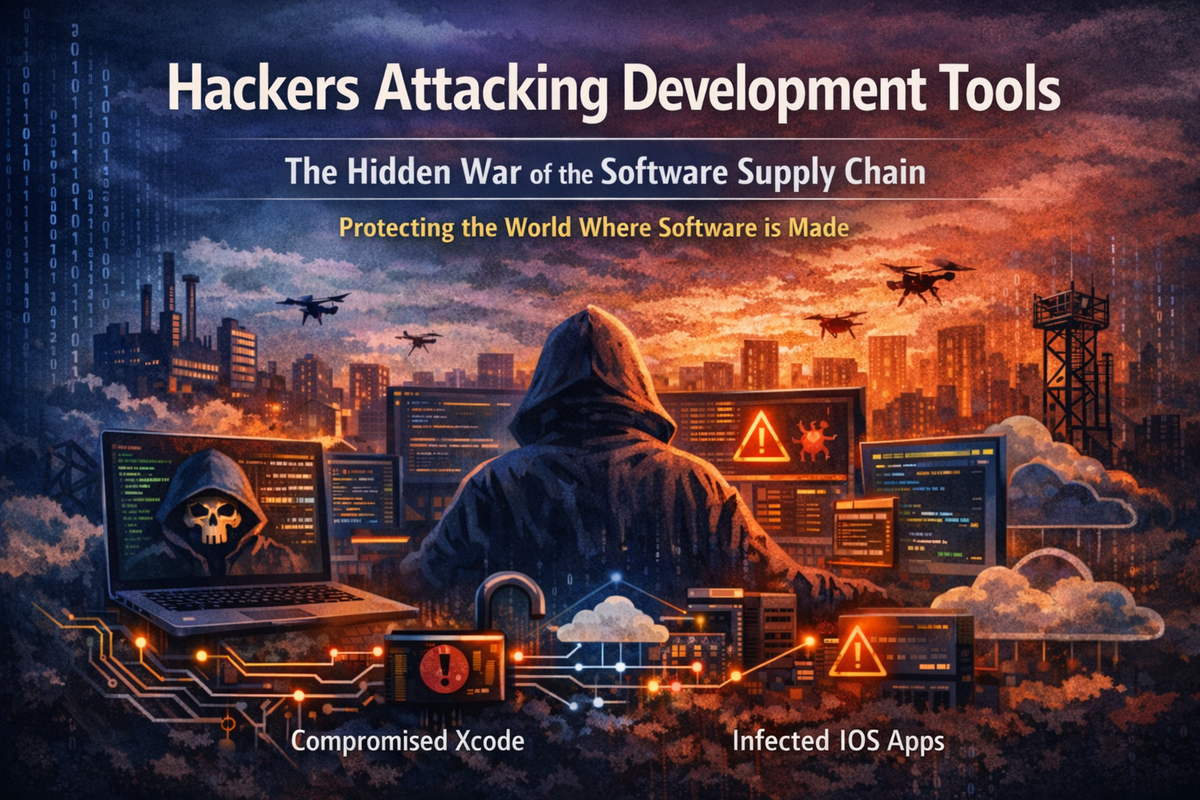
Hackers Targeting Developer Tools — The Era of Invisible Attacks
Discussions about software security usually begin with a familiar scene. A server has been breached, a database has been leaked, and a service has gone down. Most people think of that moment as the beginning of a security incident. The attacker entered the system, and damage followed. However, the cases explored in this series challenge that assumption and offer a different perspective.
Modern attacks often begin not when a service is running, but during the process by which that service is created. And at the center of that process are always the tools developers use—IDEs, build systems, update servers, and package repositories. We tend to think of them as simple tools for convenience, but in reality, they are the foundational infrastructure that connects the entire software ecosystem.
This series began with that exact question: what happens when not the program itself, but the tools used to create it are attacked?
And by following that question, the true complexity of the modern software world begins to reveal itself.
The Day the Update Was Attacked
At first glance, the Notepad++ incident seemed like a relatively simple security breach. Someone compromised the update server, and the program packages delivered to users were tampered with. It was not a vulnerability in the software itself, but an attack on the update process.
Yet the message behind this incident was far from simple.
In modern software, updates are not just a feature—they are an ongoing distribution system. Users do not install a program once and leave it unchanged. Software is continuously updated, new features are added, and security patches are applied, often automatically.
This structure greatly improves user experience, but it also introduces new risks. The moment an update system is compromised, attackers gain a channel not to a single user, but to all users simultaneously.
The Notepad++ incident illustrated this reality with striking clarity. The attacker did not need to hack the program itself. It was enough to take control of the path through which the program was delivered.
Why Developer Tools Become an Attack Surface
When we broaden the perspective, it becomes clear why developer tools themselves have become targets of attack.
Modern software is no longer built entirely by a single developer from start to finish. Most projects are constructed on top of numerous libraries and tools. Developers use IDEs, install dependencies through package managers, compile code with build systems, and ultimately deploy the results through CI/CD pipelines.
When viewed as a single flow, this structure resembles a vast production line.
And at the very top of that production line are always the tools used by developers.
From an attacker’s perspective, this point is highly attractive. Instead of targeting individual users, attacking developers provides access to far more systems. And by compromising the tools developers rely on, attackers can influence countless programs created with those tools at once.
This is precisely why supply chain attacks target developer tools. Attackers no longer focus on finished products—they target the process by which those products are created.
The Massive Impact Revealed by SolarWinds
The scale of this structure’s impact was dramatically demonstrated in the SolarWinds incident.
SolarWinds was a company providing network management software used by numerous enterprises and government agencies. The attackers did not directly target those customers. Instead, they infiltrated SolarWinds’ build environment.
As a result, malicious code was embedded into legitimate update packages, which were then distributed to customers through the normal update process. Countless organizations installed these updates without suspicion, and at that moment, attackers gained a pathway into their internal networks.
What made this incident particularly shocking was the nature of the attack. Everything appeared normal. Updates were delivered through official servers, digital signatures appeared valid, security systems detected nothing unusual, and users had no reason to suspect anything was wrong.
This is the defining characteristic of supply chain attacks. They do not operate by breaking systems in obvious ways. Instead, they hide within normal processes and operate from within.
Another Incident Created by Developer Tools
The XcodeGhost incident followed a similar structure.
At the time, many iOS developers were struggling to download Apple’s official development tool, Xcode, due to extremely slow speeds. To solve this, some developers began downloading Xcode from alternative sources.
The problem was that some of these versions had been tampered with.
Developers who used these tools unknowingly built applications containing malicious code and submitted them to the App Store. As a result, countless users believed they were installing legitimate apps, but in reality, they were downloading software embedded with malicious code.
What makes this incident significant is that developers were not acting with malicious intent. They were simply following their usual development workflow. However, the tool they relied on had already been compromised.
In the end, the attackers did not directly target users or developers. They simply altered a single developer tool—and that was enough.
Where Is the Boundary of Security?
The incidents explored in this series occurred at different times, but they all lead to one fundamental question:
Where is the boundary of software security?
In the past, that boundary was relatively clear. There were servers, networks, and user accounts. Security systems were designed to protect those boundaries—firewalls blocked external access, authentication systems verified users, and intrusion detection systems monitored attacks.
But in modern software environments, that boundary has moved much earlier in the process.
The moment code is written
The moment a build is executed
The moment a package is created
The moment an update is distributed
Each of these stages becomes a new security boundary.
Attackers no longer need to break into servers. Instead, they can simply intervene in the process by which software is created.
An Invisible War
Most of the software we use is built on top of multiple layers—IDEs and editors, package managers, open-source libraries, build tools, CI systems, deployment infrastructure, and update servers. Together, these form a vast and interconnected ecosystem.
And if even one point in that ecosystem is compromised, the impact can spread far more widely than expected.
The tools developers use are not just simple programs. They are the starting point of software production. The moment that starting point is compromised, the attack can extend beyond a single application and propagate across the entire ecosystem.
This is the shift taking place in modern security. Attacks no longer occur only in visible places. Instead, they happen silently, invisibly, and with remarkable efficiency.
Epilogue — The Structure We Must Understand
This series set out to illustrate a single pattern through several well-known incidents: the Notepad++ update server attack, supply chain attacks targeting developer tools, the SolarWinds incident, and the XcodeGhost case.
Each of these incidents occurred in different contexts, but they all point in the same direction.
The risks in modern software do not arise solely from individual vulnerabilities.
Sometimes, the entire development ecosystem we trust becomes the target of attack.
Developers are not just people who write code. They stand at the center of a vast software supply chain—one that is now connected to nearly every digital system in the world.
This series does not end with the summary of specific incidents. Rather, it begins with understanding the structure those incidents reveal.
The era of attacking software has existed for a long time. But what we are facing now is something different.
Attackers are no longer targeting programs.
They are targeting the entire world in which those programs are created.