
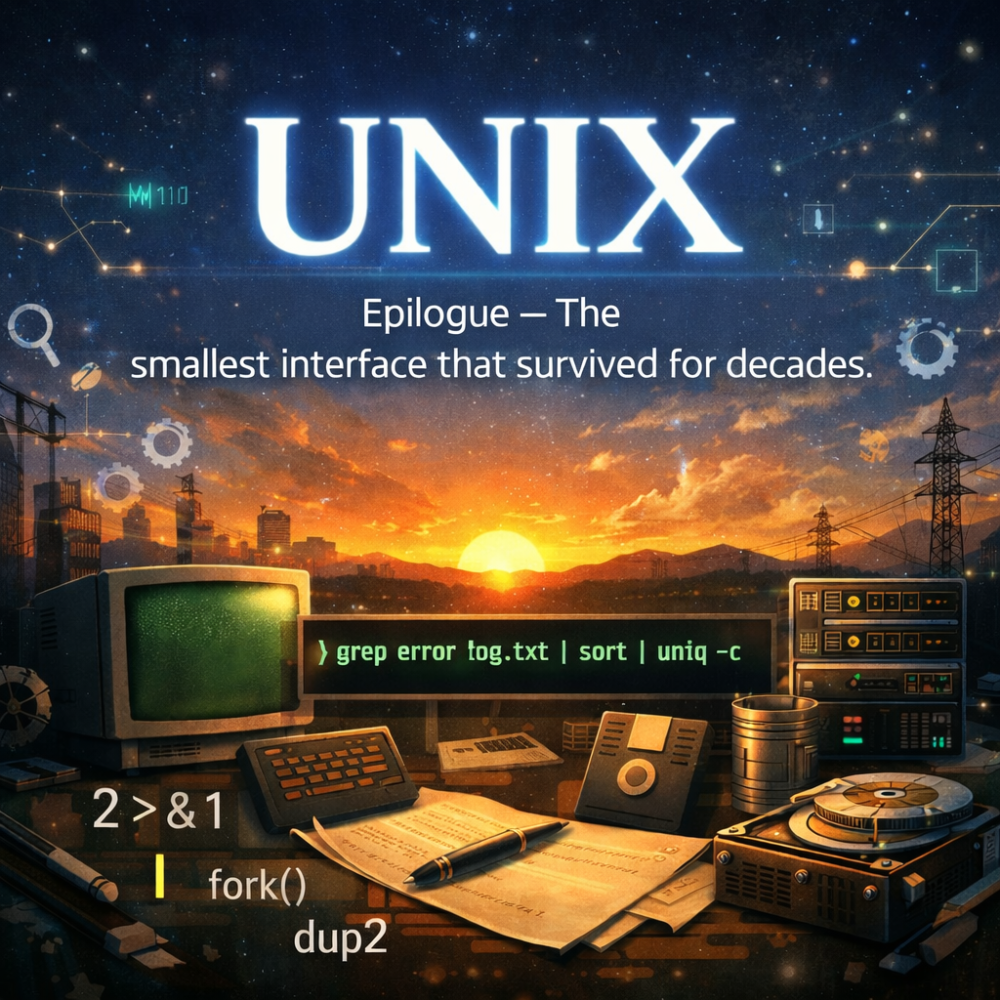
Throughout the history of computing, countless technologies have emerged—and just as many have disappeared. Some were innovative but too complex to survive. Others were forgotten because they arrived at the wrong time. Still others once dominated the world, only to quietly fade away as new technologies took their place. Yet amid all this change, there are a few things that have endured with almost no change at all.
They are the small Unix commands and the design philosophy behind them.
This series began with those very small things. The symbols we casually use in the terminal, the seemingly simple redirection syntax, and constructs like pipes. At first glance, they look like nothing more than parts of a command. But if you look a little deeper, you begin to see the design principles that have sustained the software world for decades hidden within them.
And remarkably, those principles are still alive today—
in the cloud, in containers, and in modern development tools.
stdout and stderr — structural freedom from a simple separation
The first post in this series began with the concepts of stdout and stderr. On the surface, this appears to be nothing more than a separation of output channels: a program sends normal output and error messages to different streams.
But this simple separation reveals an important characteristic of Unix design.
From the beginning, Unix separated the meaning of output. By distinguishing between normal data flow and error information, programs became far more flexible when connected to other programs.
For example, when the output of one program becomes the input of another, mixing in error messages can break the entire pipeline. But because stderr exists as a separate stream, the data flow remains intact.
This small design choice ultimately became the foundation that made it possible to connect programs together.
And from that foundation emerged the Unix pipe.
Pipe — a way to compose programs
The symbol | is now deeply familiar. But it is not just syntax. It is an invention that fundamentally changed how software is built.
The idea behind the pipe is simple:
connect the output of one program directly to the input of another.
Yet this simple mechanism produced profound results. In Unix, software is not built as one large, monolithic system. Instead, a system is formed by connecting many small programs together.
This philosophy has influenced countless software designs since. The data processing pipelines we use today, streaming systems, and even modern microservice architectures all, in some way, reflect this idea.
The Unix pipe was not just a feature—it introduced the concept of composition into the world of programming.
fork and exec — separation of processes
When you look inside shell redirection, another important design principle emerges.
It is the process model built around fork and exec. In many modern operating systems, process creation can be quite complex. But in Unix, it is clearly divided into two steps.
First, the current process is duplicated with fork, and then a new program is executed with exec. This model is simple, yet powerful.
The shell first creates a child process, then manipulates file descriptors within that process, sets up the necessary redirection, and finally executes a new program.
As a result, we can casually use commands like:
command1 | command2 > output.txtYet behind this single line, multiple processes are created, file descriptors are duplicated, pipes are established, and redirections are configured.
All of this is possible because Unix separated process creation and program execution from the very beginning.
Everything is a file
There is a phrase that always appears when discussing Unix philosophy:
Everything is a file.
At first, it may sound like an exaggeration. But once you look a little deeper into the Unix system, you realize that this is not just a slogan—it is a real design principle.
In Unix, not only disk files are files.
Disk files are files, network sockets are files, terminals are files, and even device drivers behave like files.
By unifying everything under the file interface, programs can handle many different kinds of data in the same way.
With simple system calls like read and write, programs can interact with a wide range of devices.
This design dramatically reduced software complexity.
At the same time, it enabled extensibility. Even when new devices appear, existing programs can continue to work with little to no modification.
A design that survived into the container era
The final article in this series explored Docker logging.
Modern container systems are astonishingly complex. Cloud infrastructure, orchestration systems, distributed networks, and countless services are all interconnected.
Yet at the center of that complexity, we still rely on something very simple:
stdout
stderr
Container logs are, in most cases, collected through standard output.
Kubernetes, Docker, and most logging systems ultimately operate on top of this old Unix interface. Why?
The reason is simple.
Because it was already well designed.
The Unix I/O model is both simple and powerful. A program only needs to write data to stdout, and the rest—log collection, storage, and analysis—is handled by the system.
This structure remains valid even decades later.
Why did the Unix philosophy endure?
What makes the Unix philosophy special is not the technology itself, but the way it was designed.
Unix was built from the beginning with a few core principles:
Build small.
Keep it simple.
Make components work together.
These principles are remarkably powerful. Complex systems tend to collapse over time. But simple systems endure.
Unix chose simplicity.
As a result, its small interfaces have survived for decades with almost no change.
The power of small interfaces
Today, we build enormous systems. Cloud platforms, distributed databases, AI models, and global service infrastructures—all far more complex than the systems of the past.
Yet beneath all that complexity, the same small interfaces still exist:
File descriptors.
Standard input and output.
Processes.
Pipes.
All of these concepts were created in the 1970s.
And they are still working today.
In the end, what matters is not the technology, but the philosophy
What we explored in this series was not simply how commands work.
2>&1
|
fork
dup2
stdout
All of these are, in fact, small interfaces that embody the Unix philosophy.
Unix did not build massive frameworks. Instead, it created small tools—and designed them so they could be connected.
The result is the vast number of systems we use today.
And we are still standing on top of it
Even on the computer you are using right now, many Unix ideas are likely at work.
Commands executed in the terminal.
Container logging systems.
The process model of cloud infrastructure.
All of these are, in a sense, descendants of Unix.
And this reveals a simple truth:
Good design does not disappear over time.
Behind every small command, there is always design
Think about when you type a command like this in the terminal:
grep error log.txt | sort | uniq -cWe usually use it without much thought.
But behind that single line lies decades of accumulated design philosophy.
The separation of stdout and stderr.
Data flow through pipes.
The process creation model.
The unification of the file interface.
All of these come together to form that one line.
And that is the world Unix created.
Epilogue
Many of Unix’s ideas are very old. But being old does not necessarily mean being outdated.
Sometimes, it means the opposite. Designs that have survived for a long time are usually already good enough.
The small symbols we use in the terminal—
behind them lies a design philosophy that has endured for decades.
And it will likely continue to endure for quite a long time.
Behind every small command, there is always a story.
And Unix is an operating system built from those stories.