
The Question Between the Ideals and Reality of Open Source
From the very beginning, open source software carried a uniquely distinct philosophy. At its core was the idea that code could become shared knowledge rather than the property of a single company, and the belief that developers could collaborate to build better software together. This philosophy originated in the free software movement of the 1980s and spread rapidly alongside the growth of the internet. Developers were no longer isolated individuals writing programs alone. Countless developers across the world could participate in the same project, sharing and continuously improving code. This collaborative structure was something rarely seen in the traditional software industry.
Over time, open source evolved beyond a development culture and began to establish itself as the core infrastructure of the software industry. If you look closely at most modern technology stacks, you will almost always find open source projects underneath. Web servers rely on Nginx or Apache, databases on PostgreSQL or MySQL, and container environments on Kubernetes. Even Android, the operating system for smartphones, is built on an open source foundation. From this perspective, one fact becomes clear: modern software is already built on top of open source.
However, as open source became industrial infrastructure, a new question naturally emerged. It was not a technical question, but an economic one: how are these projects sustainable? Many open source projects begin as experiments or hobby projects by individual developers. But as a project succeeds and gains users, the situation changes. Bug fixes, feature development, security updates, and community management all become increasingly demanding. Eventually, the project grows beyond what can be sustained as a personal hobby.
This is where the problem arises. While open source projects are used by countless companies and services worldwide, there is rarely a structure that provides direct financial compensation to those maintaining them. Some projects are used by thousands of companies, yet are maintained by only a handful of developers. This often leads to what is known as open source maintainer burnout. The fact that software relied upon by millions is maintained by just a few individuals is one of the most ironic aspects of the open source ecosystem.
As time passed, more realistic questions began to emerge within the open source world. How can open source projects make money? This was not merely a question about business models—it was ultimately about whether the open source ecosystem could be sustained in the long term. Various answers to this question emerged. Some succeeded, others failed. And in the process, entirely new forms of software business models began to take shape.
Why Successful Open Source Projects Struggle to Make Money
The reason open source projects structurally struggle to generate revenue is deeply tied to the nature of software itself as an industry. Software is not a physical product. Unlike cars or consumer electronics, it does not incur repeated production costs. Once a program is created, it can be replicated infinitely through the internet. The marginal cost of replication is effectively zero. This characteristic fundamentally distinguishes the software industry from others.
This structure becomes even more extreme in the open source environment. Open source licenses fundamentally allow anyone to freely use the code. Developers can download, modify, integrate it into their own services, or even redistribute it as part of another product. This freedom of use is the most important driver of open source ecosystem growth. At the same time, however, it is also the structural reason why creating a revenue model is so difficult.
Consider a hypothetical open source database. Suppose it delivers excellent performance and is widely used by many companies—startups, large enterprises, even government institutions. However, using that database does not necessarily require paying the project. In most cases, companies simply download and use the software as-is. When problems arise, they either fix them internally or look for solutions in community forums.
This structure paradoxically makes success harder for open source projects. As adoption increases, so does the burden of maintenance. Feature requests grow, bug reports accumulate, and security vulnerabilities must be addressed. Yet increased usage does not automatically generate revenue. In some cases, global services depend heavily on a specific open source library, while only a handful of developers maintain it.
In recent years, this problem has become even more apparent. Especially in the GitHub era, countless projects have been open sourced, and internet infrastructure itself has come to depend on a vast number of small libraries. Many of these libraries are maintained by individuals or small teams. This often leads to the problem of open source maintainer burnout. Maintainers must handle dozens of issues daily, manage community expectations, and respond to security concerns—yet in most cases, this labor is barely compensated.
As a result, an increasingly critical question has emerged in the open source ecosystem: how can open source projects build a sustainable economic structure? Relying solely on sponsorships or donations is insufficient to sustain large-scale projects. Especially for software used in enterprise infrastructure, stable development organizations and long-term support are essential. Various business models have been proposed to address this issue, and one of the earliest successful examples was the Red Hat model.
The First Answer to Open Source Business Models — The Red Hat Model
In the early days of open source, many people shared a fundamental question: if software is released for free, how can companies make money? This question was one of the most debated topics surrounding the open source movement for a long time. Some believed open source would threaten the commercial software industry, while others argued that it could never become a sustainable business. However, in the late 1990s, one company provided a decisive answer to this debate: Red Hat.
Red Hat’s strategy was highly unconventional at the time. It did not sell the Linux operating system. Anyone could download and use Linux freely, and Red Hat also made its code publicly available. Instead, what Red Hat sold was stability and support. In enterprise environments, using an operating system means more than simply installing software. Security patches must be reliably delivered, updates must be thoroughly tested, and professional support must be available when issues arise. Red Hat turned this need into a business.
Enterprise customers used Red Hat Enterprise Linux through a subscription model. This subscription included multiple forms of value: long-term support versions, validated packages, security updates, and technical support. From a company’s perspective, relying on Red Hat’s support was a far safer choice than using freely available Linux without guarantees. This was especially true in large-scale server environments where stability and reliability are critical. The result was highly successful. Red Hat grew into a rare large-scale open source company and was eventually acquired by IBM for approximately $34 billion.
However, the Red Hat model could not be applied universally to all open source projects. Its success was closely tied to the unique nature of Linux. An operating system is a core infrastructure component, and enterprises are willing to pay for its stability and support. Most open source projects, however, are not operating systems. Development libraries, frameworks, and smaller tools typically cannot generate revenue through support contracts. Companies do not feel the need to establish separate support agreements for such software.
This limitation led to another important question. While the Red Hat model was clearly successful, not all open source projects could generate revenue in the same way. So what other approaches could open source projects take to build sustainable business models? From this question emerged another model that would become central to the open source industry: the Open Core model.
The Emergence of the Open Core Model — A Structure Between Free and Paid
The Red Hat model was the first case to demonstrate that open source could be commercially successful. However, its success also revealed a limitation. What Red Hat sold was not the software itself, but support and stability, and this model worked particularly well for software that formed the core of enterprise infrastructure, such as operating systems. But most open source projects did not share this nature. Projects like development libraries, data processing tools, and development platforms found it difficult to generate revenue through support contracts alone. Companies rarely enter separate support agreements just for using a single library.
It was in this context that the Open Core model emerged. This model attempted to solve the problem from a different direction than Red Hat. The core idea is relatively simple: the essential features of a project are released as open source, while certain features needed by enterprises are offered under commercial licenses. In other words, the “core” of the project remains open source and accessible to anyone, but advanced features required in enterprise environments are separated into paid products. This structure creates the possibility of maintaining community participation while also generating revenue from enterprise customers.
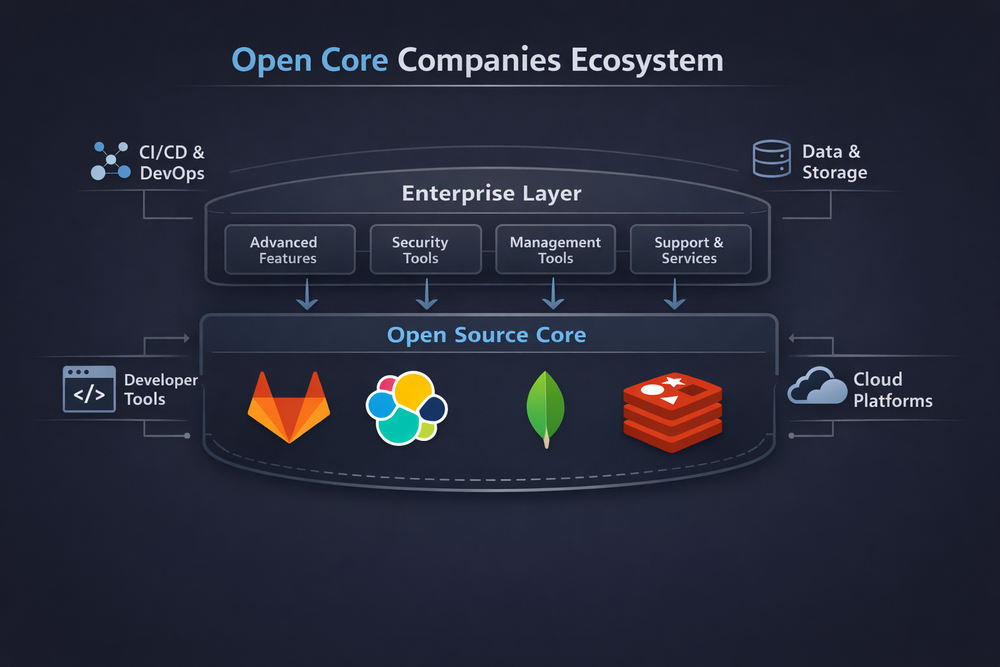
The Open Core model began to appear in the mid-2000s and spread rapidly after the 2010s alongside the growth of DevOps and cloud infrastructure. This was a period of major transformation in the software industry. Internet services expanded explosively, and data infrastructure and development platforms became increasingly important. At the same time, a developer-first product strategy emerged—developers would adopt a product first, and enterprises would follow. In this environment, open source projects could naturally expand their user base and generate revenue by offering additional features to enterprise customers. The Open Core model was a new form of open source business structure that emerged within this shift.
How the Open Core Model Actually Makes Money
The essence of the Open Core model is not simply dividing free and paid features, but strategically deciding which features remain free and which become paid. This decision is not just a matter of product design—it is directly tied to a company’s business model. Most Open Core companies adopt a strategy where the core functionality used directly by developers remains open source, while management and security features required in enterprise environments are offered as commercial products. This allows developers to freely use the software, while enterprises pay for additional capabilities when needed.
For example, many Open Core products provide basic data storage, APIs, and core engines as open source. Developers can build services using only these features, and individuals or startups can use them freely. However, enterprise environments are different. Large-scale systems require authentication systems, audit logs, security policy management, and monitoring capabilities. These features are typically offered as paid components in Open Core products. In other words, the core technology is accessible to everyone, but operational tools necessary for production environments are packaged as commercial offerings for enterprise customers.
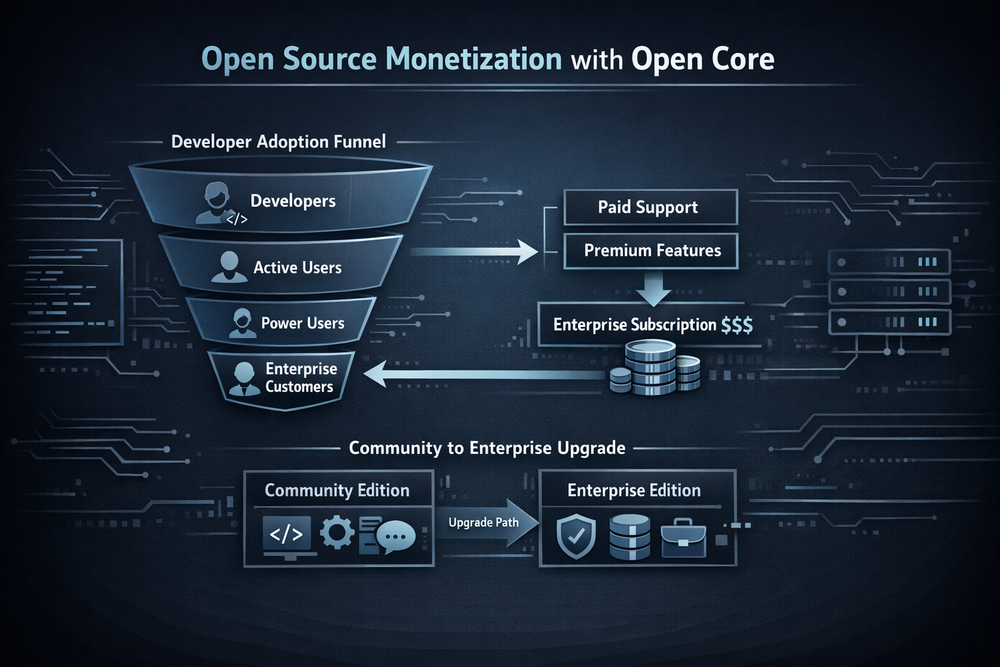
This model is often combined with a developer-driven adoption strategy. Many Open Core companies focus first on expanding their product within developer communities. As developers use the open source version, they naturally become familiar with the product. Later, when more advanced capabilities are required in enterprise settings, the paid version is adopted. This strategy is often referred to as Product-Led Growth, and it has become a key growth model in the modern software industry. The open source version acts as an entry point, while enterprise features form the revenue stream.
The Open Core model also aligns well with SaaS environments. Many companies now prefer using software as cloud-based services rather than installing it themselves. In such cases, the open source version continues to be used within developer communities, while enterprise customers adopt managed cloud services or enterprise-grade features. Ultimately, the Open Core model evolves beyond a simple product structure into a strategic framework that connects developer ecosystems with enterprise markets.
Representative Examples of the Open Core Model
The reason the Open Core model became significant in practice—not just theory—is the emergence of multiple successful companies using this approach. Especially after the 2010s, many developer tools and data infrastructure companies grew based on this model. These companies expanded their user base through open source communities and generated revenue by offering additional features to enterprise customers. The Open Core model began to establish itself as a standard growth strategy for open source startups.
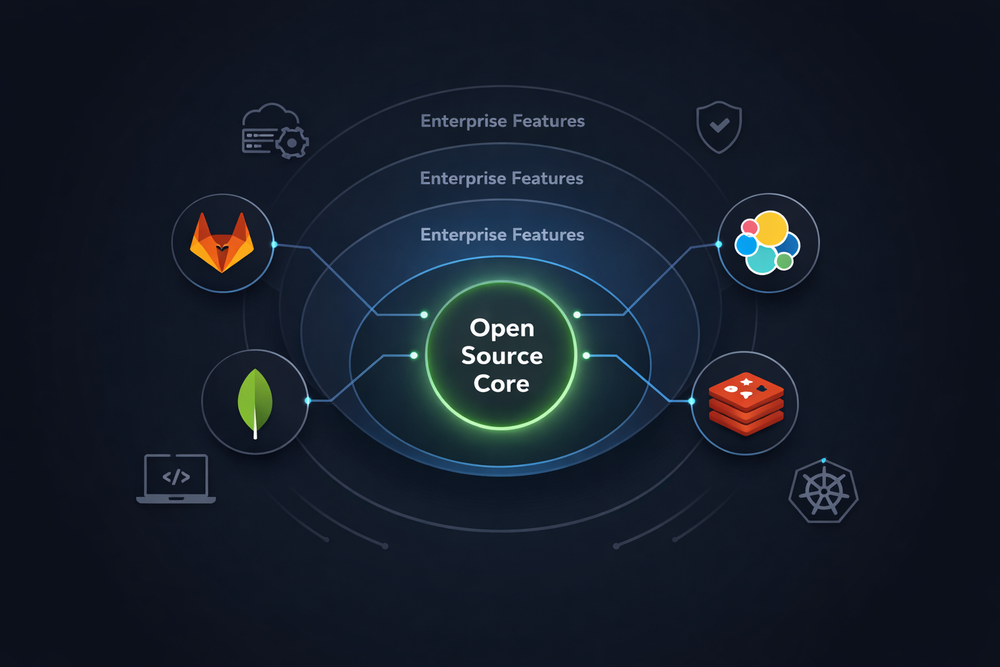
One of the most representative examples is GitLab. GitLab started as an open source Git repository management platform. It served a similar role to GitHub, but structured its product into three clear tiers. The Community Edition is fully open source and available to anyone. However, enterprise environments require additional capabilities, such as DevOps analytics, security scanning, and advanced project management features. These are included in paid tiers such as Premium and Ultimate. This structure allowed GitLab to maintain its open source community while building a stable enterprise revenue model.
Elastic is another frequently cited example of the Open Core model. Elasticsearch began as a powerful open source engine for search and log analysis. Many companies built data platforms on top of this technology, and Elastic expanded its product offerings around it. However, large-scale enterprise environments required features such as security, cluster management, and monitoring. Elastic provided these as commercial products and cloud services, effectively leveraging the Open Core model. This strategy enabled Elastic to grow rapidly and establish itself as a key player in the data infrastructure market.
Data infrastructure companies such as MongoDB and Redis Labs followed similar strategies. These companies released their core database engines as open source to build developer communities, while generating revenue through management tools and cloud services for enterprise customers. These examples show that the Open Core model is not merely a compromise, but a practical structure that enables open source companies to grow. It does not completely erase the boundary between open source and commercial software, but it creates a new economic model where both can coexist and function together.
Tension Created by the Open Core Model — Between Community and Enterprise
The Open Core model emerged as a practical way for open source projects to generate sustainable revenue, but at the same time, it introduced new tensions. This tension is less a technical issue and more of a philosophical one. Open source originally evolved around the free sharing of code and collaborative development. Developers publish code, and others use or modify it to collectively improve software. This collaborative structure has long been a core value of the open source ecosystem. However, in the Open Core model, some features of a project are no longer openly available. Features intended for enterprise customers are provided under commercial licenses.
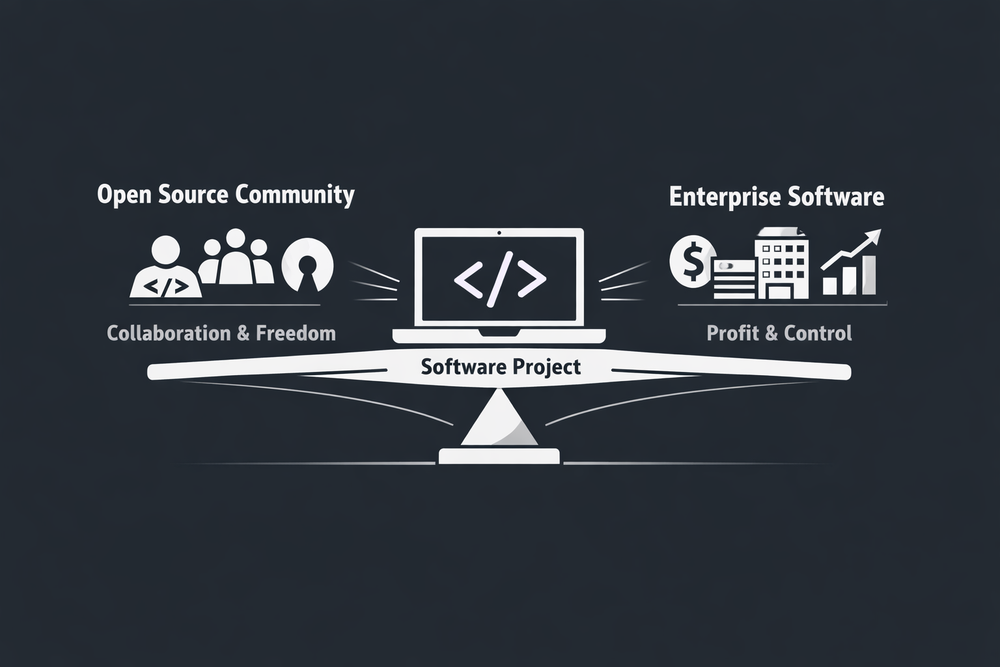
At this point, a subtle tension begins to arise within the community. From the community’s perspective, the project may appear to be gradually shifting toward a more enterprise-centric direction. In some cases, projects that started as fully open source move more and more features into paid versions over time. Developers sometimes criticize this shift as “fauxpen source”—something that looks like open source on the surface but is closer to commercial software in reality. Of course, not all Open Core projects face this criticism. However, when the balance between community and enterprise breaks down, such debates tend to emerge easily.
From a company’s perspective, maintaining this balance is far from easy. If too many features remain open source, it becomes difficult to generate revenue. On the other hand, if too many features are moved into paid products, the community may weaken. A weakened community slows down innovation. One of the reasons open source projects have been able to evolve rapidly is the contributions of countless developers. Therefore, companies using the Open Core model must constantly balance two goals: maintaining the trust of the developer community while generating revenue from enterprise customers.
When this balance is maintained, the Open Core model becomes a highly powerful strategy. The community continues to drive innovation, while the company secures stable revenue. But when the balance collapses, the project may experience conflict between the community and the company. In this sense, such tension can be seen as an inherent characteristic of the Open Core model. Because open source and commercial software coexist within a single project, a subtle tension between the two is almost inevitable.
A New Software Industry Structure Shaped by the Open Core Model
The Open Core model is more than just a revenue strategy—it has reshaped the structure of the software industry itself. In the past, the software industry typically operated on a model where companies sold products and customers purchased licenses. However, in open source-based companies, the situation is different. The product is already publicly available, and anyone can use it. As a result, companies must first build a developer community in order to grow. This structure requires a fundamentally different growth strategy compared to traditional software companies.
One of the key concepts that emerged in this process is the developer-first product strategy. Many Open Core companies chose to distribute their products to developers first, allowing the ecosystem to expand organically as developers adopt and use them. Developers use the open source version when starting new projects, and as those projects grow, enterprise features are introduced when needed. This approach is fundamentally different from traditional sales-driven software companies. The product spreads first, and enterprise customers follow later.
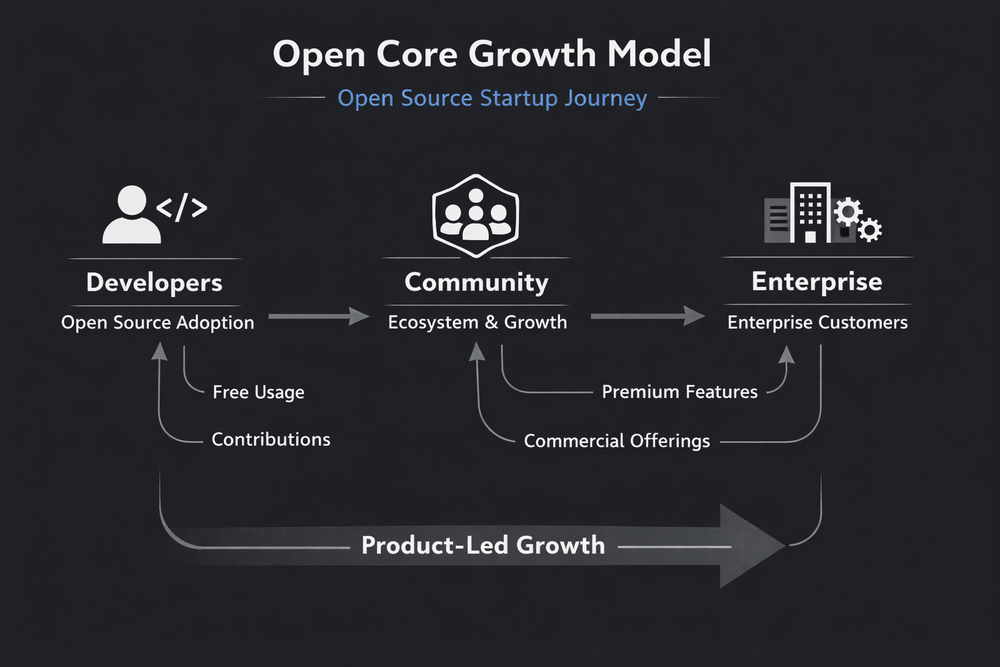
This strategy is also closely tied to startup investment dynamics. Many venture investors recognized that open source projects could rapidly build a user base. Open source can spread quickly through developer communities without requiring large marketing budgets. Later, companies can generate revenue by offering enterprise features or cloud services to business customers. This structure became especially prominent in areas such as data infrastructure, DevOps tools, and development platforms. Companies like GitLab, Elastic, and MongoDB grew based on this model.
These changes also affected the power structure of the software industry. In the past, large software corporations dominated the market. However, open source-based companies could grow around communities and ecosystems. Developers were no longer just customers purchasing products from a company—they became users and contributors to the project itself. This structure accelerated the pace of technological innovation and gave rise to new types of software companies. Ultimately, the Open Core model can be seen as a new industrial structure formed through the convergence of open source and startup economics.
But the Bigger Problem Emerged in the Cloud
The Open Core model provided an important breakthrough for open source companies. Many companies grew based on this model, and some even became large-scale enterprises. However, the transformation of the software industry did not stop there. From the mid-2010s onward, another major shift emerged: the rise of cloud computing. Platforms such as AWS, Google Cloud, and Microsoft Azure began to change the way software itself was delivered.
In a cloud environment, users no longer need to install software themselves. Instead, they can use products directly as services. This structure is extremely convenient for users. There is no need to manage servers or go through installation processes. With just a few clicks, users can access databases or search engines. The problem is that this shift began to destabilize the revenue structures of open source companies.
Consider a company that develops an open source database. This company generates revenue by selling enterprise features through an Open Core model. However, a cloud provider may start offering a managed service based on that same open source project. Users no longer install the software themselves—they simply use the managed service provided by AWS or another cloud platform. While the user experience improves, the company that originally developed the open source project does not capture that revenue.
This issue has increasingly been recognized as a major threat to open source companies. The company that develops the technology is not necessarily the one that profits from it—cloud providers can take that technology and monetize it as a service. This tension has led to new debates around open source licensing and business models. The decisions by companies like MongoDB and Elastic to change their licenses are deeply connected to this issue.
Ultimately, while the Open Core model became an important revenue strategy for open source companies, it could not solve every problem. With the arrival of the cloud era, open source companies faced a new set of challenges. And this collision would lead to one of the most well-known controversies in the history of open source.
In the next article, we will explore this very case:
Elastic vs AWS — Why Open Source Companies Fear the Cloud.
This story is not simply about competition between companies, but about how the economic structure of open source itself is evolving.