
How Can Open Source Be Free and Still Build a Company
Today, open source has become a natural part of the software industry. Most developers use dozens of open source libraries every day. When building web servers, they use Linux; in container environments, Kubernetes; and for databases, PostgreSQL or MySQL. Programming languages and frameworks are also largely open source. It is hardly an exaggeration to say that a significant portion of the software industry runs on top of open source.
But if you think about it for a moment, a strange question arises. If so many people are using this software, it seems natural that there should be a massive economic structure behind it. Yet reality is the opposite. Most open source projects do not make money. Many are maintained through the hobbies or passion of individual developers, and it is not uncommon for even widely used libraries—depended on by services around the world—to have only a single maintainer. GitHub hosts millions of projects, but only a very small fraction of them have a stable revenue model.
Because of this, a common perception has emerged around open source: it is technically successful but economically fragile. Many developers contribute code, but that does not necessarily translate into a sustainable business. Even large corporations actively use open source while providing little direct financial return to the ecosystem. This structure has long been pointed out as a fundamental problem within the open source world.
Yet within this environment, one company took a completely different path: Red Hat. Red Hat is not just a successful open source company—it is widely regarded as the most successful business case in the entire history of open source. In 2019, IBM acquired Red Hat for approximately $34 billion, the largest acquisition of an open source company in the history of the software industry. What is even more interesting is that Red Hat’s core products were entirely based on open source.
This naturally leads to a key question. If most open source projects cannot generate revenue, how did Red Hat become such a massive company? How was it able to build a multi-billion-dollar business on software that anyone could use for free? To understand this, we need to first look at the Linux ecosystem before Red Hat emerged. That world looked quite different from the Linux ecosystem we know today.
The Linux Ecosystem in the 1990s — Technology Existed, But There Was No Product
In the mid-1990s, Linux was already spreading rapidly among developers. The Linux kernel, started in 1991 by Linus Torvalds as a personal project, grew through collaboration with developers around the world via the internet. Combined with the compilers and utilities provided by the GNU project, Linux began to evolve into a complete operating system environment. From a technical perspective, Linux was a powerful system. Its stable architecture, rooted in Unix philosophy, made it especially appealing to many developers.
However, the Linux of that time was quite different from the operating systems we know today. Above all, it was not easy to use. Installation was complex, and hardware compatibility issues were common. Package management systems were not as sophisticated as they are now, so installing and managing software required significant trial and error. Documentation was limited, and there were few ways to receive official technical support when problems occurred.
For individual developers, this environment was not a major issue. In fact, many valued Linux for its openness and flexibility. But in enterprise environments, the situation was entirely different. Servers operated by companies require a level of stability far beyond that of personal experimentation environments. When a system fails, it can bring down entire services, leading directly to financial losses. As a result, companies approach new technologies with extreme caution.
At that time, the dominant operating systems in the enterprise market were mostly commercial products. Unix-based systems such as Solaris from Sun Microsystems, AIX from IBM, and HP-UX from Hewlett-Packard were widely used. Microsoft was also expanding into the enterprise market with Windows NT-based server systems. These systems were expensive, but they provided what enterprises needed: stable updates, official technical support, long-term maintenance, and certification for hardware and software.
In other words, Linux at the time was technically excellent but not yet a product that enterprises could readily adopt. It was an attractive platform for developers, but from a corporate perspective, it was still difficult to trust. This gap is critically important. The technology already existed, but no one had yet turned it into something usable in the enterprise market. And it was precisely at this point that Red Hat entered the scene.
Red Hat’s Insight — Companies Don’t Pay for Code
Bob Young, one of Red Hat’s founders, viewed open source software differently from most people. While many developers saw Linux as a technical project, he focused on the economic structure that could emerge from it. The Linux kernel was already evolving rapidly through global collaboration. The real problem was not the technology itself, but how to transform it into something usable in the market.
The key insight Bob Young discovered was surprisingly simple. Companies do not pay for software itself—they pay for the stability and accountability that the software provides. In enterprise environments, what matters is not ownership of the code, but whether the system runs reliably and whether there is a support structure to resolve issues when they arise. This is exactly why commercial operating systems succeeded in the enterprise market despite their high cost.
From this perspective, Linux takes on a completely different meaning. It was already a powerful and rapidly evolving technology, driven by the community. However, it lacked the structure needed for enterprise use—stable update systems, long-term support, and reliable technical assistance. If someone could solve these problems, Linux could become competitive in the enterprise market.
Red Hat set out to solve exactly this. They did not try to create a new operating system. Instead, they took the existing Linux kernel and open source software and assembled them into a stable distribution. But they did not stop at packaging. They ensured stability through rigorous testing, established long-term update policies, and began providing technical support services for enterprise customers.
This approach was a highly innovative business model at the time. Most software companies sold the product itself. You had to purchase a license to use the software, and updates or support came afterward. Red Hat chose a completely different path. Linux itself remained free and open source, but the stable operating environment and support system that enterprises needed were offered as paid services.
This model can be summarized in a single sentence:
Software can be free, but trust is not.
This simple insight became the foundation of open source business models for decades to come. And based on this insight, Red Hat began transforming Linux from a developer tool into an enterprise platform. In the next section, we will explore how this strategy was implemented in practice and how Red Hat Enterprise Linux came into existence.
Red Hat Enterprise Linux — Turning Open Source into an Enterprise Product
As discussed earlier, the core problem Red Hat identified was not the technology itself, but productization. Linux was already an excellent operating system, but it was not in a form that enterprises could readily use. A system driven by a developer community evolved rapidly, package versions changed frequently, and there was no consistent standard for stability verification. This flexibility was an advantage for individual developers, but in enterprise environments, it could become a risk. It was precisely at this point that Red Hat began transforming Linux from a simple community project into an enterprise-grade product.
What Red Hat did was not to create an entirely new operating system. Instead, they took the Linux kernel and various open source software components and assembled them into a unified system, building on top of it the stability and support structure required in enterprise environments. They stabilized package versions and managed them for long-term maintenance, while also introducing a systematic approach to delivering security updates. In addition, they collaborated with hardware vendors to create certification programs ensuring stable operation on specific server equipment. This process was not merely technical work—it closely resembled full-scale product development.
In 2002, Red Hat made a critical strategic decision. They discontinued the existing Red Hat Linux distribution and launched a new product specifically for the enterprise market: Red Hat Enterprise Linux (RHEL). This product was built on a fundamentally different philosophy from developer-oriented distributions. Rather than rapidly introducing new features, the goal was to maintain thoroughly tested and stable software. Through RHEL, enterprise customers could receive long-term updates and technical support, enabling them to use the operating system as a reliable infrastructure component.
The core value of RHEL was not simply providing Linux, but delivering an operable system. It was a complete service that included update policies, security patch management, long-term maintenance, and a structured support organization. This elevated Linux from a developer tool to the foundation of enterprise infrastructure. In effect, Red Hat reassembled open source projects into a cohesive enterprise operating system platform. This platform would go on to power countless data centers and server environments.
The Paradox of GPL — Freely Replicable, Yet Profitable
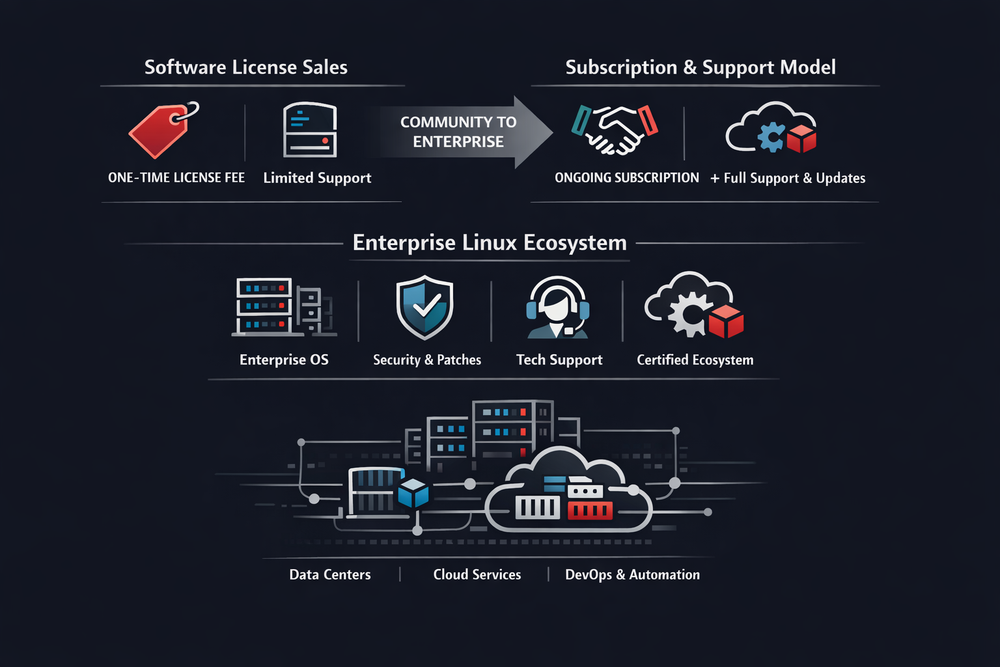
To understand Red Hat’s business model, it is essential to understand open source licensing—especially the GPL (GNU General Public License). GPL is a highly influential open source license. It allows software to be freely used, modified, and redistributed, but imposes one critical condition: if the software is distributed, the source code must also be made available. This requirement both guarantees the freedom of open source and limits exclusive corporate control.
Because Red Hat Enterprise Linux was built on GPL-licensed software, Red Hat was required to release its source code. This created a fascinating situation. In theory, anyone could take the RHEL source code and rebuild the same operating system. In other words, Red Hat’s core product was legally a fully replicable piece of software. For a typical software company, such a condition would undermine the entire business model.
In fact, this structure led to the emergence of projects like CentOS. CentOS was a Linux distribution rebuilt from the publicly available RHEL source code, with Red Hat trademarks removed. Technically, it was almost identical to RHEL, but it did not include Red Hat’s official technical support or certification programs. As a result, users could run an operating system nearly identical to RHEL for free—an outcome made possible by open source licensing.
Despite this, many enterprises still chose to pay Red Hat. The reason is straightforward. In enterprise environments, the operating system itself is less important than the support and accountability surrounding it. Companies need official support to resolve system failures, rapid security patches when vulnerabilities are discovered, and a stable platform maintained over the long term. While CentOS was technically excellent, it did not provide this support structure. As a result, many enterprise customers chose Red Hat’s services over free alternatives.
This created a highly distinctive economic model. The product itself is freely replicable, but the value enterprises need—stability, support, and accountability—remains paid. In other words, Red Hat did not generate revenue through exclusive control of software, but through service and trust. This structure later became a reference model for many other open source companies.
Red Hat’s Real Business — The “Subscription” Model
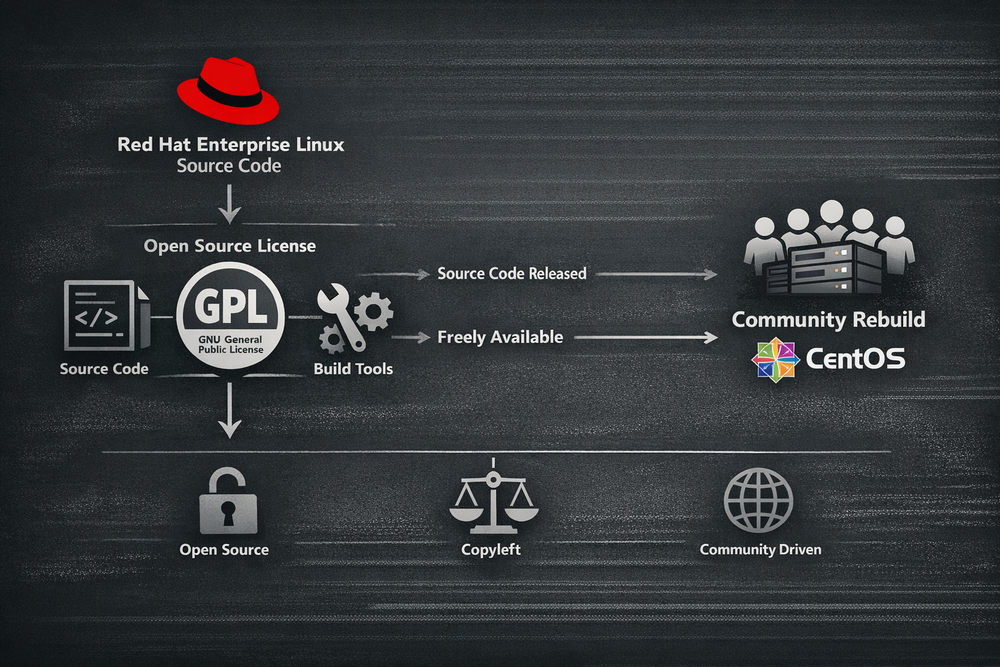
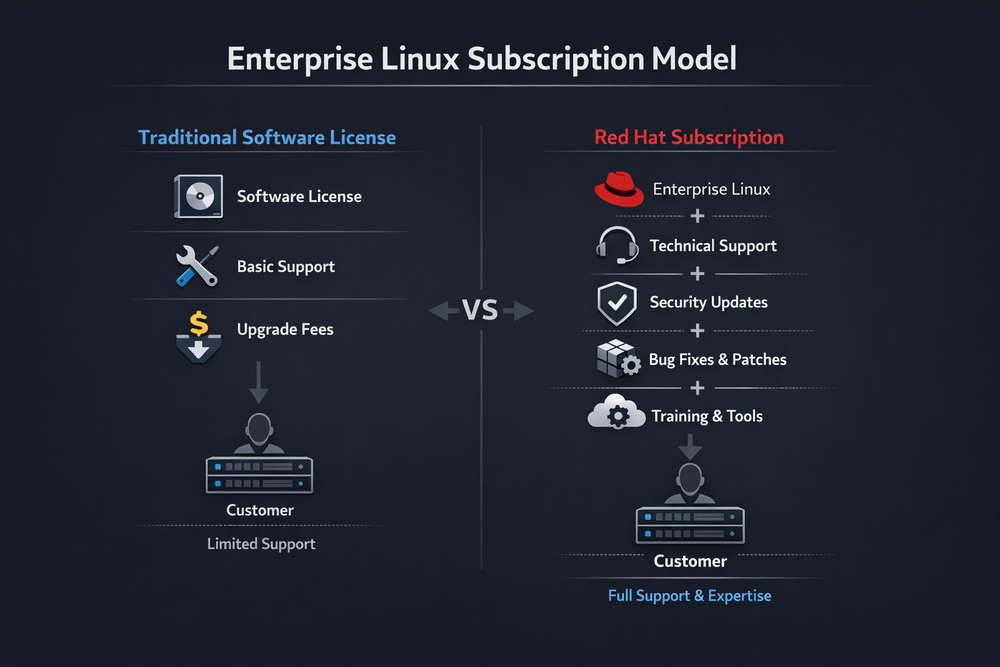
If you think of Red Hat’s business model simply as selling Linux distributions, you miss the essence. What Red Hat actually sold was not the operating system itself, but a subscription-based service. Instead of purchasing a software license, customers paid to subscribe to Red Hat’s support and update services over a defined period. This model was relatively novel at the time, but it closely resembles the subscription-based structures that would later define the SaaS era.
Red Hat’s subscription service included multiple components. Enterprise customers received continuous updates and security patches for the operating system, along with technical support from Red Hat engineers when system issues arose. They also benefited from certification programs verifying compatibility with specific hardware and software. These elements are critically important in enterprise environments. Server infrastructure is not software that is simply installed and forgotten—it requires continuous management and maintenance.
Another advantage of the subscription model was that it provided Red Hat with a stable and recurring revenue stream. In traditional software sales, revenue is typically generated once when a license is purchased, making it difficult to create sustained income afterward. In contrast, the subscription model generates predictable annual revenue as long as customers continue using the service. This not only stabilizes the company’s financial structure but also helps maintain long-term relationships with customers.
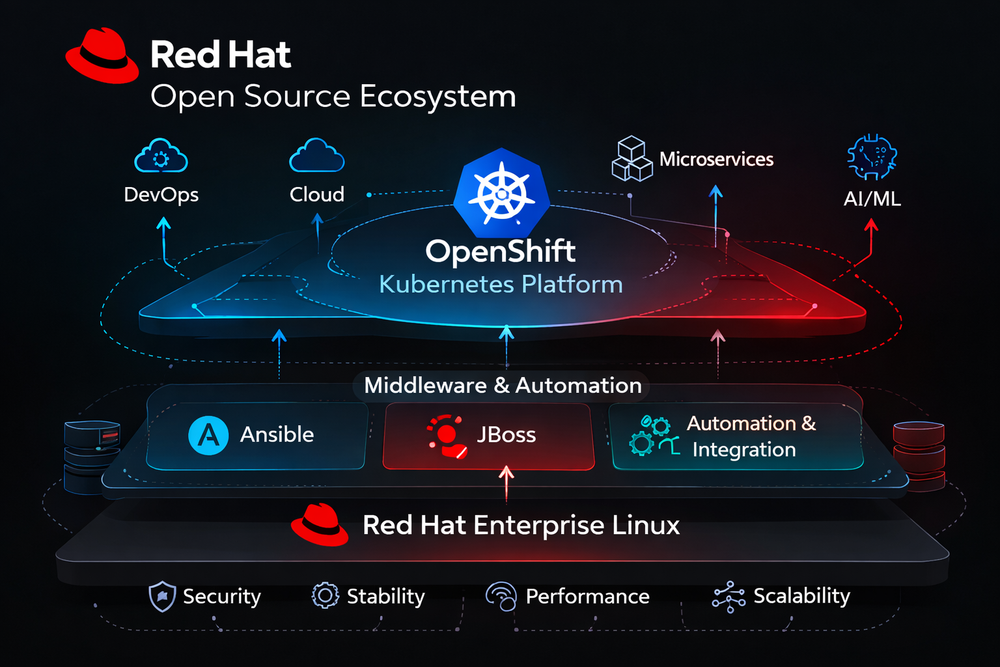
Thanks to this structure, Red Hat was able to grow from a Linux distribution company into an enterprise infrastructure platform provider. The subscription-based operating system service built trust with enterprise customers and created a foundation that allowed Red Hat to expand into new products. In fact, Red Hat later extended its platform strategy with open source-based products such as Ansible, OpenShift, and Ceph. This expansion transformed Red Hat from a simple operating system vendor into a central player in the enterprise open source ecosystem.
In the next section, we will examine how Red Hat expanded beyond being just a Linux company and evolved into a full-fledged open source platform provider. In this process, Red Hat built a unique ecosystem that connects open source communities with the enterprise market, going beyond a simple product sales strategy.
Red Hat’s Expansion Strategy — Evolving into an Open Source Platform Company
As discussed earlier, Red Hat was not simply a company that sold Linux distributions. After establishing a stable subscription model centered around RHEL, Red Hat naturally faced the next question: could the software ecosystem running on top of the operating system also be expanded based on open source? Enterprise infrastructure is not completed by an operating system alone. A data center environment is formed by combining multiple components such as application servers, automation tools, storage systems, and container platforms. Red Hat began expanding its business into exactly these areas.
A key point in this strategy is that Red Hat did not build most of these technologies from scratch. Instead, it actively leveraged open source projects that were already evolving within the community. Some projects were acquired directly, while others were developed into enterprise platforms through collaboration with their communities. This strategy brought two advantages at once. First, it allowed Red Hat to build products quickly based on already proven technologies. Second, it enabled the company to expand the technological ecosystem while maintaining strong relationships with open source communities.
One representative example is JBoss. JBoss began as an open source Java application server and was already widely used in enterprise environments. In 2006, Red Hat entered the enterprise Java platform market by acquiring JBoss. After the acquisition, JBoss became a core component of Red Hat’s middleware product line, and many enterprise systems began running on this platform. This marked a turning point where Red Hat expanded beyond being just an operating system company to becoming a provider of enterprise application platforms.
Another important example is Ansible. Ansible is an open source tool for server automation and configuration management, enabling complex infrastructure environments to be managed as code. Red Hat entered the automation platform market in earnest by acquiring Ansible in 2015. As enterprise infrastructure grew increasingly complex, the importance of tools capable of automatically managing hundreds or thousands of servers became more significant. Through Ansible, Red Hat moved beyond simply providing an operating system to offering a platform that automates the entire infrastructure lifecycle.
At the peak of this expansion is OpenShift. OpenShift is a Kubernetes-based container platform that enables enterprises to develop and deploy applications in cloud environments. With the rise of container technology, application infrastructure was shifting toward a new paradigm, and Red Hat actively embraced this change. While OpenShift is built on the open source technology Kubernetes, it evolved into a platform that provides enterprise-grade stability and management capabilities. Ultimately, Red Hat built a comprehensive enterprise open source ecosystem that spans operating systems, automation, middleware, and container platforms.
Why IBM Acquired Red Hat for $34 Billion
When IBM announced in 2019 that it would acquire Red Hat for approximately $34 billion, many were surprised by the scale of the deal. It was not only the largest acquisition in IBM’s history but also one of the largest in the entire software industry. What made it particularly interesting was that Red Hat was not a traditional software company with proprietary technology. Its core products were largely based on open source, meaning that, in theory, anyone could use the same technologies.
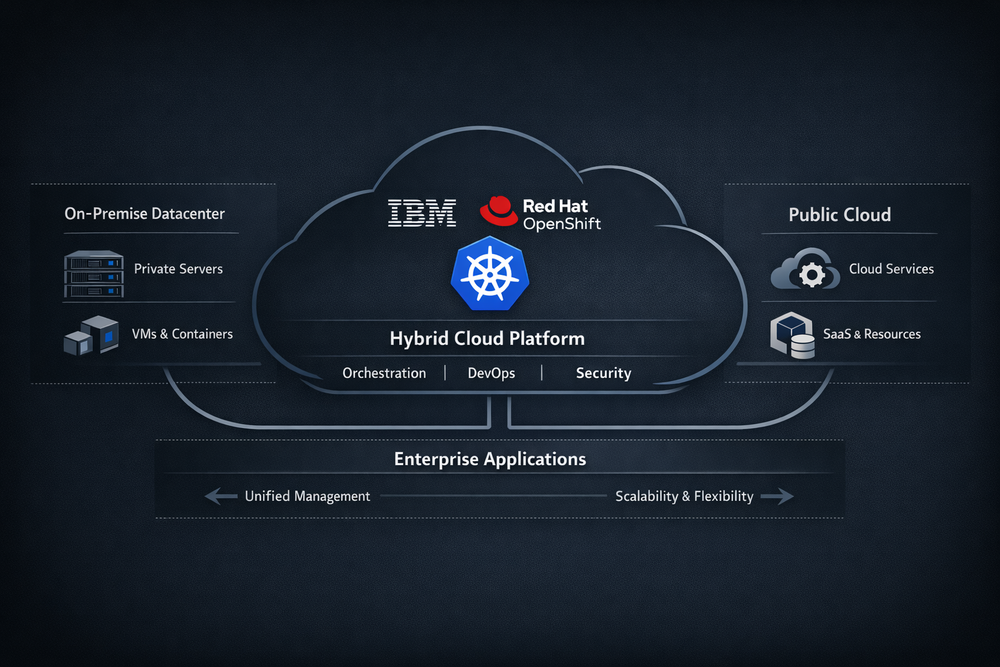
Despite this, IBM’s motivation for acquiring Red Hat was clear. At the time, the cloud market was already dominated by Amazon Web Services and Microsoft Azure, and IBM was falling behind in this competition. As enterprise customers increasingly adopted hybrid cloud strategies—using both on-premises data centers and public cloud services—the importance of platforms capable of managing such environments grew significantly. IBM saw that Red Hat’s technology could play a crucial role in this space.
Red Hat’s most valuable asset was not just software, but its platform ecosystem. Linux had already become the foundational operating system for most cloud infrastructures, and Kubernetes had effectively become the standard for container orchestration. OpenShift, in turn, was a platform that integrated these technologies for enterprise use. From IBM’s perspective, acquiring Red Hat was not simply about buying a Linux company—it was about securing core infrastructure technologies for the cloud era.
Additionally, Red Hat had built strong trust relationships with enterprise customers. Many companies were already running their data centers on RHEL, and Red Hat’s support services played a critical role in operating enterprise infrastructure. IBM was able to strengthen its cloud strategy by leveraging this customer base. Ultimately, the acquisition of Red Hat was not just a corporate merger but a strategic move in the competition for cloud-era infrastructure.
From IBM’s perspective, Red Hat represented the operating system of future data centers. As a company traditionally centered on hardware, IBM needed a strong open source ecosystem to transition into a software- and platform-focused company. Red Hat was uniquely positioned to fulfill that role. This acquisition symbolically demonstrated that open source technology is not merely a developer tool, but a core infrastructure of the global IT industry.
What the Red Hat Model Left Behind in the Open Source Economy
The success of Red Hat is not just the story of a single company’s growth. It is a critical example of how open source can evolve into a sustainable business model. For a long time, open source was associated with the idea of “free software,” but Red Hat reinterpreted this concept in a fundamentally different way. It demonstrated that while the software itself can be free, the services and platforms required to operate it reliably can carry significant economic value.
The core of this model lies in not relying on exclusive ownership of software. Most software companies generate revenue by controlling technology and selling licenses. However, Red Hat built a massive business while operating under open source licenses such as GPL. This shows that economic value can be created not through control of technology, but through ecosystem building and trust.
Furthermore, the Red Hat model redefined the relationship between open source communities and the enterprise market. Communities became the source of technological innovation, while Red Hat took on the role of transforming those technologies into stable enterprise platforms. This relationship was closer to collaboration than competition. Community projects gained broader adoption in enterprise environments through Red Hat, while enterprise customers gained access to stable open source technologies.
At the same time, the Red Hat model cannot be applied universally to all open source projects. RHEL was based on an operating system—a core infrastructure technology where stability is critically important in enterprise environments. Because of these conditions, support and maintenance services could hold strong economic value. Many open source projects do not share these characteristics, making it difficult to directly apply the Red Hat model in the same way.
This leads to another important question. If the Red Hat model cannot be applied to all open source projects, how do other open source companies generate revenue? In practice, many have adopted a different strategy—separating free and paid features. This is known as the Open Core model. In the next article, we will explore how this strategy emerged and why many open source companies have chosen to adopt it.