
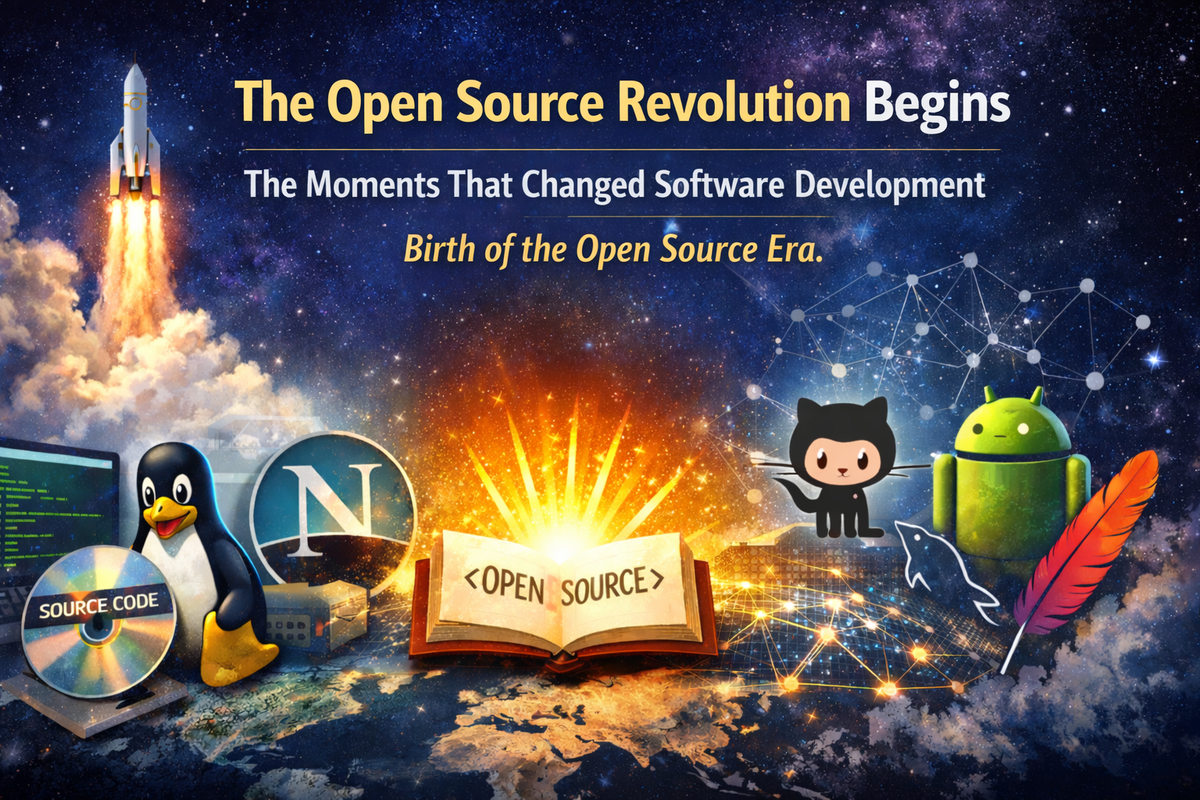
The Starting Point of What We Take for Granted
To build software today is, in practice, to use open source. From operating systems to web servers, databases, programming language runtimes, and even the development tools and libraries we rely on, most of what we use runs on publicly available code. Developers no longer build everything from scratch. Instead, they stack their own code on top of countless existing open source projects and, when necessary, contribute back to that ecosystem. Because this flow has become so natural, it can feel as if the software world has always worked this way.
But if we look just a little further into the past, it becomes clear that all of this is actually a very recent change. There was a time when software was built within strictly closed environments. Companies treated code as an asset, and making it public was almost unthinkable. Development was carried out under tight internal control, and there was a clear boundary between users and developers. Those who could access the code and those who could not were distinctly separated, and software was less a result of collaboration and more a finished product to be delivered.

How did that world transform into what we see today? The answer cannot be explained by a single technology or a single individual. Rather, it is the result of multiple events influencing one another and gradually accumulating over time. And at the beginning of that transformation were a few choices and experiments that, in retrospect, seem surprisingly simple.
From a Personal Hobby to Global Infrastructure
The first story of this season begins with Linux. As many people know, Linux did not start as a project backed by a large corporation. It was an operating system kernel project initiated by a university student out of personal curiosity. At the time, it lacked completeness, had no commercial intent, and was simply driven by the desire to build a better system.
However, this project made a choice that differed from conventional software development. The code was made public, and a structure was created where anyone could participate. This decision meant more than simply making the code visible. It meant that anyone could modify it, improve it, and redistribute it. As this process repeated itself, Linux evolved from a personal project into a system built collectively by developers around the world.
The most significant change this created was a shift in the subject of development. Software was no longer the exclusive domain of a specific company or organization. Developers from anywhere in the world could participate, and the results of their contributions were returned to the entire community. This structure grew rapidly, and eventually Linux became the de facto standard operating system in the server market. The fact that a large portion of today’s internet runs on this foundation shows just how fundamental this transformation was.

A New Flow Created by the Decision to Open Code
If Linux represents a transformation that began with a personal project, Netscape’s decision symbolizes a more structural shift. As it began losing competitiveness in the browser wars, Netscape chose to release its browser code to the public. At the time, this was an extremely radical decision. Making core assets public seemed almost like abandoning competitive advantage.
But the outcome unfolded in an unexpected direction. The released code led to the Mozilla project, and from there, the concept of open source began to spread in earnest. This event did not merely transform a single browser project—it changed the very perspective on software. The idea emerged that opening code was not a loss, but a way to build a larger ecosystem.
From this point on, open source evolved from a simple experiment into a movement. Developers were no longer just consumers—they became participants. Software was no longer seen as a finished product, but as something that continuously evolves over time.
The Invisible Foundation Supporting the Internet
This flow extended into web infrastructure. The emergence of the Apache web server is a representative example. In the early internet environment, web servers were essential, but markets dominated by commercial products limited accessibility and scalability. Apache entered this landscape by providing a web server that anyone could use and freely modify.
What makes this project important is not just its technical excellence. Apache served as a foundational technology that accelerated the expansion of the internet. As anyone gained the ability to build web servers, the web expanded beyond the domain of specific companies into an open space accessible to all. Countless web services and platforms that followed grew on top of this foundation.
At the same time, the emergence of MySQL brought another significant change. Databases had long been dominated by expensive commercial products. However, MySQL provided an open source alternative that anyone could use, which was especially meaningful for startups. It enabled services to be built without heavy initial costs, creating an environment where new ideas could be quickly tested and scaled.
The LAMP stack formed during this period was not just a combination of technologies—it became the standard model for building internet services. This marked the point where open source was no longer merely an alternative, but a central force driving the industry.
Open Source Expands Beyond Individuals into Platforms
One of the peaks of this flow is the emergence of Android. As the mobile era began, the importance of platforms grew even greater. Google released Android as open source, creating an ecosystem where countless manufacturers and developers could participate. This was not simply about providing an operating system—it was a strategy to open an entire platform.
As a result, Android spread rapidly and became an operating system used on billions of devices worldwide. In this process, open source moved beyond the domain of servers and developer communities and began to affect everyday users. It became embedded in the daily lives of individuals through smartphones.
At this point, we can clearly see a pattern. Open source is no longer just a development methodology—it has become the fundamental structure of the software ecosystem. What began as an experiment in a personal project expanded into corporate strategy and ultimately became a core element driving global platforms.
What All of This Change Means
The five events covered in this season may appear to be independent stories, but they are in fact connected as part of a single flow. It is the process of code created by individuals being opened, companies participating in that flow, infrastructure being rebuilt on open source, and eventually expanding into platforms. At the center of all these changes lies a common question: Who does software belong to?
In the past, the answer to this question was clear. Software belonged to the company that created it. But with the rise of open source, that answer began to change. Software is no longer seen as something owned by a specific entity, but as a shared asset created and used together. Of course, new challenges have emerged along the way. Maintenance responsibility, licensing issues, and security concerns remain unresolved problems. Nevertheless, the transformation brought by open source has moved in a direction that cannot be reversed.
Most of the technologies we use today exist on top of this flow. And at its origin were a few choices and events that once seemed small. This season follows those moments, tracing how the world of development we know today came to be.