

How the Web Began — An Era When No One Prepared the Infrastructure
When the web first appeared, it looked nothing like the massive platform we know today. In 1991, the World Wide Web proposed by Tim Berners-Lee was closer to a system for researchers to share documents. The internet already existed at the time, but it was structured around functions like email and file transfer, not designed as a space for people to explore and consume information. The web was an experimental interface layered on top of that network, and no one anticipated that it would eventually become the core platform connecting the entire world.
The early web was extremely simple. HTML had very limited expressive power compared to today, and the HTTP protocol was also minimal, handling only requests and responses without complex state management or security features. Web browsers were not the rich interfaces we see now, but closer to simple, text-based viewers. However, this simplicity became the foundation for the web’s rapid expansion. Anyone could easily create pages, and anyone could access them. The problem was that there was absolutely no infrastructure prepared to handle the speed of this expansion.
The concept of a web server was also just beginning to take shape during this period. One of the earliest servers was the CERN HTTP Server, software operated directly by the team that created the web. However, this server was essentially a research tool, not designed for large-scale traffic or diverse environments. As the web began to grow, its limitations became increasingly apparent. It lacked performance, scalability, and maintainability, and above all, it could not keep up with rapidly changing requirements.
As a result, the early web entered a fundamentally contradictory state. Users and content were increasing rapidly, but the infrastructure delivering them remained at an experimental level. This gap continued to widen, naturally raising the need for new web servers. Yet even at this point, no one had succeeded in creating a “standard web server.” The web was already growing, but the foundation to support it had not yet been built.

Early Web Server Competition — A Market Without Standards
As the web continued to expand, various web servers began to emerge. Among them, one of the most significant was NCSA HTTPd. Developed by NCSA in the United States, it was relatively stable and feature-rich for its time. In particular, its simple configuration and compatibility across different environments led many websites to adopt it. At one point, NCSA HTTPd effectively became the de facto standard for web servers.
However, this “standard” was built on a very unstable foundation. NCSA HTTPd was not a project managed by a company or organization with a long-term roadmap. As key developers left the project, development slowed dramatically. New features were rarely added, and even bug fixes were not properly maintained. As the web grew, these problems became increasingly severe. Website operators had to handle more traffic and more complex requirements, but the server could no longer keep up.
A defining characteristic of this period was “competition without standards.” Multiple web servers existed, but none could be fully trusted as a stable foundation. Each had its own strengths and weaknesses, and developers had to choose based on their specific situations. However, this choice was always temporary. There was no guarantee that the server chosen today would still be maintained tomorrow. The web was becoming increasingly important, but its foundation remained unstable.
Eventually, web developers came to accept a reality: they could no longer wait for a “finished product.” Existing servers had either stopped being maintained or stagnated in development, and waiting for someone to build a new one was not realistic. The web was already growing rapidly, and immediate solutions were required to keep up. At this point, developers chose a different path—not simply using existing software as-is, but modifying and improving it themselves.

Why Developers Began Fixing Servers Themselves
As web server development stagnated, developers operating real-world websites had no other choice. Traffic continued to increase, and user demands became more complex, but no official updates or new versions were being released to address these needs. In response, developers made a simple yet decisive choice: they began modifying the server code themselves.
At first, the changes were small—fixing specific bugs or adding simple features. But these modifications grew over time, and servers began to diverge into different forms depending on who was maintaining them. Even though they were based on the same NCSA HTTPd, in practice they often behaved like entirely different servers. This led to another problem: as different patched versions proliferated, sharing knowledge and solving issues became increasingly difficult.
Amid this confusion, a natural shift began to emerge. Developers started sharing their patches with each other. Through mailing lists, they exchanged pieces of code and applied improvements created by others to their own servers. In this process, an important transformation took place. What had once been isolated modifications began evolving into a form of collaboration.
This collaboration was fundamentally different from traditional software development. Instead of a single company or organization managing the entire codebase, multiple developers were loosely connected, improving the code according to their own needs and sharing the results. And it was precisely this structure that eventually led to the Apache project. In other words, Apache was not a product designed from the beginning, but the result of countless patches created to solve real-world problems.
At this point, what mattered was not the technology itself, but the shift in how development was done. Modifying web servers was not merely hacking or a temporary workaround. It was the first step away from a centralized development model toward a distributed, collaborative one. This change did not remain confined to a single project—it went on to influence the entire open-source ecosystem.
The web was no longer an experimental system managed by a few research institutions. It was becoming a living infrastructure, shaped by countless developers who participated directly, shared their work, and collectively advanced it. And at the center of this transformation, one project was gradually taking form. That project was Apache.
The Birth of the Apache Project — A Server Built from “Patches”
The moment developers across different environments began modifying servers and sharing those changes, the transformation had already begun. At first, it was simply about fixing bugs and adding features. But over time, these patches accumulated and started to form a coherent flow. As individually existing modifications came together, the concept of a “shared codebase” gradually emerged. At the center of this movement was a developer community connected through mailing lists.
What is important at this stage is that the project was not formally initiated by a single entity, but rather formed organically out of necessity. It was not a product planned by a specific company with a defined roadmap. Instead, it emerged as developers facing real problems shared their solutions with one another. The project evolved based on the existing NCSA HTTPd, with countless patches layered on top. This is where the commonly referenced phrase “A patchy server” comes from. While it may sound like a joke, it actually describes the essence of Apache with remarkable accuracy.
The early developers of the Apache project were not an organization in the traditional sense. They were spread across different companies and regions, with no predefined roles or hierarchical structure. What connected them was a shared need to solve problems and a willingness to share code. This structure represented an early form of the open-source development model we are familiar with today. Elements such as code reviews, patch sharing, and mailing list–based discussions were already emerging at this stage, later becoming the foundation of countless open-source projects.
Apache, as it was built through this process, was not just another web server. It was a turning point in how software was developed, and at the same time, an alternative to the traditional software development paradigm. For the first time, it became a practical reality that software did not have to be created within a single company, but could instead be built collaboratively by developers around the world. This possibility would later expand to reshape the entire internet infrastructure.

The Structural Strength of Apache — Why This Server Survived
Apache did not succeed by chance. While many web servers that emerged during the same period disappeared, Apache endured and ultimately came to dominate the market. The reason for this difference was clear. Apache was not just about providing features—it was designed with structural scalability and flexibility in mind.
One of its most defining characteristics was its modular architecture. Instead of integrating all functionality into a single codebase, Apache allowed features to be separated into modules that could be added or removed as needed. This design carried significant implications. Web server environments vary widely, as do their requirements. Some environments require authentication features, while others prioritize logging or URL rewriting. Apache did not enforce a single rigid structure but instead allowed users to select the features they needed. This flexibility became a decisive factor in its widespread adoption across diverse environments.
Apache also had strengths in its configuration approach. The ability to modify settings at the directory level through the .htaccess file was particularly innovative. This allowed different behaviors to be applied to specific paths without altering the entire server configuration. This feature was especially advantageous in hosting environments. Developers and operators could apply a wide range of configurations without needing full administrative access, significantly lowering the barrier to entry for web development.
Most importantly, Apache could evolve rapidly through its community-driven model. When issues arose, someone would solve them, and those solutions would be incorporated back into the project. This structure enabled a pace of evolution far beyond that of proprietary software. It was not merely about speed—it represented adaptability to changing environments. The web was evolving rapidly, and Apache was the server best positioned to respond to those changes.
In the end, Apache’s success was not due to any single feature. It was the result of structural flexibility that could accommodate diverse needs, combined with the ability to evolve quickly through community collaboration. These two factors would later become the core conditions for the success of open-source infrastructure, and Apache stands as one of the earliest examples.

The Victory of Open Source Infrastructure — The Internet Built by Communities, Not Companies
As Apache began to be adopted by more and more websites, a significant shift became apparent. The center of web infrastructure was gradually moving from corporations to communities. Previously, choosing software typically meant using products provided by companies—paying for them in exchange for stability and support. Apache fundamentally overturned this model.
Apache was free, but its significance went far beyond cost. Anyone could inspect the code, and if necessary, modify it directly. This meant that control over the software shifted to the user. There was no longer a need to depend on the policies or update schedules of a specific company. Users could add or modify features themselves as needed. This was particularly advantageous in the rapidly evolving web environment.
Furthermore, community-driven maintenance proved to be a far more powerful model than expected. As countless developers used Apache across diverse environments, a natural system emerged where problems were identified and resolved continuously. The accumulated experience and knowledge from this process were fed back into the project, making Apache increasingly stable over time. While this approach differed from traditional corporate support, it ultimately resulted in a support system that was faster and covered a broader range of scenarios.
This transformation was not limited to a single web server. Apache’s success sent a powerful signal—it demonstrated that open source could build infrastructure. Following this, other open-source projects such as Linux, MySQL, and PHP began to spread, and a significant portion of internet infrastructure became community-driven. This trend continues to this day.
Ultimately, Apache was not just a piece of technology, but a turning point. It changed how software was created, distributed, and used. This transformation laid the foundation for countless open-source projects that would follow. The web was no longer the property of a single company, but was becoming a shared infrastructure built by developers around the world.
The LAMP Stack — Why Internet Services Exploded
At the time when Apache was steadily increasing its share of the web server market, another significant transformation was unfolding in parallel. The web was no longer just a medium for delivering pages—it was beginning to evolve into an application platform. Early web systems were limited to serving static HTML documents, but as user demands grew more diverse, increasingly complex functionality became necessary. There was a need to process user input, store data, and generate pages dynamically. In response to this need, a particular combination of technologies emerged: the LAMP stack.
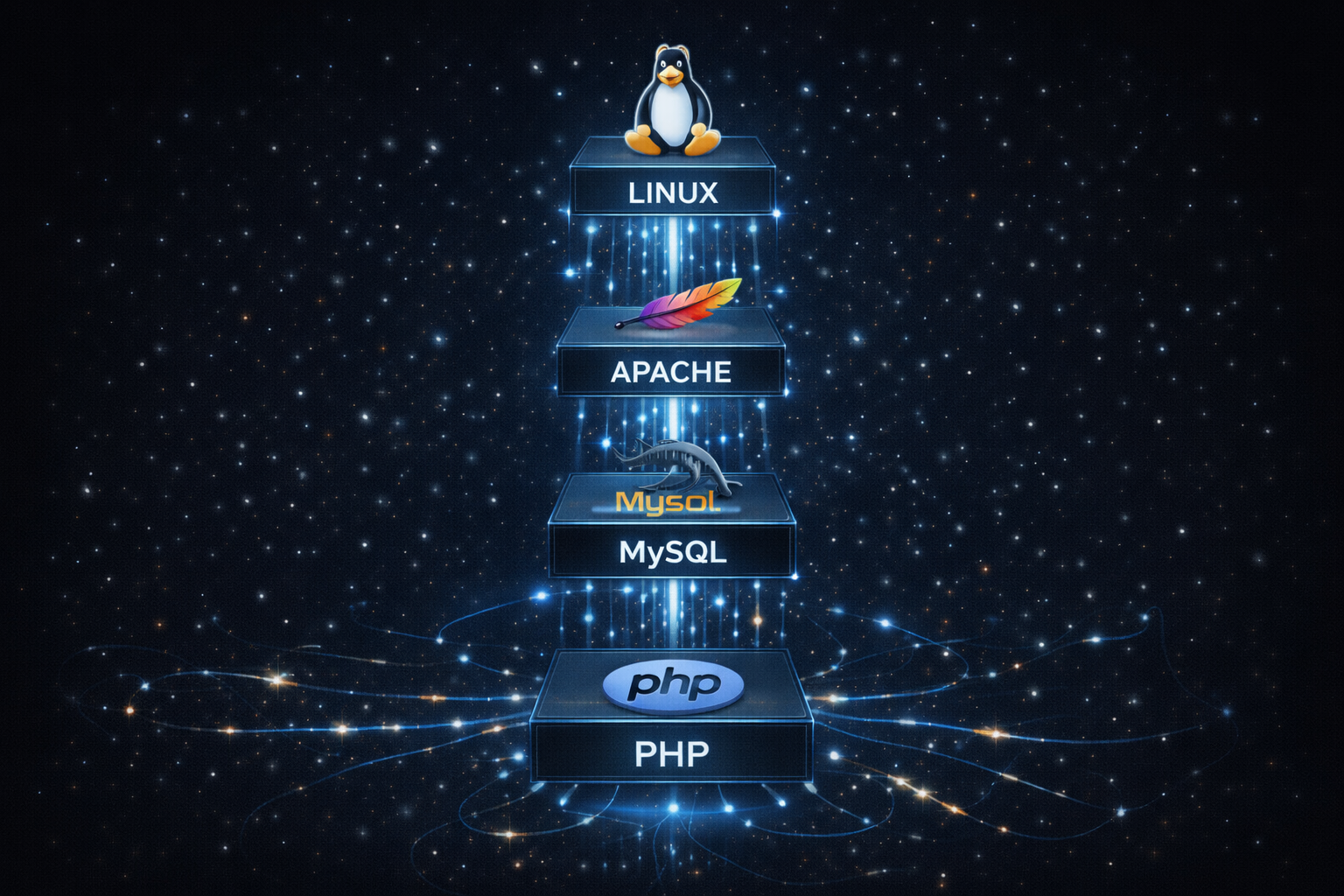
LAMP refers to the combination of Linux, Apache, MySQL, and PHP. Each of these technologies had its own value independently, but together they created a powerful synergy. Linux provided a stable server environment, Apache handled web requests, MySQL managed and stored data, and PHP generated dynamic pages on the server side. The most important characteristic of this combination was not just technical integration, but that it formed a complete web platform built entirely on open source.
This structure dramatically accelerated the spread of the internet. Previously, building a web service required significant cost and specialized infrastructure. With the LAMP stack, however, anyone could start a service at relatively low cost. This opened opportunities not only for individual developers but also for small teams, leading to the emergence of countless web services. Blogs, forums, community sites, and early social networks were all built on top of this structure. At the center of this stack, Apache processed requests and effectively served as the entry point for nearly all web services.
At this stage, the meaning of Apache extended beyond that of a simple web server. It became a core component of the web application ecosystem and the foundation that enabled countless services to exist. The LAMP stack was not the result of a single company’s strategy, but rather the natural combination of community-driven technologies. This combination played a decisive role in enabling the internet to grow to its current scale. At the center of it all, Apache established itself as an invisible infrastructure connecting everything.
The Expansion of the Web Ecosystem — The Structure of the Internet Built by Apache
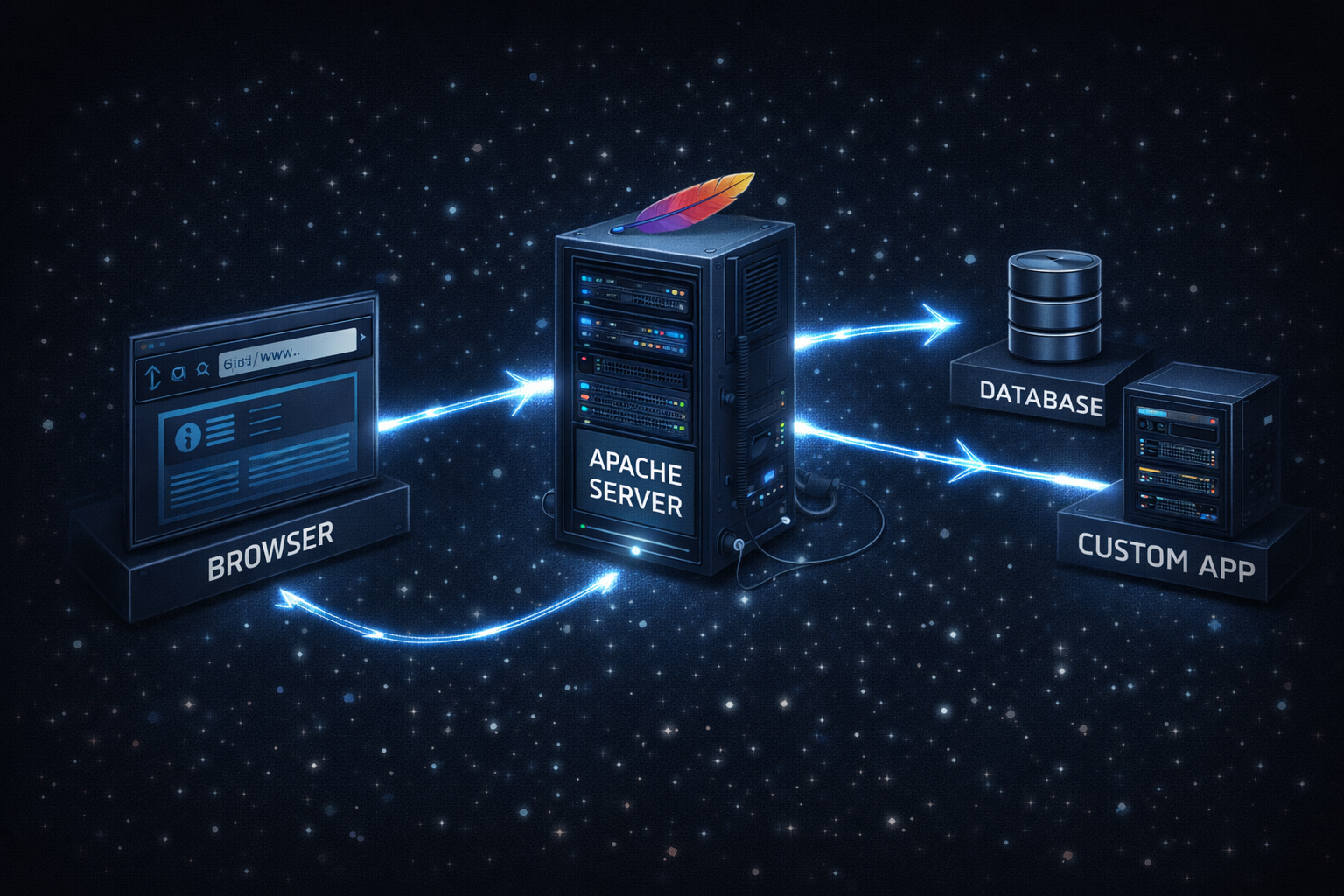
As the LAMP stack spread, the web evolved beyond a simple medium for information delivery into a vast ecosystem. At the center of this transformation was always Apache. When users sent requests from their browsers, those requests were most often processed by Apache, with various applications operating behind it. In other words, Apache was not just a server—it was the entry point of the web ecosystem.
This structure led to an explosive increase in the number of websites. As it became possible for anyone to build servers and deploy services, the internet began to expand rapidly. From personal blogs to large-scale communities and e-commerce platforms, a wide variety of web services emerged, most of them running on Apache. The defining characteristic of this era was not just the growth in the number of services, but the fact that the web had become a platform. It was no longer a space for viewing documents, but a space for executing functionality.
At the same time, dynamic web technologies advanced rapidly. Starting with CGI (Common Gateway Interface), web applications based on PHP, Perl, and Python emerged, making the web increasingly complex. Apache’s flexible architecture allowed it to accommodate these diverse technologies, enabling rapid integration whenever new technologies appeared. This is why Apache became not just one option among many, but effectively the default choice.
As a result, Apache came to define the structure of the internet. Users accessed the web through browsers, their requests were processed by Apache, and various applications operated behind the scenes. This pattern persisted for decades and continues to influence modern web architecture today. Apache, operating behind the scenes, shaped the fundamental structure of the web, and its influence extended far beyond a single piece of software to the entire internet.
The Rise of Nginx and the Shift — The World After Apache
Although Apache dominated the web server market for a long time, that dominance was not permanent. As the web became more complex and traffic increased exponentially, the limitations of the existing architecture began to emerge. In particular, the challenge of handling concurrent connections—the so-called C10K problem—exposed the fundamental limitations of process-based architectures like Apache. Efficiently managing thousands of simultaneous connections became increasingly difficult, creating the need for a new approach.
At this point, Nginx emerged. Nginx was built on a completely different architecture from Apache. Instead of a process- or thread-based model, it used an event-driven asynchronous model, allowing it to handle far more requests with significantly fewer resources. This difference was not merely a performance improvement—it represented a fundamental shift in web server architecture. As more and more services began adopting Nginx, the dynamics of the web server market gradually started to change.
However, what matters here is not that Apache disappeared. On the contrary, Apache continues to be widely used in many environments and remains the foundation of numerous projects and ecosystems. The emergence of Nginx was not a failure of Apache, but rather a natural evolution driven by changes in the web environment. If Apache drove the early growth of the web, Nginx took on the role of meeting the demands of its later expansion phase.
This shift reveals an important truth: internet infrastructure is not static—it continuously evolves with changing demands and contexts. Apache was a defining technology of its era, and its role was immensely significant. On top of that foundation, new technologies emerged, leading to further transformations. Ultimately, the true significance of Apache lies not merely in being a long-standing web server, but in representing the starting point of how the web has grown and evolved.
What Apache Left Behind — A Change More Important Than Technology
As new web servers like Nginx emerged and cloud environments and container-based architectures spread, web infrastructure has continued to evolve. On the surface, Apache may appear to be a “legacy technology.” However, a closer look reveals that what Apache left behind carries meaning far beyond a simple web server. It was not just a piece of software, but an event that fundamentally changed how software is created and maintained.
The greatest legacy of the Apache project lies in its collaboration model. Unlike the traditional approach of closed, in-house development within a specific company, Apache grew based on an open collaboration structure involving developers from around the world. Mailing list discussions, patch-based code contributions, and consensus-driven decision-making became standards later adopted by countless open-source projects. Even today’s familiar practices—GitHub-based collaboration, Pull Requests, and code review culture—evolved from this very foundation. In other words, Apache did not just leave behind code; it left behind the fundamental framework of open-source collaboration.
The creation of the Apache Software Foundation institutionalized this transformation. The Apache project moved beyond being an individual initiative and became organized as a foundation, enabling long-term maintenance and structured project management. This model later became the blueprint for many open-source foundations, supporting the growth of projects such as Hadoop, Kafka, and Spark within its ecosystem. Apache thus went beyond being a web server and established a foundational organizational model that supports the entire open-source infrastructure.
All of these changes converge toward a single direction. Software is no longer the exclusive domain of a particular company—it can become a shared public asset created by developers around the world. Apache was one of the first projects to turn this possibility into reality, and its influence continues to this day. The fact that so many of the technologies we use are open source and evolve through community collaboration is itself an extension of the change Apache initiated.
Ultimately, what Apache left behind was not a technology, but a paradigm. It transformed how we perceive software, how development is carried out, and how infrastructure is built. This transformation has not been isolated—it continues to evolve. Today’s cloud computing, DevOps practices, and open-source ecosystems all exist on top of this trajectory, with Apache standing as one of its key starting points.

Moving to the Next Chapter — The Emergence of Databases
As web servers became capable of reliably handling requests and generating dynamic pages, another issue naturally emerged: how to store and manage data. In the early days, the web was limited to serving static documents, so data storage was not a major concern. But as the web evolved into an application platform, the situation changed completely. User accounts, posts, comments, and order data all needed to be handled, creating a need for systems capable of managing data reliably.
At this point, databases began to establish themselves not as auxiliary components, but as core elements of web services. In particular, relational databases spread rapidly because they were well-suited for managing structured data. However, most of the databases dominating the market at the time were expensive proprietary products, which became another barrier to building web services. While Apache and Linux had opened up the server environment, accessibility in the data layer remained limited.
This problem was addressed by MySQL. As an open-source database, MySQL offered advantages such as being lightweight, fast, and freely available. When combined with Apache, it created a powerful synergy, ultimately leading to the completion of the LAMP stack. With both the web server and the database built on open source, an environment emerged where anyone could build web services. This transformation enabled the explosive growth of internet services.
The web was no longer just a medium for delivering information—it became a platform driven by data. As systems began recording user behavior and delivering services based on that data, the internet entered a new phase. At the center of this shift was always the database. If the web server was the entry point that processed requests, the database became the core that stored and managed the results of those requests.
In the next article, we will explore how databases emerged and why MySQL became a core infrastructure for startups and internet services. If Apache opened the door to the web, MySQL was the technology that allowed data to flow within it. And with the combination of these two technologies, the fundamental structure of modern web services began to take shape.