
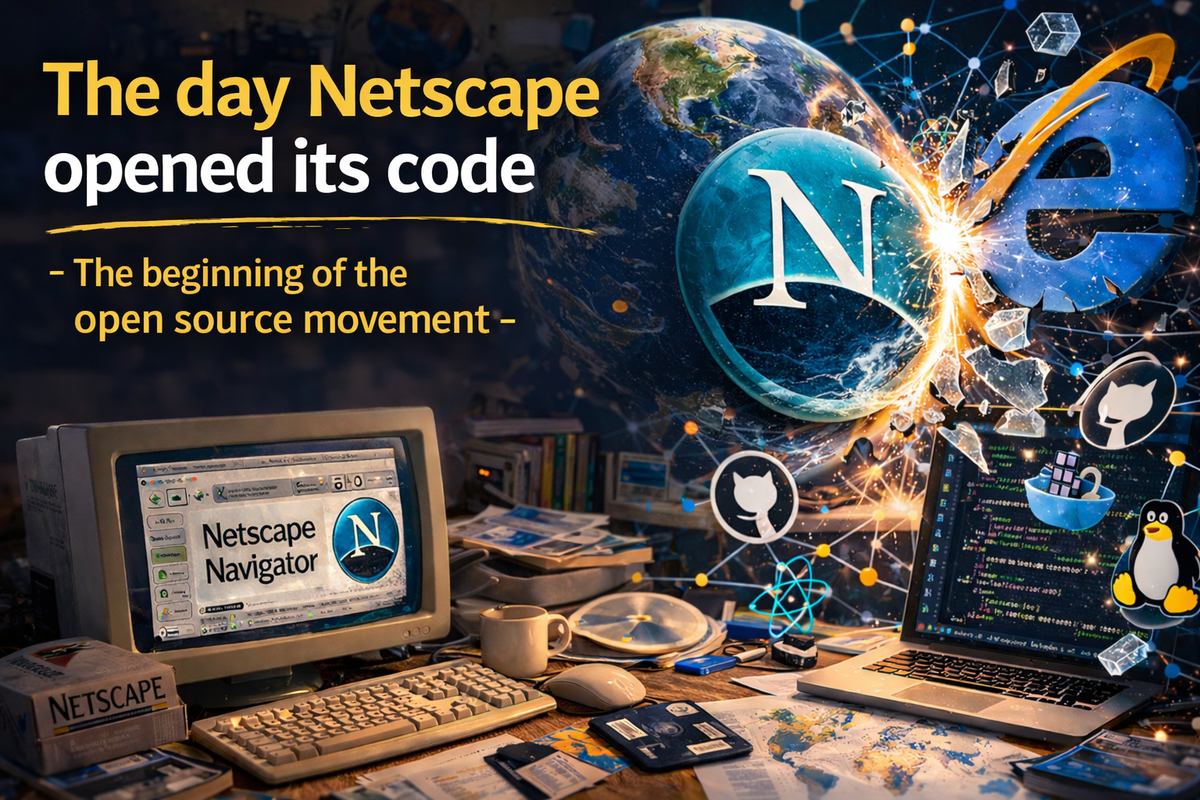
The Era When a Single Browser Dominated the Internet
In the mid-1990s, when the internet was just beginning to spread to the public, the web environment we take for granted today did not yet exist. While we now perceive a browser as just another application, at that time it was not merely a program but the only gateway into the internet itself. The act of viewing a website was effectively synonymous with using a specific browser, and the user experience was almost entirely determined by the browser’s capabilities and performance. Because the concept of standards had not yet been fully established, the features supported by a browser effectively became the features of the web itself. In other words, the companies building browsers were in a position to define the direction of the internet.
In this environment, Netscape Navigator emerged. Netscape did more than simply provide a fast and stable browser—it defined what it meant to experience the web. Many websites were built with Netscape in mind, and developers designed the web based on how specific features behaved within Netscape. As a result, Netscape naturally came to dominate the market, at one point achieving a near-monopolistic position with the majority of browser market share. At the time, almost everyone using the internet relied on Netscape, which effectively meant that Netscape itself was shaping the standards of the internet.
However, this structure rested on a highly unstable balance. An ecosystem dominated not by standards but by a single company’s product could be disrupted at any moment. And the one variable capable of breaking that balance was the emergence of a competitor with a more powerful platform. That competitor was Microsoft, which already dominated the personal computer market. If Netscape controlled the entry point to the internet, Microsoft controlled the operating systems of the devices through which that entry point was accessed. A collision between these two forces was only a matter of time.

The Rise of Microsoft and the Beginning of the Browser Wars
In 1995, Microsoft entered the browser market in earnest with the release of Internet Explorer. At its initial launch, Internet Explorer was not significantly superior to Netscape in terms of technology. In fact, early versions lacked functionality and were far from stable. However, rather than focusing solely on improving technical completeness, Microsoft chose a far more fundamental strategy: it did not compete with the browser as a standalone product, but integrated it into the operating system.
Microsoft had already secured control over the vast majority of personal computers worldwide through Windows. It began bundling Internet Explorer as a default component of the operating system. This meant that users could access a browser immediately upon turning on their computers, without any need for separate downloads or installations. This strategy was simple but extremely powerful. Netscape required users to actively seek it out and install it, whereas Internet Explorer was automatically available without any effort. By effectively eliminating the concept of user choice, this approach began to fundamentally reshape the competitive landscape of the browser market.
In addition, Microsoft provided Internet Explorer for free. At the time, Netscape was selling its browser as a paid product, placing it at a clear disadvantage in terms of pricing. Users had less and less reason to pay for Netscape, and naturally began migrating toward Internet Explorer. This shift was not merely a change in user numbers—it triggered a broader migration of the web development ecosystem itself. Developers increasingly began building websites based on Internet Explorer, and the Netscape-centered ecosystem started to fracture.
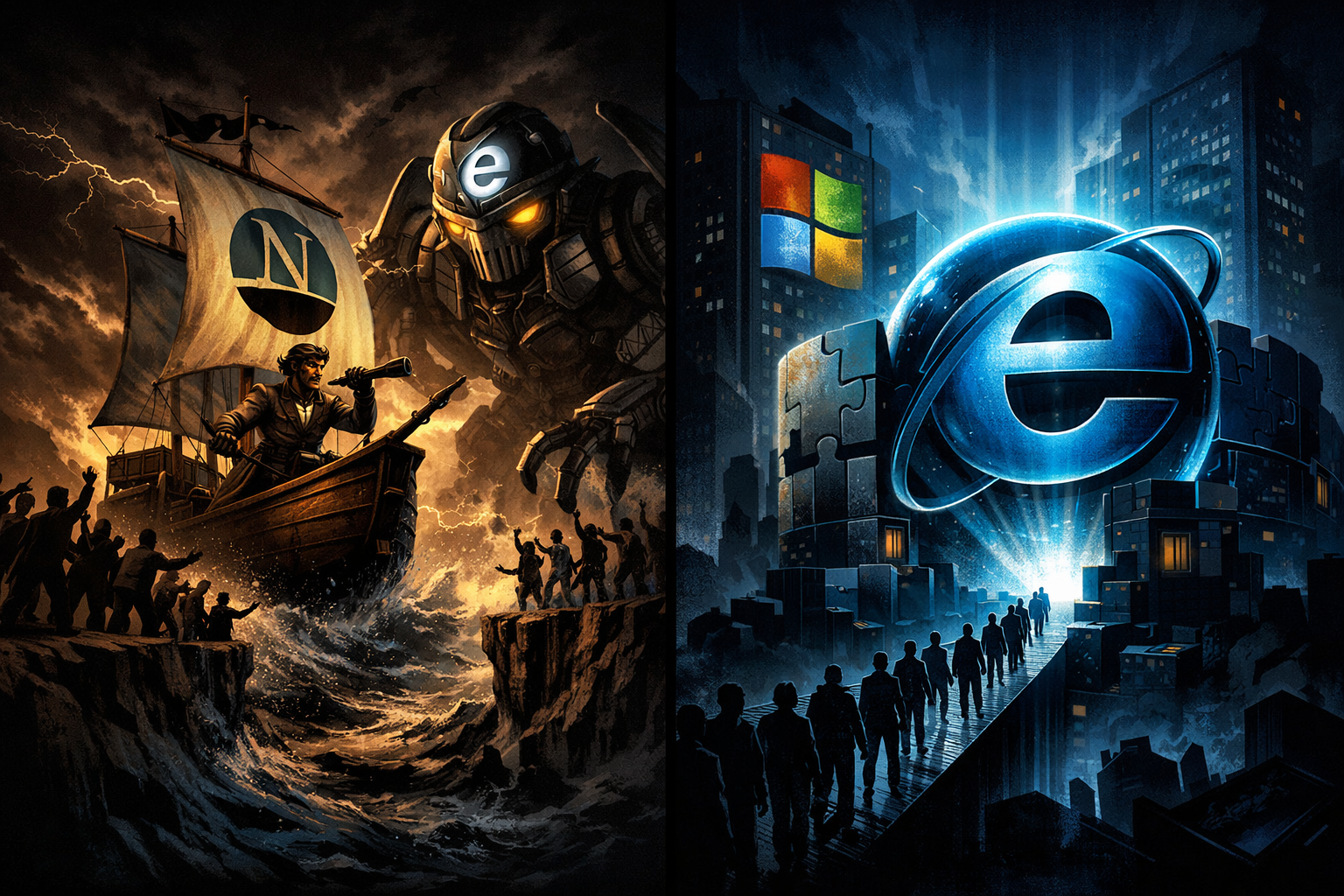
At this point, the browser war evolved beyond simple product competition. It was no longer about technological superiority or feature differences, but a clash between platform dominance and distribution strategy. Netscape controlled the web as a space, but Microsoft controlled all the pathways through which that web was accessed. In this structure, it was becoming increasingly clear which side held the advantage.
The Collapse of Netscape — A Defeat of Structure, Not Technology
As time passed, Netscape’s market share began to decline rapidly. Although it initially maintained technical advantages, the market was no longer driven by technology alone. Internet Explorer continued to improve, but more importantly, its distribution through Windows enabled an overwhelming rate of adoption. Users became increasingly accustomed to Internet Explorer, and new users often had no opportunity to encounter Netscape at all. This shift occurred quietly, yet with undeniable certainty.
The challenge Netscape faced was not simply the emergence of a competing product. It was the realization that the rules of the game itself were changing. Netscape viewed the browser as an independent product, whereas Microsoft redefined it as a component of the operating system. This difference was decisive. Netscape needed to sell its browser, while Microsoft could use the browser to strengthen its broader platform. Because their revenue models and strategic structures were fundamentally different, competing on equal terms became impossible.
Within Netscape, various response strategies were discussed, but no clear solution emerged that could fundamentally reverse the situation. Lowering prices or adding features had already proven to have limited effectiveness. More critically, Microsoft possessed a structure that allowed it to continue expanding its browser even at a loss, making it difficult for Netscape to close the gap through product improvements alone. Netscape gradually came to understand that it was losing not in a technological contest, but in a structural one.
Ultimately, Netscape reached a crossroads. Its chances of survival under the existing approach were diminishing, and a fundamentally different strategy was required. At this point, an idea emerged that would have been almost unthinkable at the time: to release the source code of its browser, its most valuable asset. This decision was not merely a shift in strategy—it marked a turning point that would redefine how software itself was created.
From here, the story moves beyond simple competitive dynamics and into one of the most significant turning points in software history. In the next section, we will examine how this decision came to be, and why it represented a complete reversal of conventional thinking.
The Decision to Open the Code — A Move Against Conventional Wisdom
The situation Netscape faced was not merely a decline in market share. It was a clear sign of an increasingly evident structural defeat. Internally, it was becoming undeniable that the existing approach could no longer turn the tide. Improving the product was not enough, and lowering the price had also lost its meaning. The very basis of competition had already shifted. Microsoft was expanding its browser through the operating system, and within that structure, no matter how good Netscape’s product was, reclaiming the market was nearly impossible. Ultimately, Netscape reached a point where a shift in strategy, not technology, became necessary.
The choice that emerged at this moment was the release of the source code. While this may seem familiar today, at the time it was a decision that went almost completely against common sense. For a software company, source code was not just code—it was the company’s most critical asset. It represented the accumulation of technical expertise, the foundation of competitiveness, and the most important weapon for survival in the market. To voluntarily release such an asset was effectively the same as exposing the internal structure to competitors. Moreover, it opened the possibility for anyone to take, modify, and utilize the code. This was a direct rejection of the principles of closure and exclusivity that had defined the software industry.
Despite this, Netscape began to seriously consider this decision. The reason was simple: there was no longer any chance of winning with the existing approach. If the competitive landscape had changed, then the rules of the game had to change as well. What Netscape sought was not merely to release code, but to bring developers from around the world onto its side. Instead of relying on a limited internal development team, they envisioned a structure where countless external developers could participate. In such a model, it might be possible to compete with Microsoft in an entirely different way.
This decision was not just a technical strategy, but closer to a shift in philosophy. It was an attempt to move away from a model where software was produced exclusively by companies and delivered to consumers, toward one where it was created and evolved collaboratively. Of course, no one could be certain whether such a structure would actually work. There were almost no successful precedents, and if it failed, there would be no way to reverse it. Nevertheless, Netscape chose this path. And that decision would later be remembered as one of the most important turning points in software history.

The Birth of the Mozilla Project — A Transformation in Development
In 1998, Netscape officially released its source code and launched the Mozilla project. This moment was not just a change in corporate strategy, but an event that marked the beginning of a transformation in how software itself was developed. The Mozilla project aimed for a structure fundamentally different from traditional in-house corporate development. Instead of a centrally controlled model, its core idea was to create a system where external developers could freely participate and contribute. This was an early form of the open-source collaboration model that is now familiar today.
To understand how radical this change was, one must consider the development environment of the time. Platforms like GitHub did not exist, and collaboration tools were extremely limited. Developers primarily communicated through mailing lists, and patches were shared as files. Code review was not a structured system as it is today, but relied heavily on voluntary participation from the community. Despite these limitations, the Mozilla project gradually began to attract the interest of more and more developers. The opportunity to directly improve the browser they themselves used was a highly compelling proposition.
The changes that occurred in this process went beyond participation in development. The very concepts of ownership and responsibility in software began to shift. Previously, a company created a product and users simply consumed it. But within the Mozilla project, the boundary between developer and user began to blur. Anyone who discovered an issue could fix it, and anyone could propose new features. This structure transformed software from a static product into a continuously evolving, shared project.
Of course, this new model did not function smoothly from the beginning. Issues such as code quality management, maintaining direction, and conflicts among contributors inevitably arose. However, the process of resolving these challenges itself began to establish a new development culture. What mattered was not creating a perfect system, but building a structure that could be continuously improved. The Mozilla project became the first large-scale experiment demonstrating that possibility.

The Emergence of the Name “Open Source”
An interesting point is that at the time Netscape released its code, the term “Open Source” was not yet widely used. The Free Software Movement led by Richard Stallman already existed, but the term “Free Software” was perceived as somewhat burdensome for companies. This was largely due to the ambiguity of the word “free.” It was unclear whether it referred to price or freedom, and for businesses, it was often seen as a concept that could conflict with their models.
In this context, Netscape’s release of its code created a need for a new way of explanation. It was no longer sufficient to frame this as a philosophical movement—it needed to be redefined as a practical development model applicable to real industry. From this need, the term Open Source emerged. This expression conveyed the idea of publicly available code in a clear and intuitive way, while also presenting the concept in a form that companies could more readily accept. In other words, it was not merely a label, but a linguistic tool that provided a new framework for understanding software development.
The concept of Open Source spread rapidly. This was because it was not just an idealistic philosophy, but a model that could actually function in practice. Companies could use it to attract external developers, accelerate development, and expand their ecosystems. Developers, in turn, were motivated by the opportunity to have their code used on a much broader scale. This structure began moving in a direction fundamentally different from the traditional closed model of software development.
Ultimately, the concept of Open Source evolved beyond a simple term and became a new standard for the software industry. And at the origin of this transformation was Netscape’s decision to release its code. Although it began as a response to corporate crisis, the outcome led to far greater change. Software was no longer the exclusive domain of a single company, but began to transform into a shared foundation built by developers around the world.
This trend would continue to expand rapidly, giving rise to numerous projects and ecosystems. In the next section, we will explore how this transformation concretely impacted industry and the broader technological landscape.
How Open Source Became the Mainstream
Netscape’s release of its source code did not end as a single isolated event. Rather, it marked the beginning of a much larger movement. The Mozilla project itself initially faced many challenges, including issues with technical completeness and direction. However, during this process, an important shift was taking place. The perception of how software should be developed was beginning to change. Previously, it was standard practice to develop software internally in a closed environment and distribute it as a finished product. Now, a structure in which software was continuously improved together with external developers was gradually being accepted as a realistic alternative. This shift was significant not as an idealistic concept, but as a model that could actually function in practice.
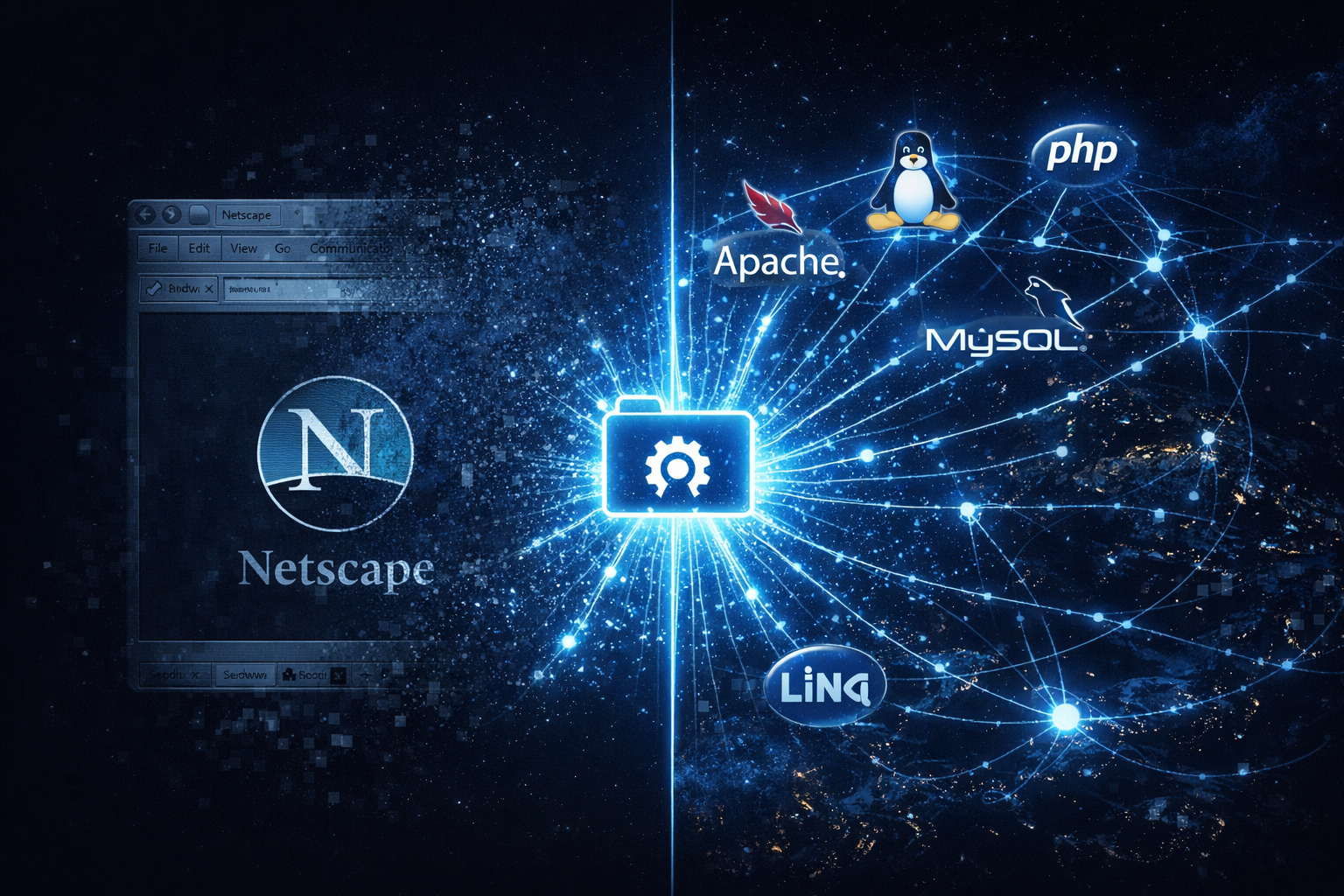
This trend soon began to spread to other projects. Linux, which already existed, started to grow more rapidly during this period, while the Apache web server established itself as a core component of internet infrastructure. Technologies such as MySQL and PHP also expanded based on open-source models, beginning to reshape the web development environment. The structure known as the LAMP stack enabled countless web services and provided startups with a foundation to build services at low cost. What was crucial was that all of these technologies were not controlled by a single company, but existed in a form that anyone could access and modify. This dramatically accelerated the pace of technological adoption compared to the past.
At this point, open source was no longer a peripheral experiment. It was becoming a movement shifting toward the center of the industry. Companies could no longer ignore this change and began to adopt open source strategically. Instead of developing everything internally, collaborating with external communities proved to be far more advantageous in terms of both cost and speed. Developers also found greater opportunities in this environment. Even without belonging to a specific company, their code could now be used globally.
Ultimately, Netscape’s decision was not merely an attempt to save a single project, but a turning point that reshaped the direction of the entire software industry. They may have lost the competition, but they succeeded in changing the rules of the game itself. This transformation continued to expand over the following decades, becoming deeply embedded in most of the technology stacks we use today.

Netscape Lost, But What Did It Leave Behind
In the end, Netscape was pushed out of the browser market by Microsoft. Internet Explorer secured overwhelming market share through its integration with Windows, while Netscape Navigator gradually lost its influence. From a purely market perspective, this battle appears to have ended in a clear defeat. However, viewing this event solely as a competition between companies is an overly superficial interpretation. What Netscape left behind was not just a product, but a transformation in how software itself is perceived.
The Mozilla project continued to evolve and eventually led to the Firefox browser. For a time, Firefox played a role in breaking the monopoly of Internet Explorer, helping to revive the importance of web standards and openness. What mattered in this process was not the success or failure of a specific product, but the fact that an open development model could actually be competitive. Netscape’s decision to release its code was not just a declaration—it became a model that countless future projects would follow.
This event also demonstrated that a company’s failure does not necessarily lead to the failure of an industry. Netscape disappeared from the market, but the direction it chose expanded on a much larger scale. Numerous open-source projects emerged, and companies began to actively adopt them. As a result, Netscape may have lost the competition, but it played a decisive role in shaping the future of the software industry.
Such cases are rare in the history of technology. In most instances, defeated technologies or companies are simply forgotten. But Netscape is different. What it left behind was not a specific product or codebase, but a new possibility for development models and collaboration structures. In this sense, Netscape’s decision can be seen not just as a strategy, but as a true turning point.
Connection to Today’s Development World — We Are Already Standing on It
When we turn our attention to the present, the depth of Netscape’s impact becomes even clearer. Nearly every technology used by developers today is connected to open source in some form. Operating systems are based on Linux, containers are managed with Docker, and orchestration is handled by Kubernetes. Databases, message queues, web servers, and even machine learning frameworks are largely open-source projects. We are no longer just developing on top of open source—we are developing within open source itself.
This structure is not merely a matter of technology choice. It represents a fundamental shift in how development is done. Developers are no longer just individuals who write code, but participants who understand, combine, and, when necessary, contribute directly to existing open-source projects. When solving problems, the default is no longer to build everything from scratch, but to leverage the vast ecosystem of existing libraries and frameworks. This approach has dramatically accelerated development speed while also enabling the construction of far more complex systems.
One of the key starting points of this entire movement was Netscape’s decision to release its code. Open source existed before, but this event elevated it into a central force within the industry. Both companies and developers began to accept this model as a practical choice, and countless projects followed this approach. As a result, we are now working on top of what once seemed like an experimental decision.
From here, the narrative naturally moves to the next stage. As open source spread, the web infrastructure built upon it began to grow rapidly as well. In particular, the Apache web server played a crucial role in this process, forming the foundation of the internet. In the next article, we will explore how this open-source movement came to dominate real-world web infrastructure, and what changes occurred along the way.