
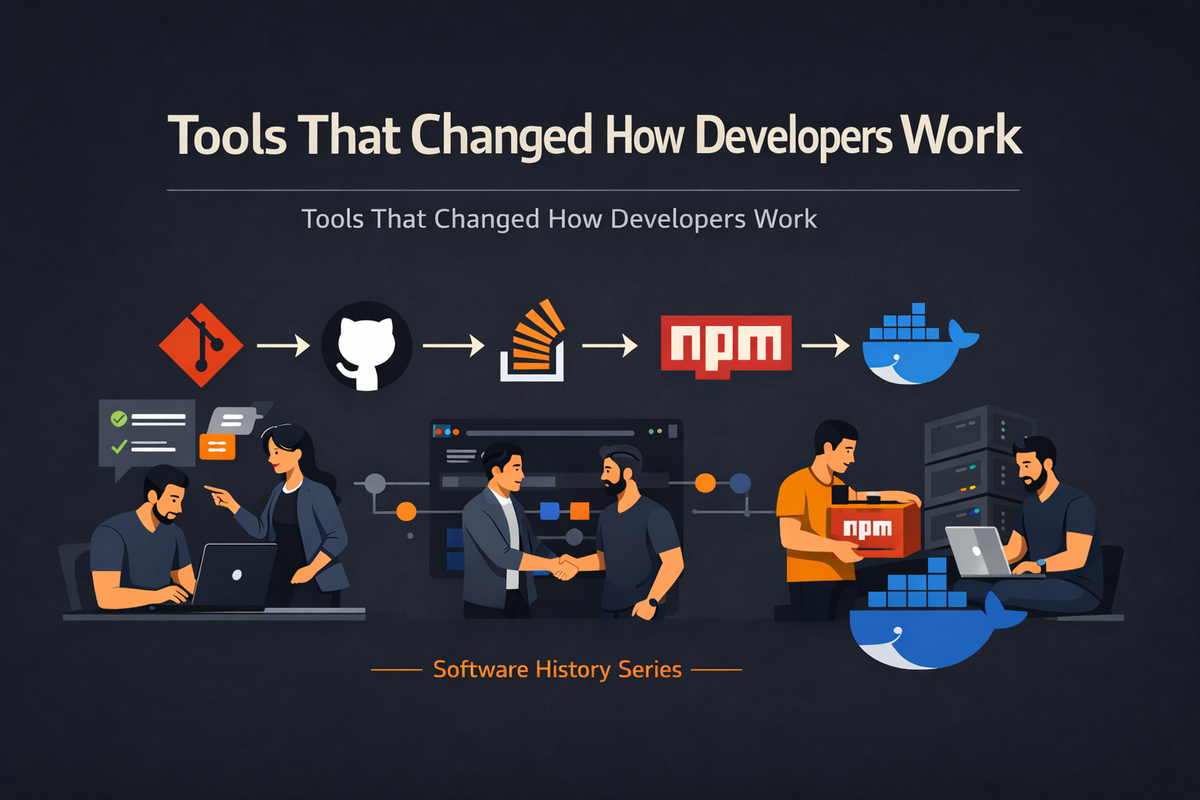
When we look back at the history of software, our attention is often drawn to languages, algorithms, or major technological breakthroughs. Faster compilers, more efficient data structures, more powerful frameworks. Yet what truly changed the way developers work was not any of these. In reality, what fundamentally transformed the structure of development was the set of tools surrounding code—systems that enabled collaboration, sharing, and distribution.
This season follows precisely that point. Not the code itself, but the way code is handled. And the tools that reshaped that way.
The Era Before Tools — When Inefficiency Was the Default
For those accustomed to today’s development environment, it may be difficult to imagine, but software development was once a slow and isolated activity. Tracking changes in code was not easy, and collaboration often relied on manually exchanging files or resolving conflicts by hand. As projects grew in size, these problems became more severe, yet developers repeatedly faced the same issues without finding a fundamental solution.
The sharing of knowledge was also limited. The resources available to developers were mostly restricted to official documentation, books, or a small number of communities. When encountering a specific error, it was often unclear whether someone else had already faced the same problem. Solutions frequently depended on individual experience, and that experience was not easily shared.
Compared to today, development in this era was clearly inefficient. However, at the time, it was considered natural, and there were no viable alternatives. The problems were evident, but the structure capable of solving them had not yet been created.
The Emergence of Tools That Redefined Collaboration
What began to change this flow was not technological advancement itself, but tools that emerged from attempts to solve specific problems. This shift became especially critical in projects that required large-scale collaboration. In environments where numerous developers had to work simultaneously, existing approaches could no longer be sustained, and a new method became necessary.
It was in this context that distributed version control systems appeared. These tools did more than simply store the history of code changes—they restructured the very nature of collaboration. Developers no longer depended on a single central repository. Instead, they could work independently while remaining seamlessly connected to the overall project. The concepts of branching and merging were not just features; they became a way of structuring the flow of collaboration.
This transformation carried meaning beyond simple productivity gains. It changed not only how developers handled code, but also how they understood collaboration itself. Conflicts were no longer problems to be avoided, but processes that could be managed. Experimental attempts also became far more flexible.
From Code Repositories to Platforms
If version control tools reshaped collaboration, the platforms built on top of them expanded development culture even further. Code repositories were no longer just places to store files. They became spaces where people and contributions gathered around projects, and at the same time, environments where developers’ activities were recorded and evaluated.
In particular, the concept of the Pull Request unified code review and collaboration into a single flow. Contribution was no longer a closed process—it became an open activity. A structure emerged in which anyone could participate in a project. This change accelerated the growth of open source and allowed individual developer activity to accumulate as a visible history.
At this point, development was no longer an individual task. It transitioned into collaboration conducted over a network. Code, people, and projects began to connect within a single platform.
The Transformation of How Knowledge Is Shared
Alongside changes in collaboration structures, the way development knowledge is shared also evolved rapidly. Information that was once dependent on specific communities or documents began to accumulate through participation from developers worldwide. The seemingly simple structure of questions and answers produced unexpectedly powerful results, significantly accelerating the speed of problem-solving.
This shift fundamentally changed developer behavior. When encountering an error message, searching became more natural than digging through documentation. Referencing existing solutions became the standard approach. Development was no longer a process of understanding everything alone, but one of leveraging accumulated knowledge.
What mattered in this transformation was not just the volume of information, but the fact that it existed in a form accessible to anyone. Development knowledge was no longer the asset of a specific group—it became a public resource available to all.
The Redefinition of Software Distribution
The evolution of development culture extended beyond writing code and collaboration, influencing how software is distributed. Setting up environments to run applications had long been a complex and unstable process. Even when running the same code, results could differ depending on the environment, and this issue was not easily resolved.
The tool that addressed this problem introduced a new approach: packaging applications together with their execution environments as a single unit. This allowed developers to run their code under consistent conditions and significantly simplified the deployment process. This change was not merely about convenience—it blurred the boundary between development and operations.
As a result, software could be deployed more quickly and run more reliably. Developers also gained a clearer understanding of how their code behaves in real environments.
The Origins of What We Now Take for Granted
Most elements that define today’s development environment are the result of these tools. Splitting branches, merging code through Pull Requests, installing packages, and running applications in containers—these processes are now entirely natural. Yet none of them appeared overnight. Each was created through attempts to solve specific problems.
The stories explored in this season are about those very moments. Some tools changed how collaboration works. Others accelerated the explosive growth of open source. Still others redefined how software is distributed. And together, all of these changes ultimately transformed how developers work—and how software itself is created.
Technology continues to advance, but it is always tools that connect that progress to real change. And sometimes, a single tool can shift the entire direction of development culture.