
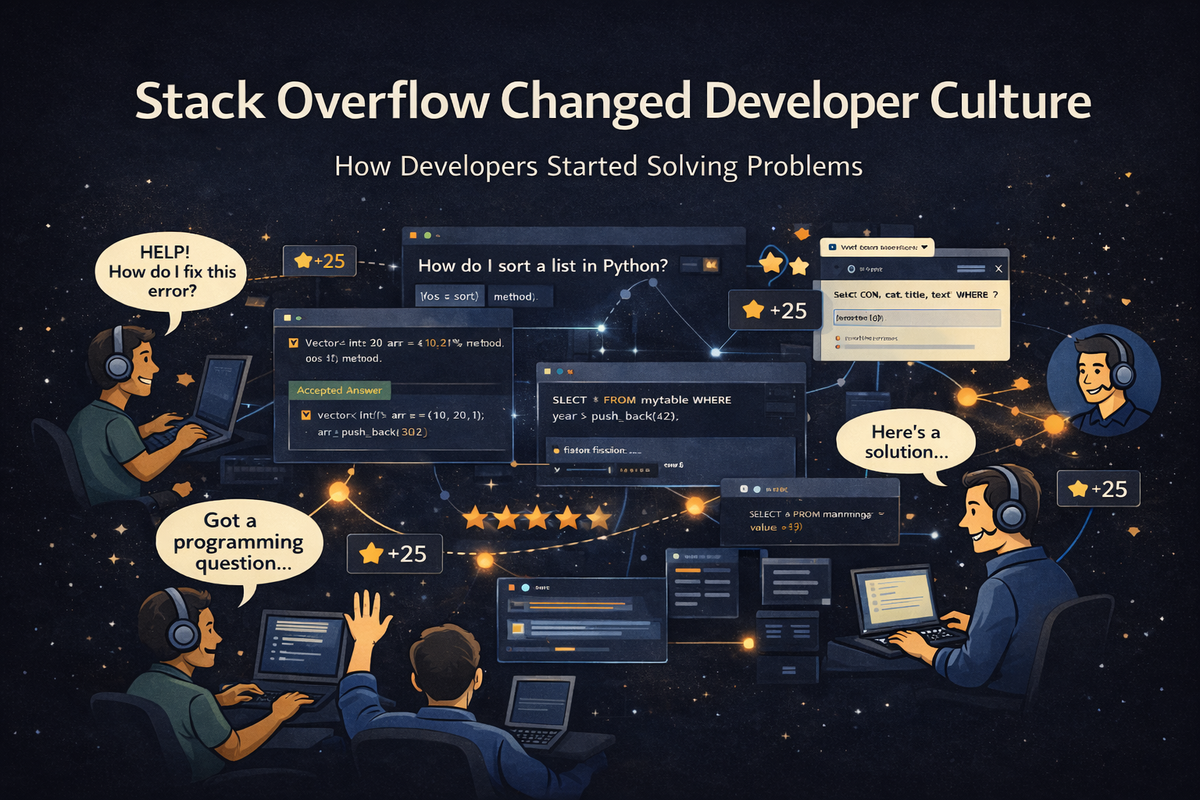
Developers Before Search — Why Problem Solving Was Slow
Software development has always been a continuous process of problem solving. However, the method we take for granted today—copying an error message into a search engine and finding a solution within seconds—is a relatively recent phenomenon. Before the emergence of Stack Overflow, developers had to go through significantly longer and more uncertain processes to resolve issues. The problem was not simply that “there was not enough information.” Rather, information did exist, but the process of discovering it was inherently inefficient, and in many cases, it was almost a matter of luck.
At the time, developers primarily relied on mailing lists, IRC channels, and various forums. When encountering an issue with a specific library or programming language, the typical approach was to post a question on the relevant project’s mailing list and wait for a response. This process was fundamentally asynchronous. Posting a question did not guarantee an immediate answer, and it was common for days to pass without any reply. Even when responses were provided, they were often incomplete or lacked clarity and reproducibility. The questioner had to describe their situation in detail, while the responder had to infer the missing context, leading to inevitable information loss that made problem solving even more difficult.
Real-time channels like IRC offered slightly faster feedback, but they came with their own structural limitations. Conversations were ephemeral and disappeared as quickly as they occurred. Even if the same question had been discussed before, it was difficult to retrieve and reference those past discussions. As a result, knowledge was not accumulated but merely consumed in the moment. Forums were not much better. While they did contain questions and answers, they were not systematically organized or optimized for search. Older threads would become buried, new questions would repeat the same issues, and identical problems would resurface dozens of times.
In this environment, developers were constantly forced to choose between two paths. One was to spend time analyzing and solving the problem independently. The other was to search through the internet in hopes that someone had already solved it. However, even in the latter case, finding a definitive answer was far from guaranteed. Search engines were not as refined as they are today, and even knowing which keywords to use was often unclear. As a result, developers frequently defaulted to solving problems on their own, which naturally led to a structural slowdown in problem-solving speed.
Development during this period was far more isolated than it is today. Knowledge could be shared within a team, but accessing knowledge beyond that boundary required significant effort. Even if someone else had already solved the same problem, it took considerable time for that knowledge to reach another developer. This latency was not merely an inconvenience; it fundamentally limited overall development productivity and influenced how developers learned. We often think of technological progress in terms of faster tools or better performance, but in reality, changes in how we access knowledge have a far greater impact. And this period represented a time when that access mechanism was at its most inefficient.

Information Existed, But Was Not Accessible — The Fragmented Knowledge Structure
An interesting point is that the core problem developers faced at the time was not a “lack of information.” The internet already contained a vast amount of technical documentation, code examples, and shared experiences. The real issue was that this information was not connected within a unified structure. Knowledge was scattered across different locations, and there was no system to link them together. This was not merely an inconvenience; it created a situation where knowledge itself could not be effectively utilized.
Consider a scenario where the information needed to solve a specific error is distributed across three different sources. One part might exist in a paragraph of official documentation, another in an old personal blog post, and yet another within the archives of a mailing list. To fully resolve the issue, a developer would need to locate and synthesize all three pieces. In reality, however, navigating all these paths was extremely difficult. Search engines were not capable of effectively connecting these fragmented pieces of information, leaving much of the knowledge in a state of “existing but undiscovered.”
Another consequence of this structure was the constant repetition of identical questions. Even if a developer solved a problem and documented it in a blog post, it would not necessarily be visible enough for others to find. As a result, another developer would encounter the same issue, ask the same question, and receive a similar answer again. This cycle repeated continuously, yet the outcomes were not consolidated into a single accumulated body of knowledge. In other words, knowledge was continuously produced, but it was not accumulated. This was not just inefficiency—it was a fundamental flaw in the knowledge production system itself.
Furthermore, most information at the time was written in a context-dependent manner. Blog posts were tailored to the author’s specific situation, and forum answers were tightly bound to the original question. This required additional interpretation from the reader. Even when facing the same problem, slight differences in environment or conditions made it difficult to apply the information directly. As a result, developers constantly had to evaluate whether a given piece of information was applicable to their own situation, adding yet another layer of time and effort.
This fragmented structure imposed two simultaneous burdens on developers. One was the cost of discovering information, and the other was the cost of interpreting it. It was not enough to simply read search results; developers had to filter out reliable information and adapt it to their own context. This process was repetitive and cognitively demanding. The concept we take for granted today—where the most relevant and reliable answers naturally rise to the top—simply did not exist at the time.
Ultimately, the internet of that era functioned as a massive repository of information, yet it was also a system with an inherently inefficient knowledge structure. Information was abundant, but the interface for utilizing it was lacking. This problem was not purely technical; it had structural implications that affected the entire development culture. It was at this exact point that a fundamentally different approach became necessary. And that necessity led to the emergence of the platform that would redefine everything that followed.

The Emergence of Stack Overflow — Why It Was More Than Just a Q&A Site
When Stack Overflow launched in 2008, many initially perceived it as just another question-and-answer website. After all, forums and Q&A platforms already existed, and the introduction of a new one did not seem particularly remarkable. However, Stack Overflow was not merely an incremental improvement over existing systems—it was a complete redesign of how problems are solved. Failing to understand this distinction makes it impossible to fully grasp why this platform transformed developer culture.
The starting point of Stack Overflow was clear. The problem developers faced was not the inability to ask questions, but the difficulty of finding high-quality answers. Jeff Atwood and Joel Spolsky accurately identified the structural limitations of existing forums. Questions were abundant, but extracting valuable answers from them became increasingly difficult over time. The issue was not a lack of questions, but rather the quality and structure of answers.
To address this, Stack Overflow introduced a system that did more than simply list questions and answers—it ranked and evaluated them. Users could directly assess the usefulness of answers, and those evaluations were immediately reflected in their visibility. This approach was fundamentally different from traditional forums. Previously, all answers were treated as if they held equal value, but Stack Overflow established a system where knowledge was clearly prioritized and structured.
Additionally, the platform was designed from the outset with searchability in mind. It was not just about resolving individual questions, but about ensuring that the knowledge generated in the process could be reused by others. Questions had to be specific, answers had to be clear, and duplicate questions were consolidated. This was not merely a matter of community guidelines—it was a structural design for accumulating knowledge.
At this point, a critical shift occurred. Previously, questions and answers were consumed as one-time interactions. With Stack Overflow, they became reusable assets. A single well-crafted answer could provide value to thousands or even millions of developers. This dramatically increased the efficiency of the entire system. It was not simply an improvement in user experience—it marked a fundamental transformation in how knowledge is produced and consumed.
As a result, Stack Overflow evolved beyond being a community platform into a searchable database of collective intelligence. This structure began to fundamentally change how developers approached problem solving. The way they asked questions, searched for answers, and even learned new concepts was reshaped by this system. While the transition appeared gradual on the surface, it spread with remarkable speed. And in the next stage, developers began to exhibit entirely new patterns of behavior that had never existed before.
Voting, Acceptance, Reputation — A Structure That Automatically Sorts Knowledge Quality
What fundamentally distinguished Stack Overflow from traditional forums was not merely that it gathered questions and answers in one place. The core difference lay in the fact that the system was designed to determine which answers were better on its own. Previously, on the internet, almost all information existed on the same level. Old posts and new posts, accurate answers and incorrect ones were all mixed together, and ultimately it was up to the individual user to decide what to trust. This structure effectively shifted the cost of information filtering onto the user.
Stack Overflow addressed this problem through a voting system. Users could evaluate answers using upvotes and downvotes, and the results were immediately reflected so that better answers naturally rose to the top. This mechanism was not merely about ranking popularity, but rather a method of refining information quality through collective intelligence. As numerous developers encountered the same question and evaluated answers based on their own experience, the most reliable responses naturally surfaced.
On top of this, the concept of an “accepted answer” introduced another layer of meaning. The person who asked the question could directly select the answer that solved their problem, providing a different type of signal beyond community voting. This created a dual structure where both the collective evaluation of the community and the actual resolution experience of the questioner were reflected. As a result, answers on Stack Overflow were not just “popular answers,” but answers that demonstrably solved real problems.
The reputation system also played a crucial role. When users provided high-quality answers, their reputation increased, which in turn granted them more privileges within the platform. Conversely, low-quality or incorrect answers were naturally pushed down. This was not merely a reward mechanism, but rather a system that simultaneously enforced responsibility and motivation in knowledge production. Developers were effectively putting their identity and credibility behind their answers, which helped maintain a certain level of quality across the platform.
All of these elements combined to create a knowledge structure fundamentally different from traditional forums. Information was no longer displayed in a flat, equal manner, but instead organized into a clear hierarchy. More importantly, this hierarchy was not controlled by a central authority, but continuously reshaped through user interactions. In essence, this was a self-organizing knowledge system, and it is precisely this structure that began to change developer behavior in the next stage.

The Experience of “You Can Just Search It” — The Moment Developer Behavior Changed
Before this shift, developers had to either ask questions, analyze code themselves, or read through entire documentation to solve problems. However, once Stack Overflow accumulated enough data, an entirely new experience became possible: searching for a problem and immediately finding that someone else had already solved it. This transformation was not just about convenience; it fundamentally changed how developers approached problem-solving.
Now, when developers encounter a problem, their first instinct is to search. They copy the error message, paste it into a search engine, and click on a Stack Overflow result near the top. What matters here is not just the act of searching, but the reliability of the results. Because of Stack Overflow’s structure, answers that appear at the top are likely to have already been validated by many others. This allows developers to make decisions quickly without going through extensive verification processes.
As this experience repeats, it begins to reshape how developers think. Instead of understanding a problem from beginning to end, the focus shifts toward finding and applying an already existing solution as quickly as possible. While this may appear negative from a purist perspective, in reality it dramatically improves productivity. Solving every problem from first principles may be ideal, but in practical development environments, it is inefficient. Stack Overflow eliminated this inefficiency and turned problem-solving into a reusable process.
This shift also expanded problem-solving from an individual experience to a collective one. Previously, only developers who had encountered a specific issue could respond quickly. Now, anyone could benefit from the shared experiences of others. This not only reduced the gap between developers but also accelerated overall development speed. In this sense, Stack Overflow evolved beyond a simple information source and became a tool that extends the cognitive capabilities of developers.
At this point, another critical shift emerges. The standard for problem-solving moves from “Do you understand it?” to “Did you solve it?” This change influences the broader development culture and leaves a lasting impact on future tools and platforms. And naturally, this transition leads to a transformation in how code itself is reused.

The Transformation of Code Reuse — The Rise of Copy-Paste Culture
After Stack Overflow became widespread, one noticeable shift in the development environment was the way code was reused. Previously, code reuse was primarily done at the level of libraries or frameworks. Developers would adopt well-built modules and integrate them into their systems in a structured way. However, after Stack Overflow, an entirely different form of reuse emerged: snippet-level reuse, or what is commonly referred to as copy-and-paste.
This shift is not merely about convenience. A change in the unit of code reuse implies a change in how developers perceive problems. Developers are no longer only thinking in terms of full system design, but also in terms of quickly finding and applying small pieces of code that solve specific issues. Stack Overflow contains an enormous number of such snippets, many of which are already validated by others. This enables developers to assemble solutions by combining only the necessary parts, rather than building everything from scratch.
Of course, this change has been criticized. The term “copy-paste developer” emerged as a way to describe those who use code without fully understanding it. Indeed, applying code without considering its context can introduce bugs and increase long-term maintenance costs. However, it is equally true that this approach has significantly increased development productivity. Writing every piece of code from scratch may be ideal, but it is not realistic in most environments. Stack Overflow effectively removed this inefficiency and established a culture of reusing existing solutions.
This transformation also affects the role of the developer. In the past, deep understanding of algorithms and internal mechanisms was essential for solving problems. Today, however, the ability to quickly find appropriate solutions, apply them, and adapt them when necessary has become more important. This shift moves developers away from being mere code writers and toward becoming designers who assemble and orchestrate solutions.
Ultimately, Stack Overflow redefined how code is reused. The shift moved from library-centric reuse to problem-centric reuse. And this transformation does not remain confined to code alone; it extends into how developers learn and think. Developers are no longer expected to master everything themselves, but rather to efficiently pull in the knowledge they need at the right moment. This trend becomes even more apparent in the next stage.
The Way Developers Learn Changed — From Documentation to Examples
One of the quiet yet fundamental changes that occurred after Stack Overflow became widespread was the way developers learn. In the past, learning followed a clear path. Developers would read official documentation, study concepts through books, and gradually build understanding by following structured examples. This process was systematic, but it was also slow, and it often took a significant amount of time before one could actually solve real problems. In contrast, learning after Stack Overflow became far more immediate and situational. Developers no longer start by learning concepts first. Instead, they encounter a problem and acquire the necessary knowledge in reverse while solving that problem.
This shift goes beyond mere speed; it changes the structure of learning itself. Previously, one would follow a curriculum with the goal of “learning a language.” Now, the starting point is “solving this error.” From there, developers absorb only the specific concepts needed to resolve the issue. This approach is often referred to as problem-driven learning, and Stack Overflow made it extremely efficient. When an error message is searched, the platform provides just enough information to resolve the issue, allowing developers to move forward without fully mastering the entire conceptual background.
In this process, the depth of understanding becomes less important than the speed of application. Even without fully grasping every concept, being able to quickly learn and apply the necessary parts is often sufficient. While this approach might be criticized in traditional learning models, it aligns closely with real-world development environments. Deadlines and requirements are always present, and it is unrealistic to expect developers to deeply understand everything. Stack Overflow reflects this reality by creating a structure that delivers knowledge exactly when it is needed.
This transformation also affects how developers remember information. In the past, it was important to store knowledge internally. Now, it is more important to know “where the knowledge exists.” In other words, the focus of memory shifts from knowledge itself to the location of knowledge. This turns developers into explorers. Solving problems no longer requires knowing everything, but rather forming the right questions and quickly finding the corresponding answers.
This learning model influences many tools and platforms that followed. Even official documentation has increasingly become example-driven, and tutorials are now structured around solving real problems. Stack Overflow did not simply provide information; it redefined how developers learn. And this shift naturally affects how knowledge is structured and where it accumulates.

The New Standard Created by Stack Overflow — The De Facto Infrastructure of Developer Knowledge
Once Stack Overflow reached a certain scale, it became difficult to view it as just another website. Instead, it began to function as the core infrastructure where developer knowledge is stored and accessed. While this transformation appeared gradual, it actually spread very rapidly. In particular, its integration with search engines made Stack Overflow the starting point for nearly every development problem. No matter what error was searched, Stack Overflow consistently appeared among the top results, and this behavior quickly became ingrained in developers’ workflows.
What is crucial here is that Stack Overflow does not merely provide information. It operates as a knowledge interface tightly coupled with search. Search engines like Google index vast amounts of data, but determining which information is actually useful is a separate challenge. Stack Overflow already provides internally ranked and validated content, giving it a high level of trustworthiness in search results. This naturally drives more traffic, which in turn leads to more data accumulation, creating a powerful feedback loop.
This structure has a direct impact on the entire development ecosystem. When a new library or technology emerges, questions and answers about it begin to accumulate on Stack Overflow. As this data grows, the technology becomes easier to approach. Conversely, technologies with limited presence on Stack Overflow face higher barriers to entry. This goes beyond a simple difference in available information—it becomes a factor that directly influences technology adoption and diffusion speed.
Stack Overflow also begins to function as a kind of unofficial standard. The most upvoted solution to a problem is often treated as the “correct answer,” forming a shared baseline among developers. Even when official documentation exists, Stack Overflow answers are often more widely used in practice. This creates an interesting inversion. While documentation is supposed to be the authoritative source, in reality, answers shaped by collective experience become the dominant standard.
Ultimately, Stack Overflow evolves into more than a community—it becomes a collective memory system for developer knowledge. Instead of relying on individual experience, millions of experiences are aggregated into a single database and reused in real time. This represents a scale and form of knowledge infrastructure that had never existed before. However, this same structure also introduces new challenges.

Limitations and Shadows — Elitism, Duplicate Questions, and Barriers to Entry
As with any system that grows at scale, side effects inevitably emerge. Stack Overflow is no exception. In fact, because its structure is so well-designed, its issues become even more visible. One of the most prominent problems is its lack of friendliness toward beginners. Questions that are unclear or considered duplicates are quickly closed or removed. While this is a structural mechanism to reduce redundancy, it simultaneously acts as a high barrier to entry for new users.
The reputation system is also a double-edged sword. Users with high reputation gain more authority, but this can lead to a situation where a specific group of users influences the direction of the community. In some cases, certain types of answers or ways of thinking are overly emphasized, while alternative approaches are marginalized. This can ultimately result in a limitation of diversity in knowledge. In rapidly evolving technological environments, even outdated answers may continue to dominate simply because they were once highly upvoted.
The strict handling of duplicate questions is another source of controversy. While repeated questions are inefficient, the context of each question is often slightly different. However, within Stack Overflow’s structure, these subtle differences are not always fully recognized and are frequently treated as simple duplicates. This can hinder not only beginners but also those exploring new or nuanced problems. In effect, the process of refining knowledge can simultaneously act as a constraint on knowledge expansion.
Despite these issues, it is impossible to separate them from the core value that Stack Overflow provides. Maintaining high-quality information requires a certain level of rules and filtering, and the friction that arises from this process is, to some extent, inevitable. The key is to understand that this structure is not perfect. Stack Overflow is not a system that completely solved the problem of knowledge—it is simply a system that reconstructed it in a far more efficient way than before.
At this point, an important question begins to emerge. If even this structure is no longer optimal, what comes next? What if there were a way to move beyond searching and selecting knowledge altogether? And that question leads directly to the transformation we are now beginning to experience.
And Now — Is AI Replacing Stack Overflow
We are now standing at yet another turning point. In the past, developers searched to solve problems, and as a result, they would read answers on Stack Overflow. However, that very step of searching is now beginning to disappear. Instead of finding someone else’s answer, it has become possible to generate an answer instantly by simply inputting a question. This shift is not just a change in interface, but a signal that the entire structure of problem-solving is being reorganized once again.
Stack Overflow was a system that connected questions to answers. Questions existed, answers accumulated, and others reused them over time. However, AI-based systems do not follow this process. Instead, they generate answers in real time based on vast amounts of previously learned data. What matters here is that answers are no longer tied to a specific document or thread. In other words, the paradigm shifts from “finding where the answer exists” to creating the answer at the moment it is needed.
This transformation has an immediate impact on developer behavior. There is no longer a need to carefully craft search keywords or compare multiple pages to determine the best answer. Instead, developers can describe a problem in natural language and receive a solution in the form of a sentence or code. This can be seen as a further compression of the experience that Stack Overflow once provided. Where the process used to be question → search → selection → application, it is now reduced to question → generation → application.
However, this shift does not mean the end of Stack Overflow. In fact, the opposite is closer to the truth. The answers generated by AI are based on previously learned data, and a significant portion of that data originates from platforms like Stack Overflow. In this sense, Stack Overflow continues to serve as a foundational knowledge database. The difference is that a new interface has been layered on top of it. Users may no longer directly access that database, but its influence remains deeply embedded.
Moreover, AI-generated answers are not always accurate or optimal. At times, they may confidently present incorrect information or produce flawed code in certain contexts. In such cases, verified knowledge sources like Stack Overflow still play a crucial role. Many developers cross-check AI-generated responses by searching or referring back to Stack Overflow. This demonstrates that the two systems are not competitors, but rather exist in a complementary relationship.
Ultimately, the current transformation is not about replacing Stack Overflow, but about adding a new layer on top of it. Problem-solving is becoming faster, and access is becoming more intuitive. However, the foundation remains rooted in accumulated knowledge. This evolution is not just a change in tools, but a fundamental shift in how developers interact with knowledge itself.

Conclusion — Knowledge Is No Longer Learned, It Is Invoked
If we follow the flow up to this point, we arrive at a clear conclusion. The essence of the change brought by Stack Overflow was not simply about making information easier to find. It was about transforming the very way knowledge is handled. In the past, accumulating and understanding knowledge was essential. Developers were expected to learn as much as possible and solve problems based on that internalized knowledge. However, in the trajectory that begins with Stack Overflow and continues into the era of AI, this assumption is steadily being challenged.
What matters now is not how much you know, but what you can retrieve at the moment you need it. Developers are no longer entities that must remember everything. Instead, they are becoming individuals who define problems and rapidly retrieve and apply the appropriate solutions. This is not merely a technological shift, but a shift in thinking itself. Knowledge is no longer a personal asset stored in one’s mind, but an external resource that can be invoked at any time.
This transformation redefines the role of the developer. Beyond the ability to write code, the ability to structure problems and formulate precise questions becomes increasingly important. The quality of the question directly determines the quality of the answer, and this ultimately impacts the quality of the outcome. In this sense, developers are evolving from “producers of knowledge” into orchestrators who assemble and apply knowledge. Stack Overflow marked the beginning of this shift, and AI is now pushing it to its extreme.
However, viewing this transition purely from the perspective of efficiency can be misleading. The ability to invoke knowledge does not eliminate the value of understanding. On the contrary, as problem-solving becomes faster, developers gain the opportunity to tackle deeper and more complex challenges. The critical factor is not the tool itself, but how it is used. Just as Stack Overflow did, AI serves not to replace the developer’s capability, but to extend it.
Ultimately, the progression outlined in this article represents a continuous transformation. The slow, fragmented knowledge exchange of mailing lists and forums evolved into a structured and accumulated system through Stack Overflow, and is now transitioning into a model of instant generation through AI. This evolution will not stop. It is highly likely that another form of interface will emerge in the next stage.
In the next article of this series, we will examine how this structure of knowledge reuse triggered an explosive transformation in the code ecosystem. In particular, we will explore how the emergence of npm expanded the JavaScript ecosystem, and how code reuse reshaped the industry at large.