
The Limitations of JavaScript as a Browser Language
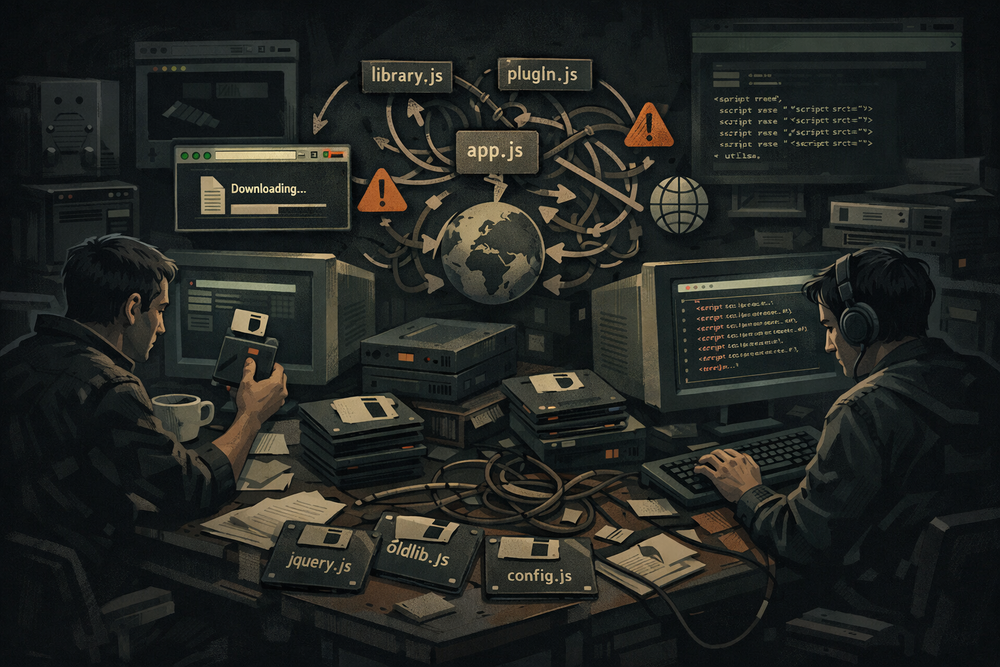
Early JavaScript existed in a completely different position from what we understand today as a general-purpose language. It was, at best, an auxiliary scripting language that operated strictly inside the browser, with a clearly limited role. Its primary responsibilities were handling user input, controlling simple UI interactions, and partially assisting communication with the server. Expecting anything beyond that was almost impossible. The most critical limitation was that there was no structure for sharing and reusing code at all. Developers had no choice but to implement required functionality themselves or copy and paste code written by others. In such an environment, code did not accumulate or evolve—it was repeatedly recreated and consumed in isolation.
The JavaScript ecosystem of that time would be considered primitive by today’s standards. Even when using libraries, the process did not involve installing packages but rather downloading .js files and manually including them in projects. The concept of version management effectively did not exist, and different versions of the same library were often mixed across projects. Dependency conflicts had not yet been formally defined, but their symptoms were already widespread. When multiple libraries were used together, global variable collisions and function name conflicts occurred frequently, making debugging an extremely difficult task. All of these problems stemmed from a single root cause: there was no standardized way to share code.
In this environment, libraries like jQuery emerged. jQuery was not merely a library—it effectively defined how JavaScript development was done. However, rather than solving the fundamental problem, it redirected it into a single dominant approach. Developers increasingly relied on jQuery for a wide range of functionality, resulting in a structure where everything converged into one massive library. While this approach improved productivity in the short term, it revealed serious limitations in scalability and maintainability over time. As codebases grew larger, they became harder to manage, and dependency on specific libraries deepened.
Ultimately, JavaScript in this era was not an ecosystem built on “small, composable modules,” but rather an environment where functionality was bundled into large monolithic libraries. Compared to other language ecosystems, this was highly unusual. Languages like Java and Python were already forming ecosystems centered around package management and modular systems, while JavaScript remained dependent on file-level copying and manual integration. This difference was not merely about developer convenience—it fundamentally limited the speed at which the ecosystem itself could grow. And this limitation would soon create pressure that pushed JavaScript into its next evolutionary stage.
What matters here is that JavaScript’s slow growth was not due to limitations of the language itself. The real problem was the absence of proper tools and structure. While this structural limitation was somewhat tolerable within the browser environment, it became impossible to ignore once JavaScript began moving beyond it. That turning point arrived when JavaScript started to escape the browser.
The Emergence of Node.js and the Need for Server-Side JavaScript
One of the pivotal moments that changed JavaScript’s trajectory was the emergence of Node.js. Node.js was not simply a tool that enabled JavaScript to run on servers. It was the turning point that elevated JavaScript into a fully capable programming language. Once freed from the constraints of the browser, JavaScript began to expand into much broader domains, including file system operations, network handling, and server-side logic. However, this expansion also introduced entirely new problems. Things that had previously been optional suddenly became essential.
Server-side development is inherently built upon the composition of numerous functionalities. HTTP handling, database connections, authentication, logging, and caching are just a few of the many components required. In the traditional JavaScript environment, there was no systematic way to integrate and manage these capabilities. Developers still had to write everything themselves or manually manage externally sourced code. However, this approach quickly became unsustainable in a server context. As applications grew in scale, code reuse and maintainability became critical, and a dependency management system emerged as a fundamental necessity.
At this point, JavaScript began to seriously require the concept of “packages.” It was no longer sufficient to simply execute code; developers needed a way to compose modules, manage versions, and deploy systems reliably. Node.js created this demand but did not provide the solution itself. In fact, it made the problem more visible and urgent. JavaScript was no longer a lightweight scripting language—it had become a language used to build complex systems, and it required an infrastructure capable of supporting that role.
This transformation represented more than just technical evolution—it marked a shift in development culture. Browser-centric JavaScript was typically written by individual developers for specific pages, whereas post-Node.js JavaScript moved toward team-based system development. In this transition, the most significant obstacle was how to share and reuse code effectively. Without solving this problem, JavaScript could not establish itself as a viable server-side language.
Ultimately, Node.js opened the door to JavaScript’s potential, but it also demanded a new structure to make that potential practical. This demand naturally led to a critical question: how should all this code be managed? The answer to that question would come in the form of npm.
The Birth of npm: Not Just a Package Manager, but the Beginning of an Ecosystem
npm is commonly described as a “JavaScript package manager.” However, this definition is far too superficial. At its core, npm is not merely a tool for installing packages—it is a system that created the flow and connectivity of code. If Node.js expanded JavaScript into the server domain, npm provided the foundation upon which an entire ecosystem could be built. These two are not separate concepts but rather complementary forces that complete each other.
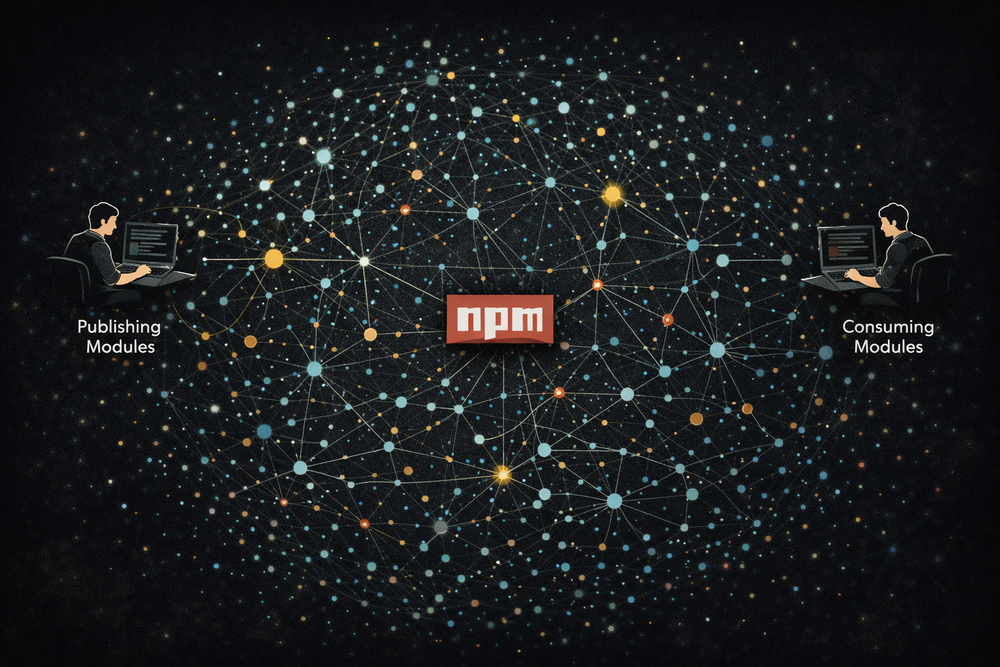
Before npm, other languages already had their own package management systems. Python had pip, and Ruby had gem. However, npm evolved in a fundamentally different direction. The most significant difference was the structure that allowed anyone to create and publish packages with extreme ease. The barrier to entry was minimal, and all packages were connected through a centralized registry. This structure did more than provide convenience—it generated powerful network effects. As the number of packages increased, more developers were drawn into the ecosystem, and as more developers participated, the ecosystem grew even faster.
Perhaps the most important aspect of npm was that it enabled “fine-grained code sharing.” Previously, creating a library implied building something of substantial size and scope. With npm, even a few lines of code could be published as an independent package. This fundamentally changed the direction of JavaScript’s evolution. Instead of being dominated by large frameworks, the ecosystem became composed of countless small modules interconnected with one another. This shift redefined how development was approached. Developers no longer needed to implement everything themselves; instead, they solved problems by composing existing pieces.
This transformation went beyond improving productivity—it altered the very paradigm of development. The value of code was no longer measured by how much was written, but by how effectively it was composed and utilized. npm accelerated this process to an extreme degree. New ideas could be immediately implemented as packages, distributed globally, and refined collaboratively by developers around the world. The speed of this cycle was unprecedented compared to traditional software development models.
In the end, what npm created was not just a tool, but an entire ecosystem. And this ecosystem began transforming JavaScript from a simple language into the fastest-evolving platform in software development. The next step is to examine the philosophy that drove this ecosystem’s growth, and the consequences that emerged from it.
The Philosophy of Small Modules: Unix Philosophy Enters JavaScript
To understand the npm ecosystem, it is not enough to simply observe that “there are many packages.” What matters more is the question: why did so many packages emerge in the first place? The answer to this question is closer to a philosophical choice than a purely technical one. At some point, the JavaScript ecosystem began to follow an implicit rule. Break things down as small as possible, keep them as simple as possible, and solve problems by composing what is needed. This approach was not created by accident, but closely resembles the long-established Unix philosophy.
The core of the Unix philosophy is simple. A program should do one thing well, and multiple programs should be combined to solve larger problems. npm brought this philosophy directly into the JavaScript world. Where it was once common for a single library to contain multiple functionalities, after npm it became natural for a single package to handle only one specific task. As a result, code reusability increased dramatically, and developers began solving problems by composition rather than implementation. This shift did more than improve productivity; it changed the way developers think about building systems.
This structure aligned particularly well with the nature of JavaScript. JavaScript’s dynamic typing and flexible syntax make it well-suited for creating and distributing small modules quickly. Additionally, the web environment itself demands rapid change and experimentation, making modular design inherently advantageous. As a result, the npm ecosystem evolved not as a “finished system,” but as a continuously recomposed and reassembled structure.
However, this philosophy was not without its flaws. While composing small modules introduces simplicity at the individual level, it also creates a new kind of complexity at the system level. Each module may be simple, but once they are connected, the overall structure can become extremely complex. Developers are no longer required to understand a single library, but instead must grasp how dozens or hundreds of modules interact. At this point, the npm ecosystem moves into a new phase. Simplicity, when accumulated, begins to produce complexity—what can be described as invisible structural complexity.
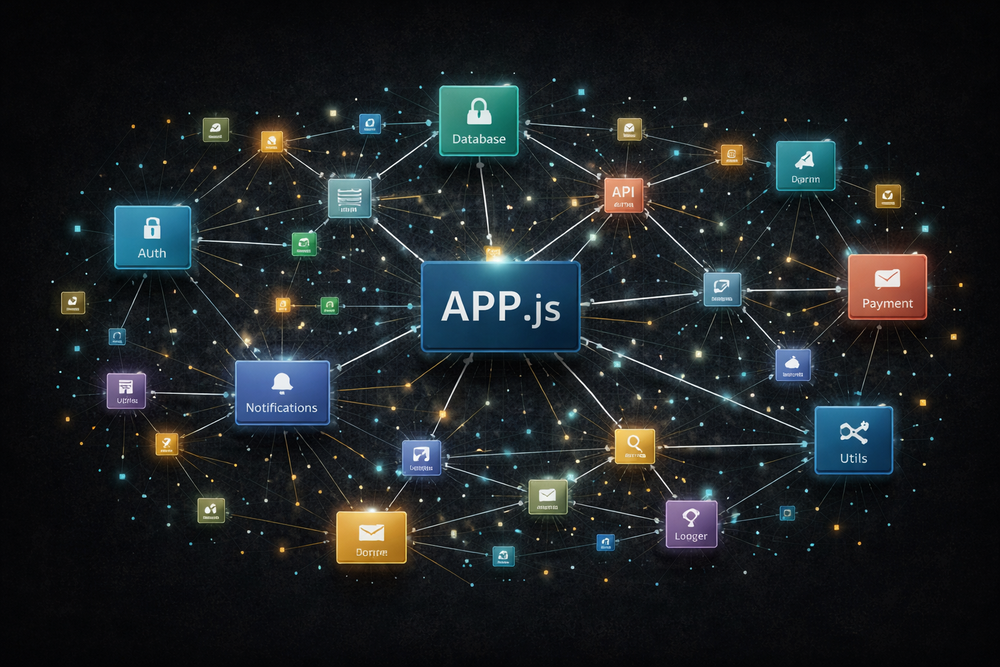
This naturally leads to the next question. As the number of small modules grows, how are their relationships managed? And what happens when those connections fall out of control? The greatest strength of npm also becomes its greatest risk.
The Explosion of Dependency Graphs: Complexity Born from Convenience
One of the most significant changes brought by npm was the dramatic increase in development speed. Problems could be solved simply by installing existing packages instead of implementing functionality from scratch. However, this convenience quickly transformed into a different kind of problem. The moment a single package is installed, its dependencies are installed alongside it, and those dependencies in turn bring in their own dependencies. This process is invisible, but in reality it forms a deep and highly complex tree structure.
Over time, this dependency structure grew exponentially. Even simple projects began to include hundreds of packages, while complex applications depended on thousands. Developers found themselves pulling in massive amounts of external code just to use a few lines of functionality. On the surface, this structure appears harmless, but in reality it resembles a system built on an unstable foundation. This is because the stability of the entire system is determined by the weakest dependency.
An even more critical issue is that most of this complexity exists outside the developer’s awareness. We tend to believe that a single npm install command resolves everything, but behind the scenes, countless packages are downloaded, connected, and locked into specific versions simultaneously. This process is automated, which makes it convenient, but also makes it difficult to identify the root cause of problems. Determining which package version caused an issue or which dependency introduced a conflict becomes an extremely challenging task.
This ultimately leads to the problem of “trust.” We rely on vast amounts of code that we did not write ourselves, assuming that it is safe and stable. However, this assumption can break at any moment. In open-source ecosystems, the maintenance status of a package, security vulnerabilities, or even a developer’s personal decision can impact the entire system. npm made development faster, but it also introduced a dimension in which development became more fragile.
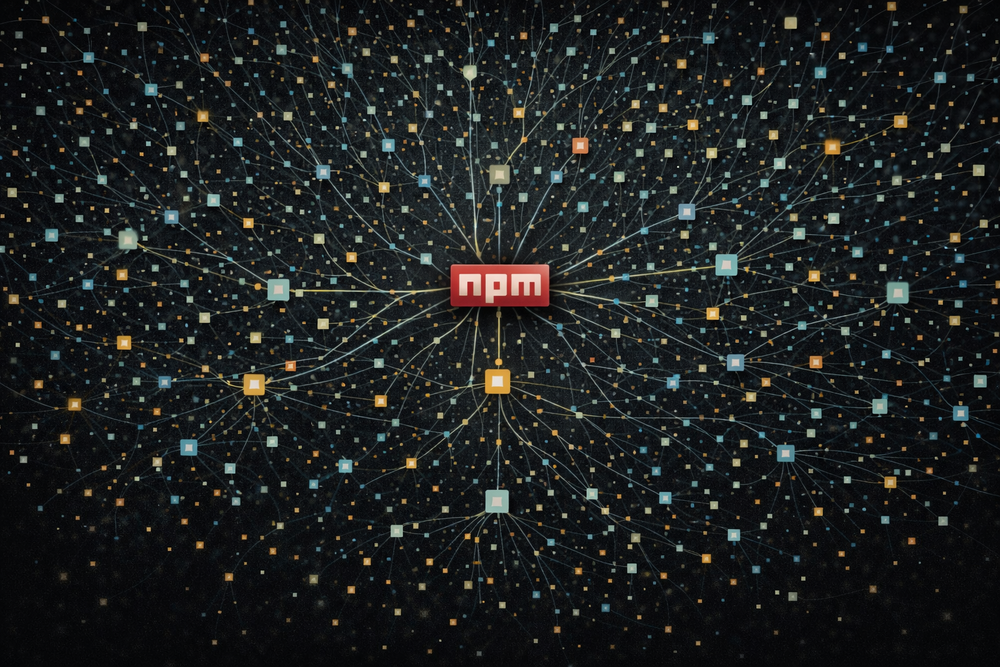
At this point, the npm ecosystem faces not just a technical issue, but a structural risk. And this risk becomes unmistakably visible to developers worldwide through a specific event.
The left-pad Incident: Revealing the Fragility of the Ecosystem
The npm left-pad incident is one of the most symbolic events for understanding the npm ecosystem. Technically, the incident itself was trivial. A package consisting of just 11 lines of code was removed from npm, and as a result, countless projects failed to build. However, what made this event shocking was not the size of the code, but its position within the dependency graph. A tiny module had become a foundational piece for an enormous number of projects, and once it disappeared, entire systems came to a halt.
This was not merely an accident, but an inevitable outcome of the npm structure. The approach of composing small modules maximizes flexibility and productivity, but it can also lead to extreme dependency concentration on specific modules. Utility functions like left-pad were widely used across numerous projects, often indirectly, meaning that a single removal triggered cascading failures. This was not simply a case of “one package being deleted,” but rather a demonstration of how deeply interconnected the entire ecosystem had become.
More importantly, this incident was not caused by a technical failure, but by a human decision. The package was removed not due to a system error, but because of the developer’s choice. This highlights that the npm ecosystem is not purely a technical infrastructure, but a structure built on people and communities. In other words, technical stability alone cannot guarantee system reliability; the social layer above it must also be considered.
Following this event, npm introduced policy changes such as restrictions on unpublishing packages. However, the most significant impact was not the policy shift, but the change in developer awareness. Many developers began to recognize the importance of dependency management, leading to the adoption of practices such as lock files, version pinning, and internal package management strategies. The left-pad incident was not just a minor disruption, but a critical moment in the maturation of the npm ecosystem.

What this incident revealed was not just vulnerability, but the fundamental nature of npm as a system. It is fast and flexible, yet highly sensitive and deeply interconnected. And it is precisely this nature that continues to drive the rapid evolution of the JavaScript ecosystem, while simultaneously introducing new forms of risk.
The Frontend Revolution: React, Vue, and npm-Centered Development
Despite the vulnerabilities exposed by the left-pad incident, the npm ecosystem did not stop. If anything, JavaScript began to expand even more rapidly afterward. At the center of this expansion was a fundamental shift in frontend development. In the past, frontend work was limited to combining HTML, CSS, and a small amount of JavaScript. But at a certain point, it began to transform into something entirely different. Applications became increasingly complex, requiring state management, component architecture, and build processes. And at the foundation of all of this was npm.
In particular, frameworks such as React and Vue.js could not have formed their current ecosystems without npm. These are not simply libraries, but platforms composed of countless packages and tools. Developers no longer use a single library; instead, they construct their development environments by combining Babel, Webpack, ESLint, and a wide range of plugins and utilities. All of these components are connected and distributed through npm. In other words, frontend development is no longer something that happens solely inside the browser—it has become a process that runs on top of an npm-centered development environment.
This shift fundamentally changed how development itself is performed. Previously, developers wrote and tested code directly in the browser. Now, it is standard practice to generate optimized outputs through a build process. Language extensions like TypeScript, code splitting, tree shaking, and bundle optimization are all made possible by tools that operate within the npm ecosystem. This does not merely mean that the tech stack has become more complex; it signals that frontend development has evolved into an independent engineering domain.
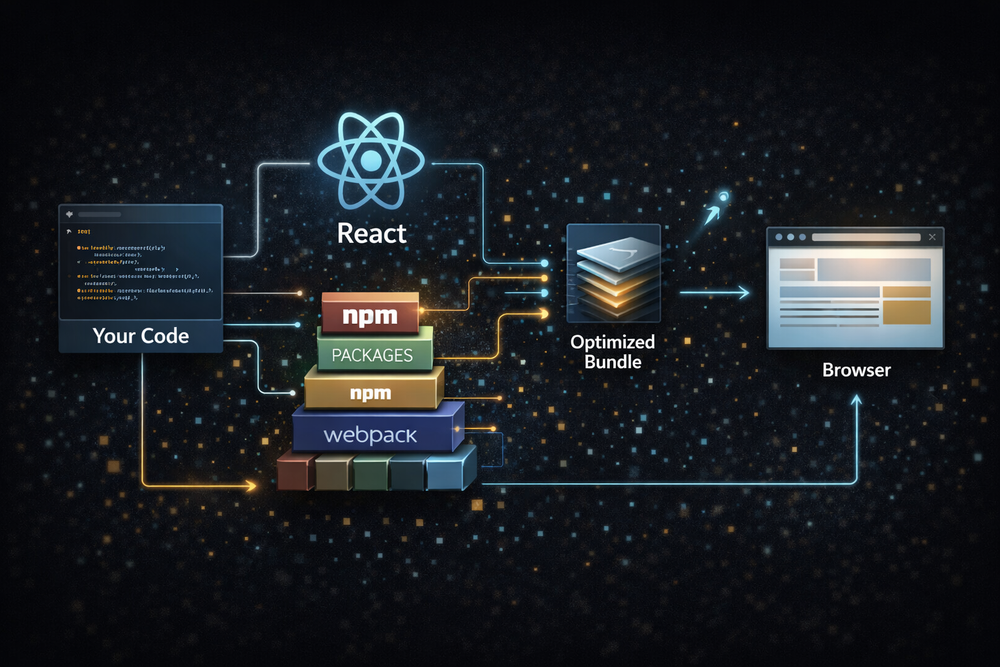
At this point, npm was no longer just “a tool for installing packages.” It had become the infrastructure that drives the entire frontend ecosystem. And on top of this infrastructure, JavaScript began to establish itself not just as a scripting language, but as the fastest-evolving development platform.
Why JavaScript Became the Fastest-Evolving Ecosystem
For a long time, JavaScript was considered an “imperfect language.” Its syntax lacked consistency, its type system was loose, and it was widely believed to be unsuitable for building large-scale applications. Yet at some point, it transformed into the ecosystem that evolves faster than any other language. While improvements to the language itself played a role in this transformation, the more critical factor was the npm ecosystem. npm became the system that accelerated the process by which ideas turn into code, and code turns into standards.
In other languages, it takes a significant amount of time for new ideas or patterns to spread. There are long validation processes before something becomes part of a standard library or is recognized as an official tool. But in JavaScript, this process works in a completely different way. When a new idea emerges, it is immediately implemented and distributed as an npm package. Developers around the world can freely use it, provide feedback, and improve it. This cycle repeats at an extremely fast pace, and successful patterns naturally become de facto standards.
This structure dramatically accelerates the cycle of “experiment → diffusion → standardization.” For example, promise-based asynchronous handling, state management patterns, and component-based architectures all began as individual ideas, but spread rapidly through npm and eventually became standard practices. This demonstrates that the evolution of JavaScript is not driven solely by language designers, but by the entire community collectively shaping the language’s direction. npm functions not just as a distribution channel, but as a platform for experimentation and validation of new ideas.
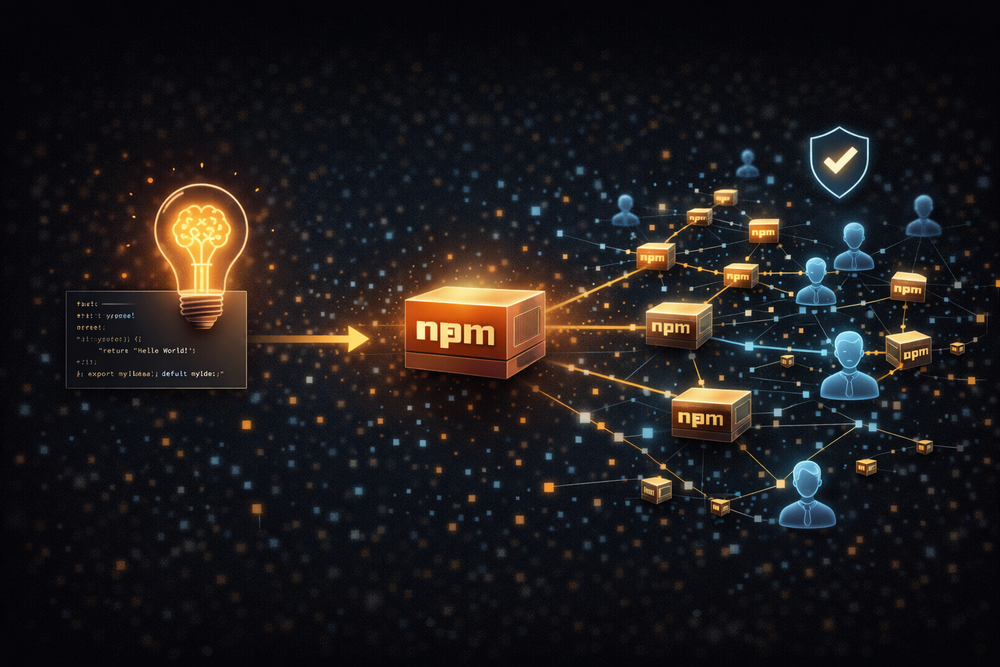
Because of this structure, JavaScript—despite its inherent weaknesses—has become the most adaptive and rapidly evolving ecosystem. And this speed does not stop at technological advancement; it evolves into a powerful network effect.
npm as a Platform: Not Code, but a Network
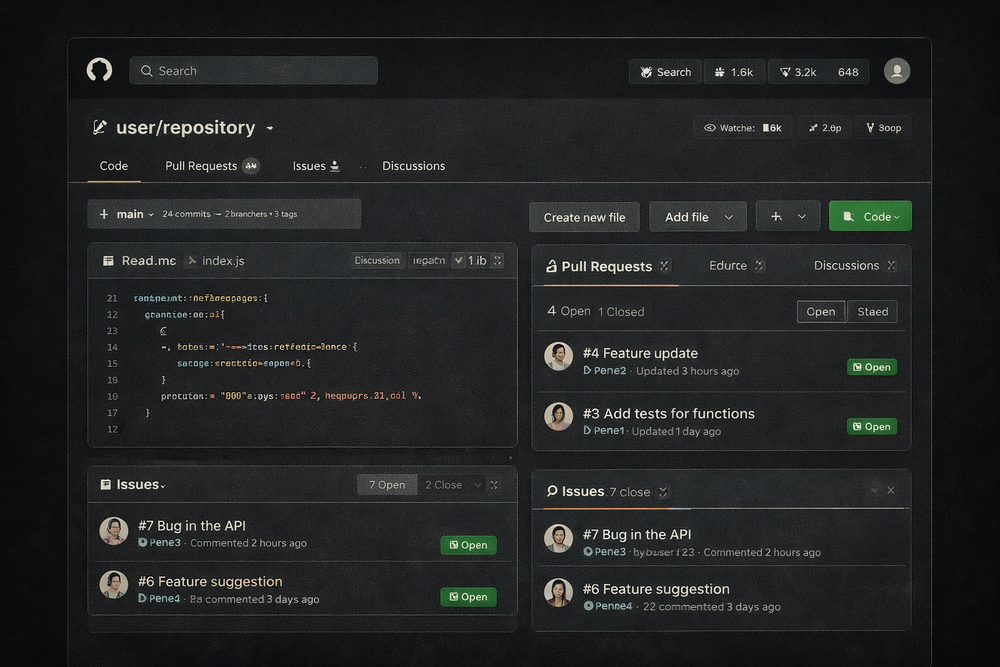
At this stage, it no longer makes sense to view npm as just a tool. npm is a platform, and at its core is not code, but a network. With millions of packages and countless developers interconnected, this structure goes far beyond a simple repository. If GitHub turned collaboration into a platform, npm turned the consumption of code into a platform. Developers are no longer only writing code—they are constantly integrating and composing code written by others.
This network has a powerful self-reinforcing structure. As the number of packages increases, more developers are drawn into the ecosystem. As more developers participate, even more packages are created. Through this cycle, npm has established itself as the central infrastructure of the JavaScript ecosystem. While other languages also have package management systems, few have grown as rapidly and at such scale as npm. The reason lies not just in technical excellence, but in a structure that maximizes network effects.
Moreover, npm has fundamentally changed how developers behave. In the past, solving a problem meant writing code from scratch. Now, the natural first step is to search npm for an existing package. This represents a shift in the starting point of development itself. Problem-solving has moved from “production” to “search and composition.” This transformation has significantly increased development speed, but it has also deepened the reliance on dependencies.
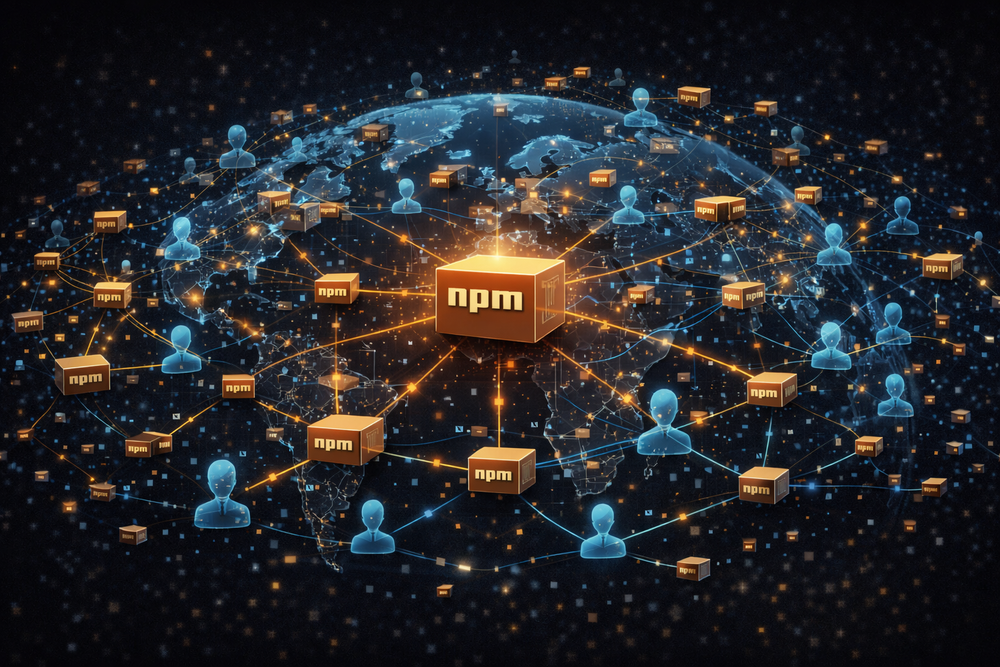
Ultimately, npm was the key element that transformed JavaScript from a simple language into a platform. And this platform would later serve as the foundation for Docker, cloud computing, and modern development environments. In the next section, we will examine what npm ultimately created as a system.
Conclusion: What npm Created Was Not Packages, but Speed
Following the flow so far, one crucial fact becomes increasingly clear. The transformation brought by npm was not simply about the convenience of installing packages. It was a change at the level of redefining how development itself is done. In the past, implementing a single feature required writing code from scratch, validating it, and then making it reusable, which took a significant amount of time. However, after npm emerged, developers no longer needed to build everything from the ground up. Problems could be solved by combining the vast number of existing packages, and this process could be executed at an extremely fast pace. The essence of this change is simple. npm was a system that structurally accelerated development speed.
This speed goes far beyond merely reducing working time. It shortens the time it takes for ideas to become reality. In the past, experimenting with a new concept or architecture required substantial preparation and implementation. Now, experimentation can be achieved simply by combining a few packages. As a result, development has increasingly shifted toward an experiment-driven model, where the cost of failure is lower and the speed of success propagation is significantly higher. In such an environment, rapid iteration becomes more valuable than perfect design. npm was the tool that pushed this dynamic to its extreme.
However, this speed does not always produce positive outcomes. The dependency issues and the left-pad incident discussed earlier demonstrate how fragile such a fast-moving structure can be. Developers have become increasingly dependent on external code, and as a result, system stability has expanded into areas beyond individual control. Additionally, the rapid pace of change shortens the lifespan of technology stacks and forces continuous learning. In other words, the speed created by npm simultaneously expands both opportunity and risk.
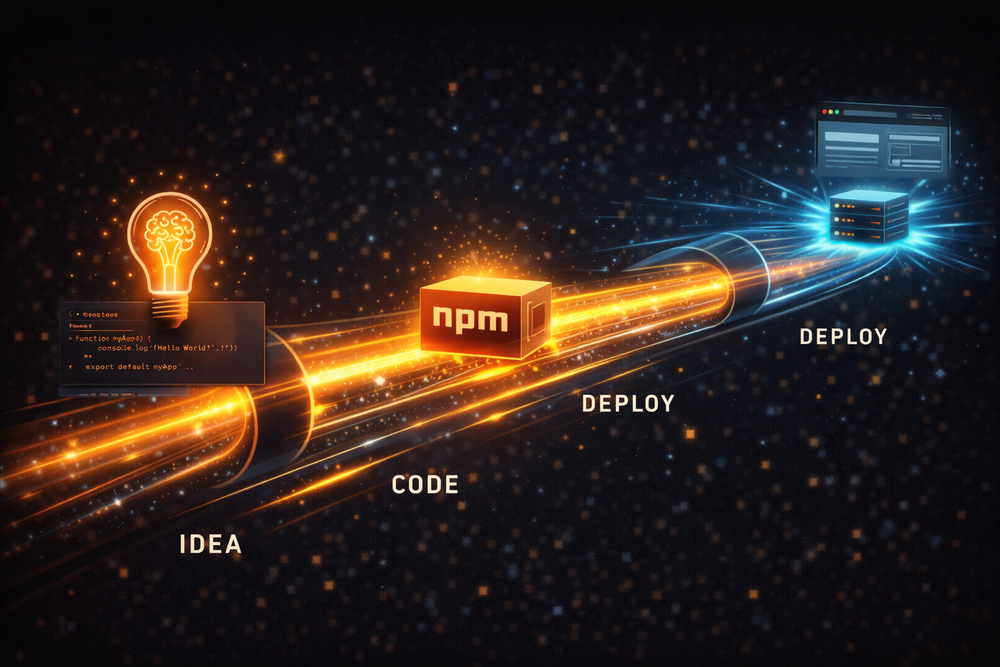
Despite this, the transformation brought by npm has become irreversible. JavaScript is no longer a language confined to the browser; it has evolved into a core technology spanning servers, frontend, and multiple platforms. At the center of this growth was npm. It was not just a tool, but an infrastructure that enabled development to occur on top of a network. This infrastructure became the foundation for many technologies that followed. Container-based deployment, cloud-native environments, and modern CI/CD pipelines all operate on the philosophy of building fast and deploying fast.
At this point, a natural question emerges. Why has development speed become so critical? And what technology pushed this speed even further to its extreme? If npm made it possible to build code quickly, the next step was how to execute and deploy that code even faster. It is within this flow that Docker emerged. In the next article, we will explore how Docker broke down the boundary between development and deployment, and standardized the execution environment of software itself.