
Where the Things We Take for Granted Began
We write code every day, create commits, install packages, and deploy applications. All of these processes feel so familiar that they no longer seem remarkable. Like air, or electricity, they have become a foundation we use naturally without conscious awareness. But this sense of normalcy did not exist from the beginning. Rather, the way we develop software today is the result of countless events, decisions, failures, and coincidences layered over time.
The history of software is not merely a history of technological advancement. It is a record of the problems people faced and how they attempted to solve them. Sometimes a personal hobby project reshaped global infrastructure. Sometimes a strategic decision by a company created an entirely new ecosystem. And in some cases, a mere eleven lines of code brought the entire internet to a halt. Through this series, we have followed those moments—not focusing simply on what was created, but on why it was needed, and what changed as a result.
A History of Choices, Not Just Technology
If there is a single thread running through this series, it is that the evolution of software has been driven less by technology itself and more by a series of choices. Linux was not just an operating system; it was the result of choosing community-driven collaboration over centralized development. Git, likewise, was not simply a tool with new features, but a response to the limitations of existing collaboration methods. Stack Overflow introduced a new way of sharing knowledge, and GitHub transformed open source into a platform.
These changes did not begin with grand declarations of innovation. Most started as practical decisions to solve immediate problems. But as those decisions accumulated, they eventually reshaped the entire culture of development. The workflow we use today was built from these layers of choices. Creating branches, submitting pull requests, installing packages, and deploying with containers are not just technical procedures—they are the outcomes of decisions made in the past.
What matters here is that the way we work today is not the only possible answer. It is simply one form that emerged from what was, at the time, the most reasonable set of choices. And that also means it can change again.
Small Tools, Massive Change
Many of the events we explored in this series seemed trivial at first. Git was just a version control system. npm was merely a package manager for JavaScript libraries. Docker began as a tool to simplify how applications are run. Yet these tools went far beyond convenience; they fundamentally restructured how development itself works.
This transformation happens gradually. At first, a tool appears to offer simple convenience. Over time, it becomes a prerequisite. Today, it is almost unimaginable to develop software without a package manager. Likewise, deploying applications without containers is increasingly seen as inefficient. In this way, tools embed themselves deeper and deeper into the development process until they eventually redefine the very assumptions of development itself.
What is particularly interesting is that these changes are not always positive. Incidents like npm’s left-pad and Log4Shell reveal how fragile our systems can be. Just as a small tool can drive massive change, a small vulnerability can ripple across the entire world. These events expose the reality that the systems we have built are both incredibly powerful and inherently fragile.
A Connected World and Invisible Dependencies
Modern software no longer exists in isolation. A single application depends on dozens, sometimes hundreds, of libraries, and those libraries depend on others in turn. This structure enables rapid development, but it also creates layers of complexity that we rarely perceive.
The events covered in this series clearly illustrate this interconnectedness. GitHub connected developers into a global network. npm expanded code reuse to an extreme degree. Docker and Kubernetes separated applications from infrastructure, enabling consistent execution anywhere. Together, these changes transformed software into a vast, interconnected system.
But connectivity has two sides. As connections increase, efficiency improves—but so does risk. When a single package disappears or a vulnerability is discovered, the impact can spread far faster and wider than expected. We have seen this through the events in this series. These were not merely accidents, but reflections of the fundamental nature of the systems we have built.
Where the Next Change Will Begin
Even now, new tools and platforms are emerging. In particular, AI-driven development tools are beginning to redefine how software is built. Code generation, automated testing, and even design-level assistance are no longer experimental—they are becoming part of everyday development. This shift is not just about improving productivity; it is about transforming the role of the developer itself.
Looking back, every major shift began with a specific problem. Git emerged because collaboration was difficult. Stack Overflow was created because knowledge sharing was inefficient. So what problems are we facing today? And what tools will emerge to solve them?
It is possible that the next decisive moment has already begun. We may simply not yet recognize its scale. Historically, change has always started gradually, then crossed a threshold where it expanded rapidly. After that point, returning to previous ways of working became impossible.
What Choices Are We Standing On
What this series ultimately reveals is a clear truth: the world of software is not just a collection of technologies, but the result of choices. Decisions about what tools to build, what approaches to adopt, and what structures to maintain have shaped the ecosystem we have today.
And those choices were made by people. Linus Torvalds created Git. Countless developers contributed to open source projects. Communities shared knowledge through Stack Overflow and collaborated through GitHub. Everything we use today began as someone’s attempt to solve a problem.
This leads to an important question. What choices will we make going forward? Whether we adopt new tools, maintain existing approaches, or attempt entirely new directions will shape the future of development in ways we cannot yet fully predict.
In the End, It Is Not Just About Code
We often think of software as code. But what this series reveals is that something even more important exists beyond the code itself. It is the way code is created, shared, and executed. In other words, software is not just a product—it is an entire process.
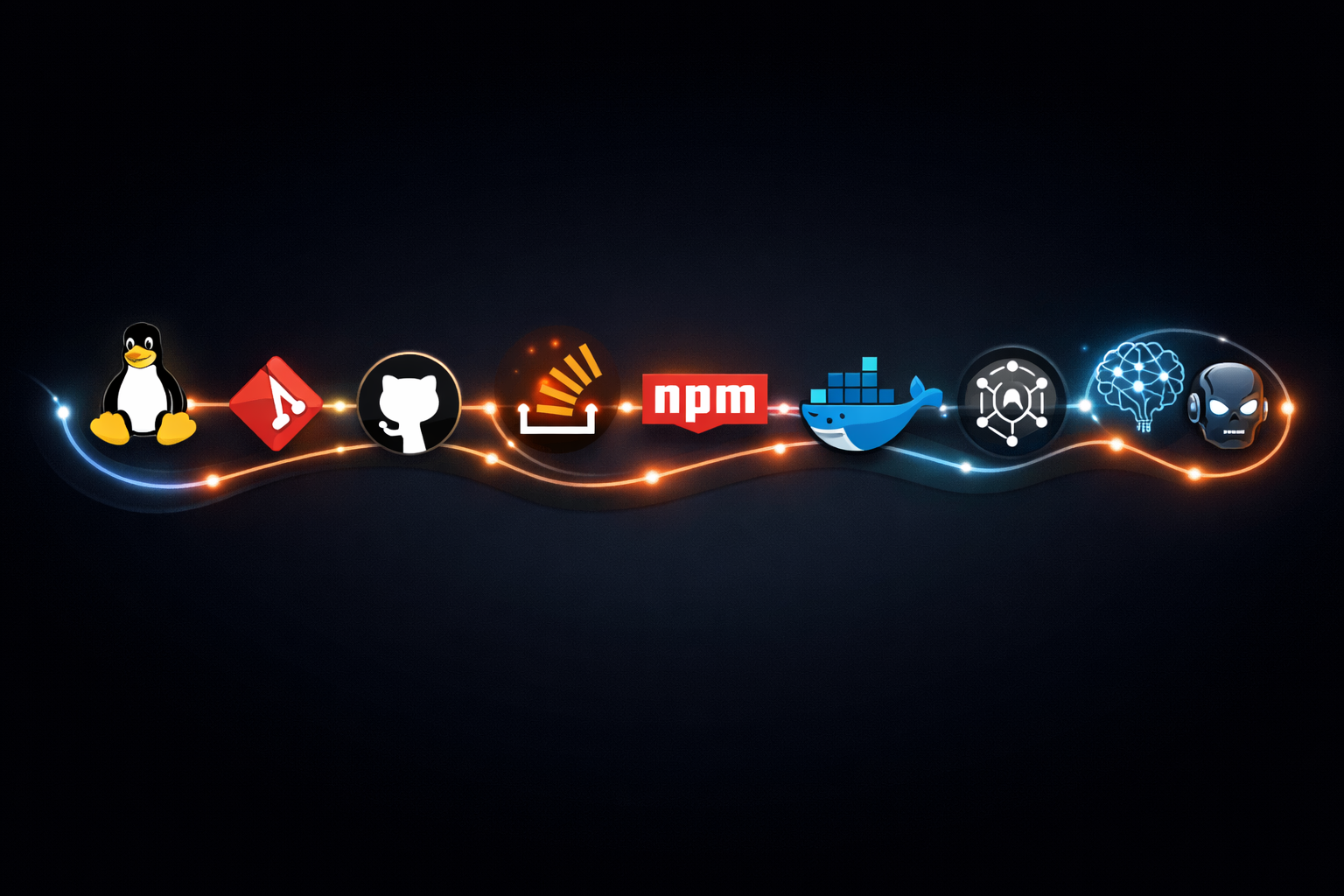
Linux, Git, GitHub, Stack Overflow, npm, Docker, and countless tools that followed have all reshaped that process. And this transformation is far from over. The moment we assume that today’s methods are permanent, a new tool may emerge to challenge that assumption.
Ultimately, the history of software is not the story of finished systems, but of an ongoing evolution. And we are still standing in the middle of it.