Text Tools Are Converging on a Common Syntax
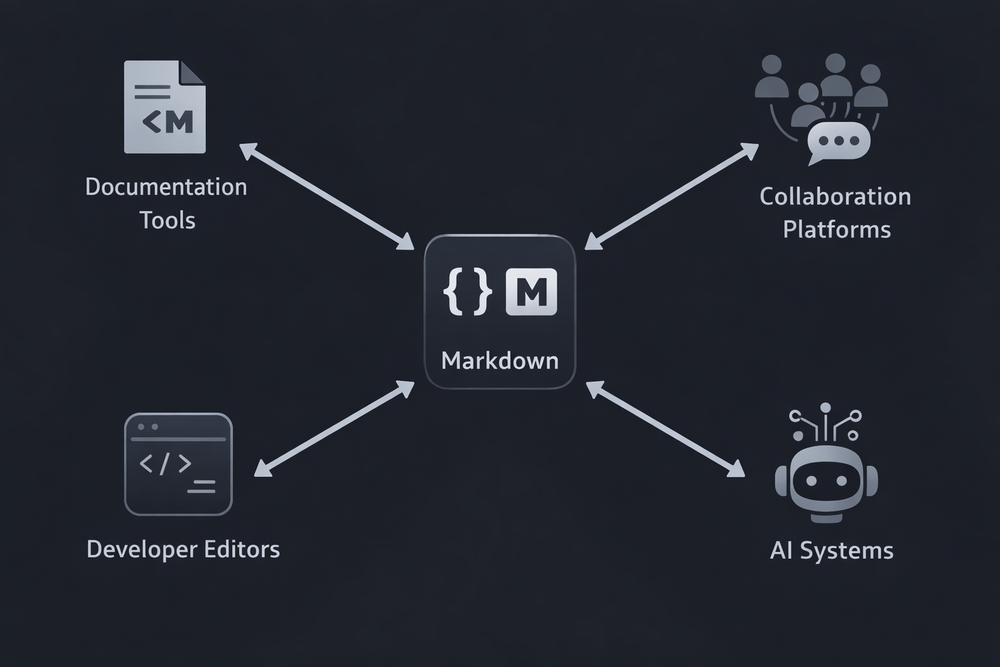
In recent years, an interesting pattern has emerged across a wide range of software. Tools with very different purposes are beginning to represent text in increasingly similar ways. GitHub README files used by developers, Notion pages for collaborative documents, Slack messages for team communication, Discord channels in developer communities, and even personal knowledge tools like Obsidian—all of these products, despite serving different domains, rely on Markdown or Markdown-like syntax as their default way of expressing text. At first glance, this may seem like a simple convenience feature. But considering how widely this pattern appears, it is difficult to view it as mere coincidence. Rather than evolving in completely different directions, text tools appear to be gradually converging toward a shared representation model.
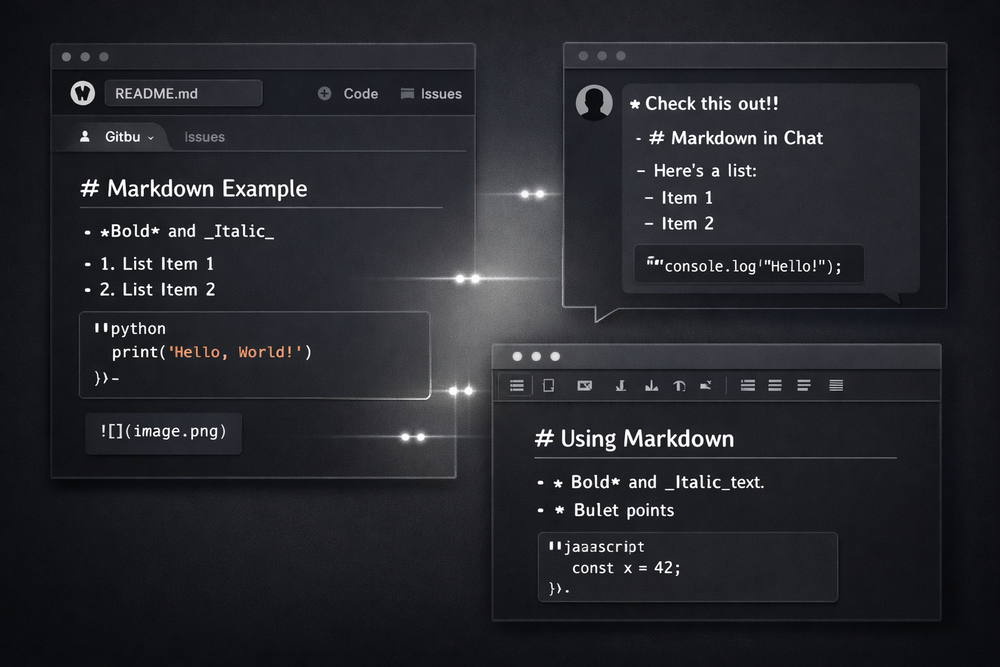
This trend becomes especially clear in collaborative environments. On GitHub, writing project documentation in Markdown has effectively become a standard, and developers naturally use Markdown syntax for explanations and documentation. At the same time, in tools like Notion, elements such as headings, lists, code blocks, and links are structured in ways almost identical to Markdown. Chat platforms like Slack and Discord also adopt Markdown-style syntax for bold text, code blocks, and links. Even large language model–based AI systems, which have emerged more recently, tend to use Markdown as their default output format. When presenting code examples, they use code blocks; when structuring explanations, they rely on headings and lists. Different systems, without explicit coordination, have arrived at remarkably similar conventions.
This phenomenon is not simply a matter of syntax becoming popular. It signals a deeper shift in how text tools are designed. In the past, document tools focused on producing finished outputs within a specific application. Today, however, tools increasingly treat text itself as a structured form of data. Documents, messages, code explanations, knowledge notes, and collaboration records are all stored and shared as text, moving fluidly between different systems. In such an environment, complex, application-specific formats become less practical than simple, flexible text syntax that can still express structure. Markdown can be seen as the natural solution that emerged at this intersection.
This article begins with a central question: why are text tools converging on similar syntax? Is it simply because Markdown is convenient, or is there a deeper structural reason behind it? To answer this, we first need to explore how Markdown originated and what problems it was designed to solve.
How Markdown Was Created
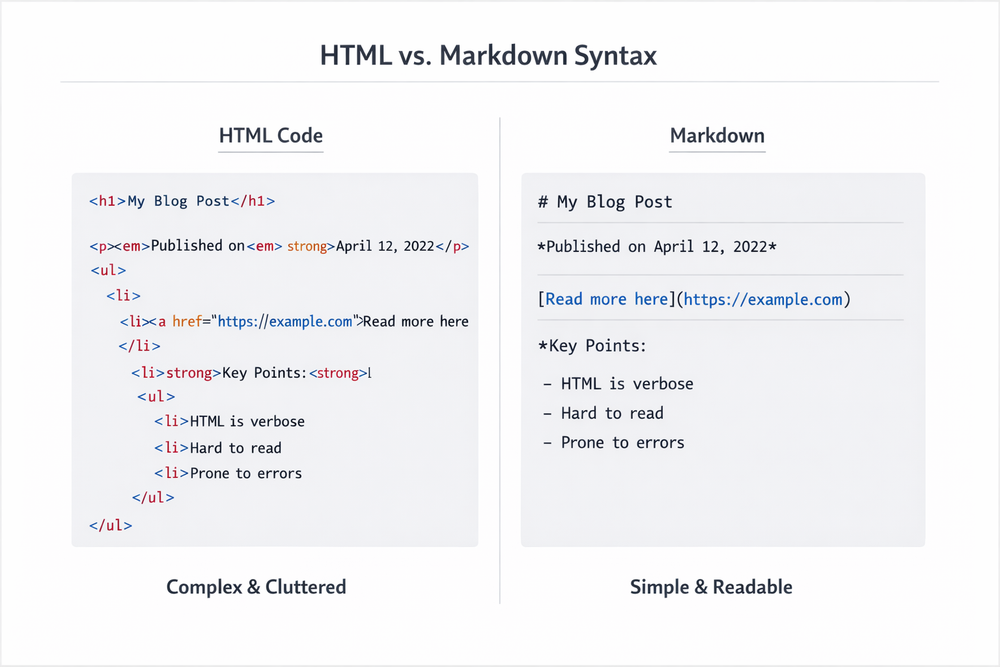
The story of Markdown goes back to 2004. At the time, the most common way to write web documents was to write HTML directly. While HTML was a powerful language for representing web pages, it was quite inconvenient for those creating documents. Even simple emphasis required typing tags like <strong>, and creating lists or links meant remembering multiple tags. Although HTML documents looked clean when rendered in a browser, the source code itself was often cluttered with tags, making the actual text harder to read. In many cases, the structural tags stood out more than the content itself.
Markdown was created to solve this problem. John Gruber and Aaron Swartz designed it with the goal of allowing writers to avoid dealing directly with HTML. Their core principle was simple: a document should be easy to read even before it is rendered. In other words, a Markdown document should remain understandable in its raw form, before being converted into HTML. To achieve this, Markdown syntax was designed to be highly intuitive—using double asterisks for emphasis, hash symbols for headings, and dashes for lists. These conventions are easy to understand without special tools and closely resemble plain text.
One of Markdown’s key strengths is the balance between “readable text” and “structured documents.” HTML is powerful for expressing structure but difficult to read, while plain text is easy to read but lacks the ability to represent structure. Markdown was designed to satisfy both needs simultaneously. It reads like plain text, yet clearly expresses structure such as headings, lists, code blocks, and links. This balance made it suitable for use across many different systems.
When Markdown was first introduced, few people expected it to become so widely adopted. Initially, it was mainly used for writing blog posts or simple web documents. Over time, however, its advantages became apparent in more and more environments. In particular, Markdown spread rapidly within developer communities, where it fit naturally into workflows that involved managing both code and documentation together.
Two Philosophies of Document Tools: WYSIWYG vs Plain Text
Looking more broadly at the history of document tools helps clarify the position of Markdown. Over the past decades, document creation tools have evolved along two major directions. One is the WYSIWYG approach, exemplified by Microsoft Word. WYSIWYG stands for “What You See Is What You Get,” meaning that what appears on the screen matches the final output. Users can write and see the result at the same time—applying bold text or setting headings immediately reflects on the screen. This approach is intuitive and easy to learn, which is why it has become familiar to many users.
However, the WYSIWYG approach also has limitations. Because documents are stored in complex internal formats, they are difficult to move across systems and are not well suited for version control. In collaborative environments where multiple people edit the same document, conflicts are more likely to occur. Additionally, documents are often tied to specific applications—for example, Word files are best edited within Microsoft Word. These characteristics can create friction in collaborative and development contexts.
The alternative approach is to write documents entirely in plain text. A representative example is LaTeX. In LaTeX, document structure is defined through textual commands, which are later rendered into a final document. This approach is extremely powerful and capable of producing complex documents, but it is also difficult to learn. Its syntax is complex, creating a high barrier to entry for general users. Markdown can be seen as a solution that emerged between these two worlds.
Markdown is a fully text-based document system, but it is not as complex as LaTeX. At the same time, it maintains a much simpler structure than WYSIWYG systems like Word. As a result, Markdown documents are easy to read and write, while still clearly expressing structure. Because of this, they can be easily processed across different programs. This combination of simplicity and structure is why Markdown has become widely used not only for personal documents but also in collaboration tools and development environments.
At this point, the significance of Markdown becomes clearer. Markdown is not just a syntax—it is a philosophical choice about how documents should be created. Instead of producing a finished result within a specific application, it emphasizes writing structured text that can be used across multiple systems. This characteristic is what makes Markdown so important in modern collaboration platforms and development tools.
The Moment GitHub Made Markdown the De Facto Standard
The decisive turning point for Markdown’s widespread adoption came with the rise of GitHub. Although Markdown was introduced in 2004, it was initially used in a limited way for blog posts or simple web documents. However, as GitHub grew into the central platform for open-source development, Markdown took on an entirely different role. GitHub allowed repository README files to be written in Markdown and rendered them automatically on the web. Developers naturally began writing project descriptions, installation guides, usage examples, and API documentation in Markdown—and these documents were stored alongside the code within the same repository.
This shift carried meaning far beyond a simple convenience feature. Previously, documentation was often managed separately from code, stored in wikis or external systems loosely connected to the repository. With GitHub, however, code and documentation were managed together in the same place. This structure encouraged developers to treat documentation like code. Documents were version-controlled through Git, reviewed via pull requests, and updated alongside code changes. Markdown was ideally suited to this environment. Because it is text-based, changes can be easily compared in Git, and conflicts can be resolved relatively simply.
Over time, Markdown became the de facto standard documentation format on GitHub. Most open-source projects include a README.md file, and developers often form their first impression of a project through it. Markdown allows intuitive representation of key elements such as code blocks for examples, lists for instructions, and headings for structure. As developers became familiar with this syntax, it began to spread beyond GitHub to other platforms. Markdown was no longer just a document format—it was becoming a shared language across the developer ecosystem.
GitHub’s influence extended even further. Nearly all text fields on the platform—GitHub Actions, Issues, pull request descriptions, and wiki pages—began to rely on Markdown. Developers used Markdown daily to write documentation, report issues, and leave code reviews. Through this process, Markdown became a natural part of development culture. As Git-based workflows that integrate code and documentation spread, Markdown spread with them. Ultimately, it established itself as the common documentation language within developer communities, laying the foundation for its expansion into collaboration tools and knowledge management systems.

Why Notion and Collaboration Platforms Chose Markdown
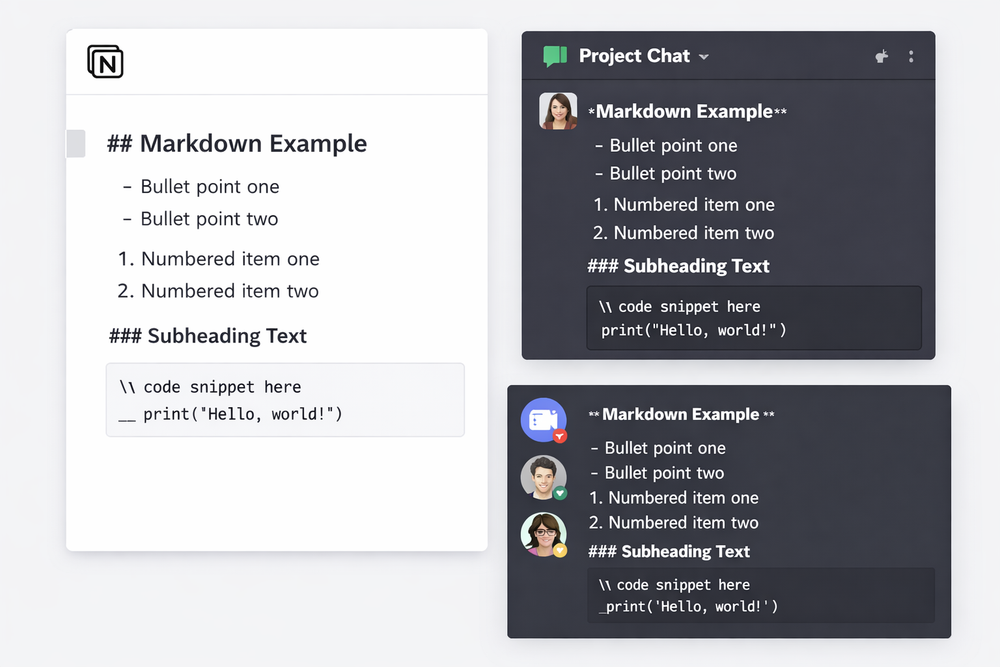
After Markdown spread widely within the developer ecosystem, it began to expand into collaboration tools and knowledge management platforms. A representative example is Notion. Although Notion uses a block-based document system, its text input method is very similar to Markdown. Users create headings with #, write lists with -, and represent code blocks or inline code using simple syntax. Chat platforms like Slack and Discord follow a similar pattern, allowing bold text, code blocks, and links to be written using Markdown-style syntax. While these platforms serve different purposes, a common pattern in text representation has clearly emerged.
There is a clear reason for this. Markdown is a simple syntax, yet it provides the essential features needed to express document structure. In collaboration tools, messages and documents carry more meaning than plain text. Meeting notes, technical documentation, task plans, and code explanations are all stored as text. In these cases, plain paragraphs are not enough—structure is required. Headings, lists, code blocks, and links all play a role. Markdown allows these structures to be expressed in a very simple way. Users can create structured documents without learning complex editors, and systems can easily process that structure as data.
Another important factor is that Markdown is well-suited for storage as a text-based data structure. Collaboration platforms do not simply display documents—they manage them as data. Features such as search, version control, linking, and automated transformation are essential. Because Markdown is fundamentally text, these operations become much easier. It can be stored in databases, transmitted between systems, and processed without difficulty. This makes Markdown highly compatible with the internal architecture of collaboration platforms.
Interestingly, many platforms do not use Markdown exactly as-is, but adopt syntax that is very similar to it. This is because Markdown has already become a familiar input method for users. Even when using new platforms, users naturally type in Markdown-style syntax. From a platform’s perspective, aligning with familiar conventions is far more efficient than introducing entirely new ones. For this reason, Markdown has increasingly established itself as the default way of representing text across many collaboration tools.
Why Markdown Became a Platform-Independent Document Format
Another key reason Markdown has spread so widely is its platform independence. Many document formats are tightly coupled to specific applications. For example, Microsoft Word documents are designed to work best within Word. While they can be opened in other programs, the exact same result is not always guaranteed. Because such documents contain complex formatting information and metadata, different programs may interpret them differently. This can create problems in collaborative environments—layouts may change, or certain features may not function correctly when opened in another tool.
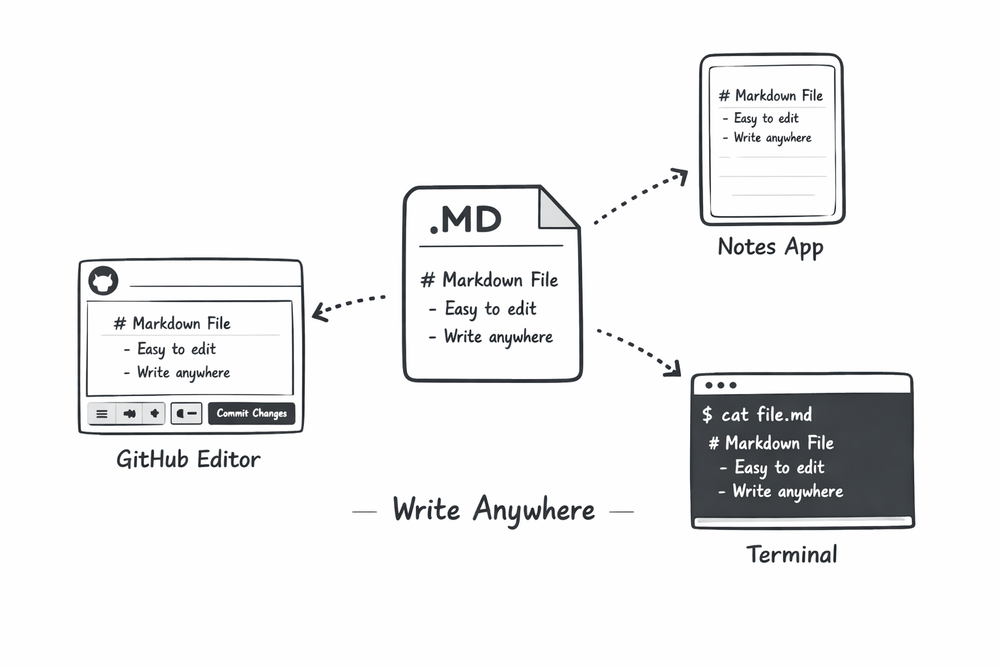
Markdown avoids these issues at a fundamental level. A Markdown document is essentially a simple text file. It can be opened in any environment, regardless of the operating system or application. Even without a dedicated Markdown editor, it can be read and edited using a basic text editor. This makes Markdown a highly flexible document format. Because it is not tied to any specific platform, it can move freely across systems. A Markdown file can be stored in a Git repository, uploaded to a web service, or kept locally without any compatibility concerns.
This platform independence is particularly advantageous in development environments. Developers manage code using version control systems like Git. Since Markdown files are plain text, changes are easy to track. Comparing two versions clearly shows what has been modified, and conflicts that arise from simultaneous edits can be resolved relatively easily. These characteristics make Markdown especially well-suited for collaborative workflows.
Ultimately, Markdown’s widespread adoption can be understood as the result of three combined factors: simplicity of syntax, ability to express structure, and independence from any specific platform. Because of these qualities, Markdown has evolved beyond a format tied to a single application into a common document language that connects multiple systems. What began as a tool within developer environments has now expanded into collaboration platforms and knowledge management tools, forming a broader text ecosystem. And this trend is closely connected to the next transformation we will explore—the rise of text tools in the age of AI.
Why Markdown Has Become Important Again in the Age of AI
The widespread use of Markdown is not just due to its convenience for writing documents. In recent years, its renewed importance has been driven by the rapid advancement of AI technologies. With the emergence of large language models (LLMs), the way we handle text is fundamentally changing. AI models operate primarily on text, and they can process structured text far more effectively than unstructured content. Markdown fits perfectly into this context. Although it is plain text, it also contains rules for expressing document structure. Elements such as headings, lists, code blocks, and tables are clearly defined, making it easier for AI models to understand the content.
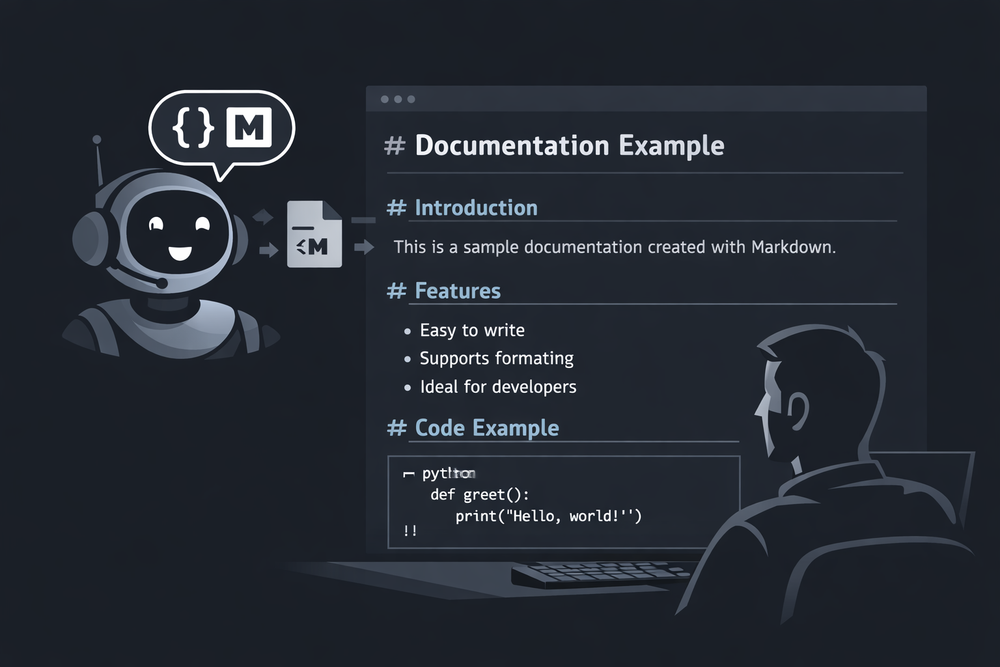
For example, when writing code explanations or technical documentation, Markdown’s code blocks play a crucial role. Content within code blocks is treated differently from regular text, and AI models can recognize it as a separate context. Similarly, heading structures clearly define the hierarchy of a document. This structure is highly beneficial when AI systems summarize long texts or extract specific information. In fact, many AI systems naturally generate responses in Markdown format. They use code blocks for examples and headings or lists to structure explanations. This is not just for readability—it is because structured text is inherently easier for AI to interpret.
Looking at text tools in the AI era, it becomes clear how naturally Markdown is being used. Tools like GitHub Copilot and other AI coding assistants output explanations in Markdown format. Large language models such as ChatGPT do the same. When writing long explanations, using Markdown-style headings and code blocks significantly improves clarity. As a result, Markdown has become a shared format used by both humans and AI. Its ability to be easily read by humans and easily processed by machines makes it especially well-suited for AI-driven environments.
At this point, the role of Markdown becomes even clearer. It is no longer just a document syntax—it is becoming an interface for communication between humans and machines. AI models interpret text based on Markdown structure, and users can directly read the results without additional transformation. This dual advantage is what makes Markdown a natural and powerful format in the age of AI.
Document Systems After Markdown
As Markdown became widely adopted, a new question began to emerge: will Markdown become the final form of all document systems? In practice, while Markdown is highly useful, it is not a perfect format. It has limitations when it comes to expressing complex layouts or highly sophisticated document structures. For example, table representation is limited, and more advanced structures often require additional extensions. Because of these limitations, many platforms have evolved by extending or modifying Markdown rather than using it as-is.
A representative example is GitHub Flavored Markdown. GitHub introduced several extensions to the base Markdown syntax, including task lists with checkboxes, improved table support, and enhanced code highlighting. These extensions were designed to preserve Markdown’s simplicity while adding features necessary for real-world documentation. As developers became accustomed to these features on GitHub, similar capabilities began to appear on other platforms as well.
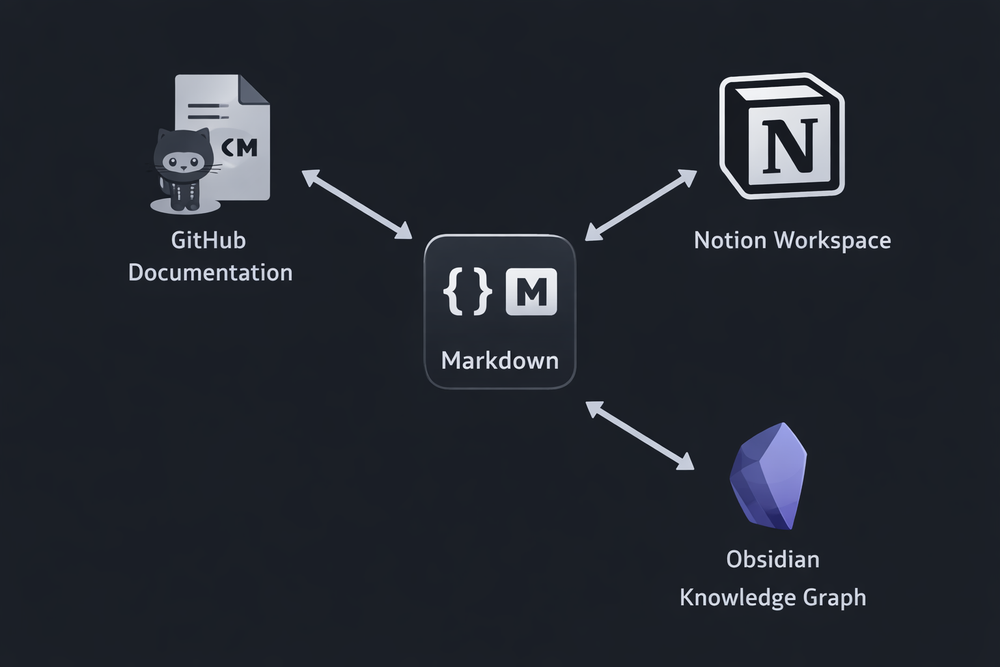
Tools like Notion and Obsidian follow a similar approach. They are built on Markdown syntax but use more complex internal data structures. Notion, for instance, relies on a block-based document system, while Obsidian layers link graphs and extensions on top of Markdown files. Users write text using Markdown, but internally, the system manages it as a richer data structure. This enables features such as linking between documents and automated organization.
These developments show that Markdown’s role is evolving beyond a simple syntax into the foundational structure of document systems. Rather than replacing Markdown with entirely new formats, most platforms choose to build on top of it. This is largely because Markdown is already widely adopted. Maintaining a familiar syntax while adding new capabilities is far more efficient than introducing something entirely new. As a result, Markdown is not being replaced—it is continuously expanding across different systems.
Why Text Is Becoming Central Again
When we look at changes in document systems from a broader perspective, an interesting pattern emerges. For a long time, the software industry evolved around graphical interfaces. WYSIWYG editors, rich document formats, and visually driven editing environments were emphasized. Tools like Word and PowerPoint represent this trend. Users created documents based on what they saw on the screen, directly adjusting formatting and layout. This approach was highly effective for producing visually polished documents.
However, in recent years, text-centered systems have regained importance. Git-based documentation, Markdown-driven collaboration tools, personal knowledge management systems, and even AI models all rely on text-centric structures. The reason for this shift is that text is the most flexible data format. It is easy to version, easy to search, and easy to process across different systems. In collaborative environments especially, text-based documents are far more efficient to manage. Markdown serves as a tool that preserves this text-based structure while still enabling clear expression of document organization.
Another important change is that software is increasingly connected to automated systems. Technologies such as AI models, search systems, and automated document generation tools all operate primarily on text-based data. In such environments, simple text structures are far more effective than complex document formats. Markdown is one of the formats best suited to this context. It remains plain text while still expressing structure, making it highly adaptable across systems.
Ultimately, the spread of Markdown is not just a trend in syntax—it represents the return of text-centered software architecture. Markdown plays a key role within this shift. And this naturally leads to the next question: if text tools are becoming so central, how are the most fundamental tools for writing text—editors—changing? The next article will explore this very topic: how simple text editors evolved into full development platforms.
Text Tools After Markdown and What Comes Next
Looking at the trajectory so far, it becomes clear that Markdown represents more than just a convenient document syntax. Originally created to simplify writing web documents, it has evolved into a common language used across development tools, collaboration platforms, personal knowledge systems, and even AI tools. GitHub established Markdown as a de facto standard for developer documentation, while platforms like Notion and Slack structured their content around Markdown-style syntax. More recently, with the rise of large language models, Markdown has also become a format for communication between humans and AI. This shift shows that Markdown is no longer just a text syntax—it is becoming an interface for representing information in modern software systems.
What is particularly interesting is that, despite its widespread adoption, Markdown has remained extremely simple. While many technologies grow increasingly complex over time, Markdown has taken the opposite path. Its core syntax has barely changed, and most systems have chosen to extend it rather than replace it entirely. This is because Markdown already provides a structure that is both simple and flexible. Users can write text easily, and systems can process that text in multiple ways. This structure naturally aligns with collaboration, automation, and AI-driven systems.
The importance of Markdown lies in this balance between simplicity and extensibility. For users, it removes the need to learn complex syntax; for developers building systems, it provides a structured format that is easy to process. Because Markdown documents are plain text, they integrate well with version control systems like Git, as well as search engines and automated processing tools. These characteristics have allowed Markdown to become a shared foundation across diverse software environments, supporting the emergence of new collaboration tools and document systems.
However, the spread of Markdown does not only represent a shift in document systems. As Markdown becomes the common language of text tools, the tools used to write and edit text are also evolving. In the past, text editors were extremely simple—tools like Notepad offered little more than the ability to open and save files. But as Markdown-based systems spread, the role of editors has begun to change. Code editors and document editors are merging, collaboration and version control features are being integrated, and AI-powered writing tools are becoming part of the environment.
This transformation is fundamentally changing the nature of text editors. They are no longer just simple editing tools—they are becoming platforms for creating, managing, and even executing documents. Tools like VS Code, widely used by developers, already go far beyond traditional editors. Within a single environment, users can write Markdown documents, edit code, manage Git workflows, and collaborate with others. As a result, the boundaries between document tools, development tools, and collaboration tools are increasingly blurring.
If Markdown has become the common language of text tools, a natural question follows: how will the tools that create and edit Markdown continue to evolve? Why have simple text editors grown more complex, and why are so many evolving into IDE-like platforms? The spread of Markdown is closely tied to the transformation of text editors themselves. As documents and code are managed in the same format, editors are taking on new roles.
The next article will explore this point. We will look at how tools that once began as simple text editors evolved into full development environments—and why today’s editors are transforming into development platforms. If Markdown has become the shared language of text tools, the next step is to understand how the tools that use that language are evolving.