
The World Before Smartphones
The mobile world before the rise of smartphones was fundamentally different from what we now take for granted as a “platform.” At that time, mobile devices were essentially finished products, and the software inside them functioned more like a collection of features confined within a closed environment controlled by manufacturers and carriers. When users purchased a device, they were effectively buying all of its capabilities at once. The ability to extend or evolve those capabilities afterward was extremely limited. The now-familiar experience of installing and removing apps to expand functionality was not yet a standard part of mobile usage.
The dominant mobile operating systems of that era included Symbian, Windows Mobile, and BlackBerry OS. Each had its own strengths, but they all shared a common characteristic: they were structured around products rather than platforms. Symbian was centered around Nokia’s ecosystem, Windows Mobile extended Microsoft’s desktop experience into the mobile space, and BlackBerry dominated the enterprise market with its strong focus on secure email and hardware keyboards. However, none of these systems provided a truly open structure for external developers. Development environments were fragmented, and application distribution was heavily dependent on approval from manufacturers or carriers.
This structure naturally limited the growth of the developer ecosystem. Developers were forced into platform-specific constraints, and deploying a single application across multiple devices or operating systems required significant effort and resources. As a result, mobile software evolved slowly, shaped more by the strategic decisions of manufacturers than by an open and rapidly iterating developer community. Even as hardware capabilities improved, the software experience remained constrained by these structural limitations.
From today’s perspective, this mobile environment can be seen as an incomplete computing model. Internet access was limited, and web browsing experiences were far inferior to those on desktop systems. Mobile devices were considered supplementary tools rather than primary computing platforms. Most meaningful digital work still happened on PCs. However, this situation was on the verge of a dramatic shift. A moment was approaching when mobile devices would transition from simple communication tools into fully realized computing platforms.

The Arrival of the iPhone and the Collapse of the Mobile Paradigm
When Apple introduced the iPhone in 2007, many initially perceived it as nothing more than a more refined mobile phone. In reality, it was a disruptive force that reshaped the entire structure of the mobile industry. The iPhone removed the physical keypad that had defined mobile devices and replaced it with a touch-based interface. This change was not merely about input methods; it marked a fundamental transition toward software-driven interaction models.
The web browsing experience on the iPhone was especially transformative. For the first time, users could access web pages on mobile devices in a way that closely resembled the desktop experience. This significantly expanded the perceived potential of mobile internet usage. It demonstrated that mobile devices could become primary gateways to the internet, rather than secondary tools. In doing so, it raised user expectations to a level that existing mobile operating systems struggled to match.
The introduction of the App Store further redefined the mobile ecosystem. Developers were no longer required to rely on manufacturers or carriers for distribution. Instead, they could directly deliver applications to users, while users could freely discover and install apps. This model transformed mobile devices from static products into dynamic platforms. The key shift was that mobile devices were no longer fixed in functionality; they became systems that could continuously evolve through software.
However, existing mobile operating systems failed to adapt to this paradigm shift. Symbian and Windows Mobile attempted incremental improvements while maintaining their existing architectures, but they did not fundamentally redesign user experience or platform structure. As a result, the market rapidly began to reorganize around the iPhone, and the dominance of previous leaders started to erode.
At this point, the mobile industry had reached a critical turning point. Mobile was no longer just about devices; it had become the center of platform competition, where control over the platform would determine control over the future of the internet. And it was precisely at this moment that Google found itself facing a strategic dilemma.

The Threat Perceived by Google
For Google, the transformation of mobile computing was far more than a technological trend. At the time, Google’s core business revolved around search and advertising, both of which depended heavily on how users accessed and interacted with the internet. As the mobile era began to take shape, the pathways through which users accessed information were shifting. If a single company were to dominate the mobile platform, Google’s services could become dependent on that platform’s rules and restrictions.
Apple’s iOS, in particular, was built on a tightly controlled ecosystem. The App Store governed application distribution, and the platform owner retained significant authority over what services could operate within it. While this approach allowed Apple to deliver a consistent and integrated user experience, it also introduced potential constraints for external service providers. For Google, this raised a serious concern: its core services could be limited or reshaped by decisions made at the platform level.
In this context, Google recognized that simply developing applications would not be sufficient. The real issue was not the applications themselves, but the platform on which those applications operated. To ensure that its services could function freely and reach users without restriction, Google needed to control or at least influence the mobile platform layer. This was not just a technical decision, but a strategic move that would shape the future structure of the internet.
As a result, Google chose to enter the mobile platform space directly. However, its approach differed fundamentally from Apple’s. While Apple pursued a tightly integrated and controlled ecosystem, Google opted for an open and scalable ecosystem strategy. This decision would ultimately define the trajectory of Android and determine how it would grow.
At this point, the central question emerges.
Why did Google, in building a mobile operating system, choose to release it as open source?
The answer to this question goes beyond technical reasoning. It lies in Google’s broader perspective on platforms, ecosystems, and the dynamics of scale. And that story unfolds in the next section.
Acquisition of Android Inc. and Early Strategy
At the point when Google decided to directly enter the mobile platform competition, their first move was not to build an entirely new operating system from scratch internally. Instead, Google chose to acquire a small startup that was already developing a mobile operating system: Android Inc.. This company, founded around Andy Rubin, was initially focused on creating an operating system for devices such as digital cameras rather than smartphones. However, Google recognized that this technology could play a critical role in the upcoming era of mobile internet, and began expanding its strategy based on it.
What is particularly interesting is that Android’s initial direction was quite different from the smartphone operating system we know today. Early versions of Android were designed with keyboard-based, BlackBerry-style devices in mind, and touch-based interfaces like those of the iPhone were not a central component. However, with the release of the iPhone in 2007, everything changed. Google quickly realized that maintaining its original direction was no longer viable and began rapidly shifting Android’s trajectory. This was not a simple matter of adding features, but rather a transformation at the level of redefining the philosophy of the platform itself.
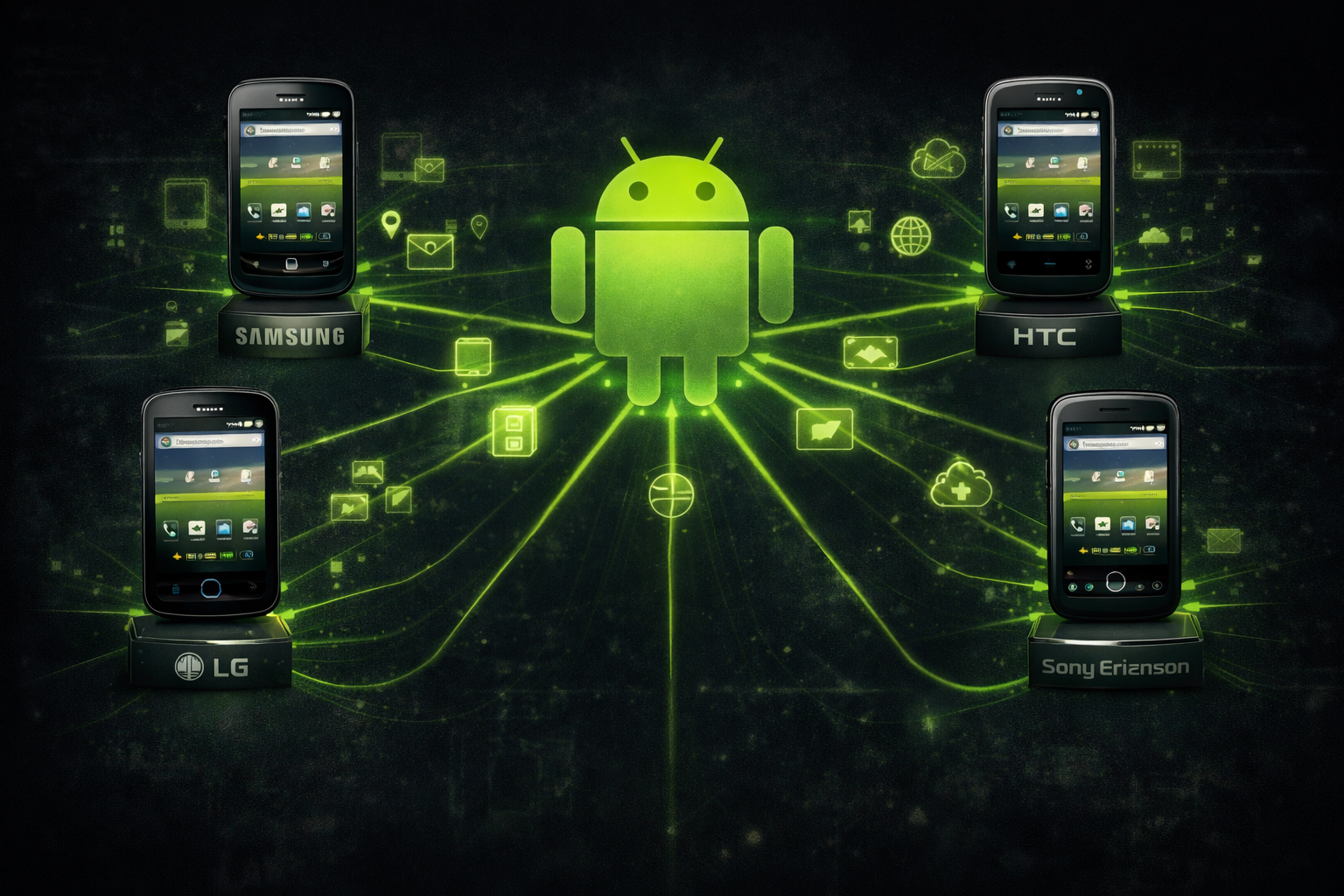
In this process, the Open Handset Alliance emerged. Instead of building the platform alone, Google chose to bring together multiple manufacturers and carriers into a single alliance. Companies such as Samsung, HTC, LG, and Motorola joined this initiative, turning Android from a mere software project into a platform project involving the entire industry. This approach was fundamentally different from Apple’s. While Apple chose to tightly integrate and control hardware and software, Google opted for a strategy that expanded the ecosystem through broad participation.
This strategy, however, was not without its trade-offs. In the short term, it introduced complexity and uncertainty. With multiple manufacturers involved, maintaining a consistent user experience became difficult, and platform control was inevitably more limited. But Google was not optimizing for short-term polish. What they prioritized was long-term scalability. Android was never designed as a single finished product, but as a growing platform, one that would become stronger as more participants joined.
At this point, Android was no longer just an operating system. It had begun to take shape as a strategic platform designed by Google to secure control in the mobile era. And this strategy soon led to a more fundamental question: should the platform be controlled, or should it be opened?
Why Was It Open Source?
Once we understand that Android was not merely a mobile operating system but a platform strategy, the next question naturally follows. Why did Google choose to make this platform open source? This decision was not just a technical one, but a strategic judgment about how to grow a platform.
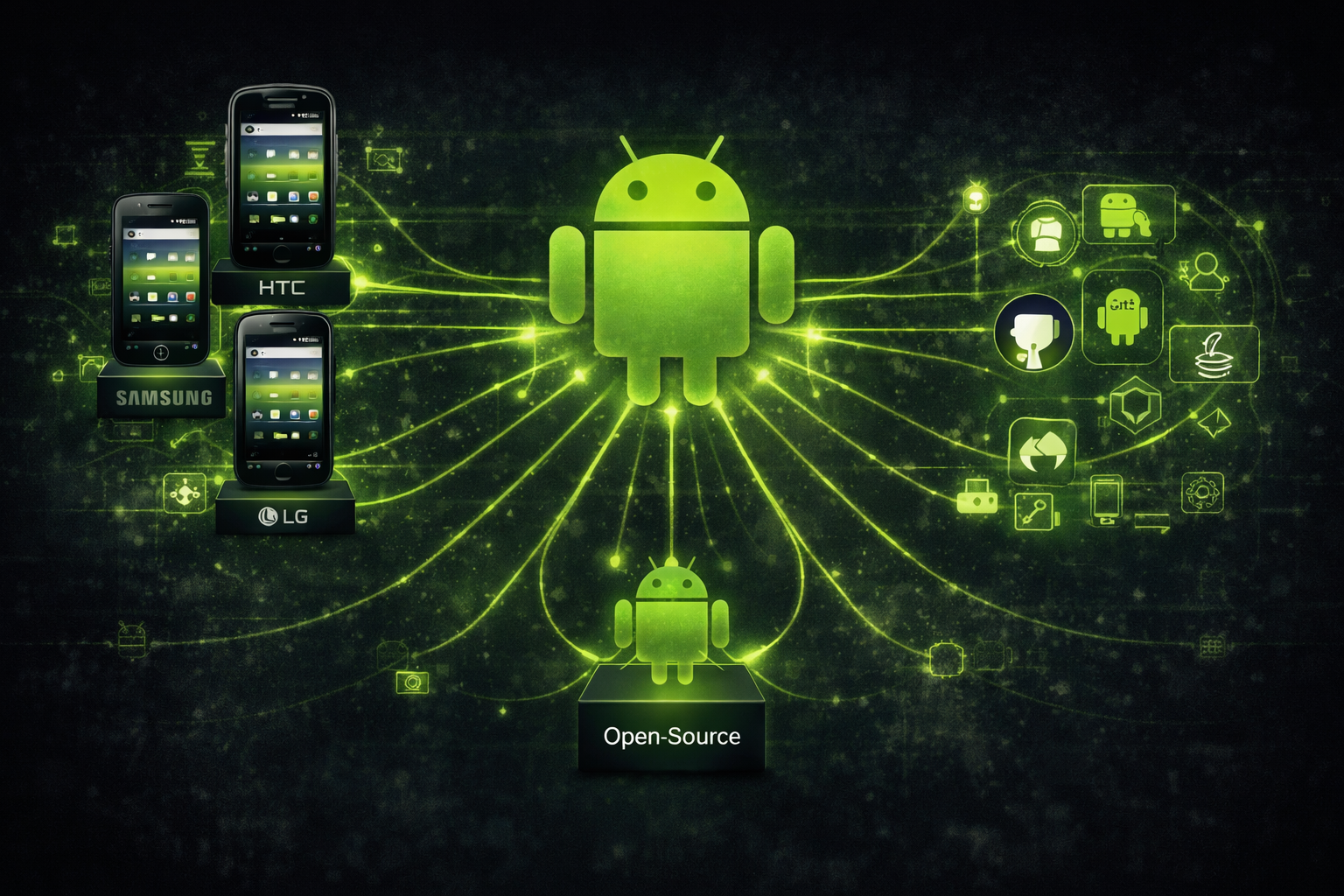
First, for Android to succeed, it needed participation from as many manufacturers as possible. However, a closed operating system can only expand under the control of a single entity, which inherently limits participation. In contrast, an open source model allows manufacturers to freely adopt and modify the platform. This was not simply about reducing costs, but about lowering the barrier to platform participation, which was a critical factor. From a manufacturer’s perspective, instead of developing an operating system from scratch, they could build devices quickly using Android as a foundation. This dramatically accelerated the spread of Android.
In addition, the open source strategy was highly effective in maximizing network effects. As more manufacturers joined, more devices entered the market, which in turn attracted more users and developers. Developers naturally gravitated toward platforms with larger user bases, and users preferred platforms with a richer application ecosystem. This positive feedback loop is an extremely powerful force in platform competition. Android leveraged this structure to rapidly gain market share.
However, the core of this strategy was not simply openness. While Google released Android as open source, it chose to keep key services such as Google Play Services separate. This meant that while the base platform was open, the core services and the center of the ecosystem remained under Google’s control. In other words, Android was not a completely free open source project, but rather a hybrid platform designed to balance openness and control.
Ultimately, Android’s open source strategy was not driven by idealistic principles of openness, but by a highly pragmatic approach to platform competition. While Apple built its ecosystem through control, Google chose expansion through openness. And this choice would go on to fundamentally reshape the structure of the mobile market.
The next question then becomes clear. How was this strategy actually implemented at the technical level? Android was more than just a set of released source code—it was a carefully structured system designed to achieve both flexibility and scalability.
AOSP Structure and Android’s Technical Design
The Android Open Source Project, or AOSP, forms the core structure of the Android platform. This project is not simply about releasing parts of the operating system’s code; it provides the foundational layers that make up the entire platform. Android’s architecture is built on top of the Linux kernel, with multiple system layers stacked above it. This structure was not just a technical choice, but a design optimized to handle both hardware diversity and scalability simultaneously.
Choosing the Linux kernel as the foundation of Android was a highly strategic decision. Linux was already a stable and mature kernel capable of running on a wide range of hardware, and its open source nature made it easy to modify and extend. This was especially important for Android, which needed to operate across devices from numerous manufacturers. On top of the kernel sits the Hardware Abstraction Layer (HAL), which allows Android to provide a consistent interface across different hardware environments. This structure enabled manufacturers to implement hardware-specific drivers while keeping the upper layers unchanged.
Above this layer lies the application framework and runtime environment. Initially, Android used the Dalvik Virtual Machine, which later evolved into ART to improve performance and efficiency. This architecture allows developers to build applications without depending directly on specific hardware, providing a consistent execution environment. In other words, Android was not just offering an operating system, but a stable platform environment for developers.
What is crucial is how this structure combined with the open source model to create powerful effects. Manufacturers could take AOSP as a base and add their own customizations, enabling a wide variety of devices to emerge. At the same time, Google maintained control over the core service layer, ensuring the overall direction of the platform. In this sense, Android’s architecture was not merely a technical design, but a deliberate implementation of platform strategy.
Ultimately, AOSP served as the technical foundation that allowed Android to scale rapidly, while also acting as a mechanism to balance openness and control. Thanks to this structure, Android was able to provide an environment where manufacturers and developers could actively participate, while still maintaining coherence as a single ecosystem. And this technical design would soon lead to an explosive expansion in the actual market.
A Platform Structure That Attracted Manufacturers and Developers
No matter how technically sophisticated Android’s architecture was, that alone could not guarantee the success of a platform. A platform is ultimately defined by how many participants it can attract and sustain. The reason Android was able to spread so rapidly was not simply because it was open source, but because it was designed from the ground up as a participation-driven platform structure that naturally drew in both manufacturers and developers. This structure was not merely a technical detail, but a strategic design choice that became the decisive factor in Android’s success.
From the perspective of manufacturers, Android was an extremely compelling option. Building a proprietary operating system required enormous cost and time, but Android provided a ready-made, battle-tested platform that could be used to bring products to market quickly. Moreover, because AOSP could be freely modified, manufacturers were able to differentiate their devices by adding their own user interfaces and features. This was not just about reducing development cost; it directly impacted time-to-market, which is one of the most critical factors in the hardware industry. As a result, a wide range of manufacturers adopted Android, and the market quickly filled with devices across different price ranges and form factors.
For developers, Android also offered a relatively low barrier to entry. The Java-based development environment was already familiar to many engineers, and the Android SDK was accessible enough to encourage widespread adoption. More importantly, the application distribution model fundamentally changed the rules. Through Google Play, developers could publish their applications directly to users, without waiting for approval from device manufacturers or carriers. This represented an unprecedented level of freedom compared to earlier mobile ecosystems. Developers were no longer constrained by gatekeepers; they could build and distribute services on their own terms.
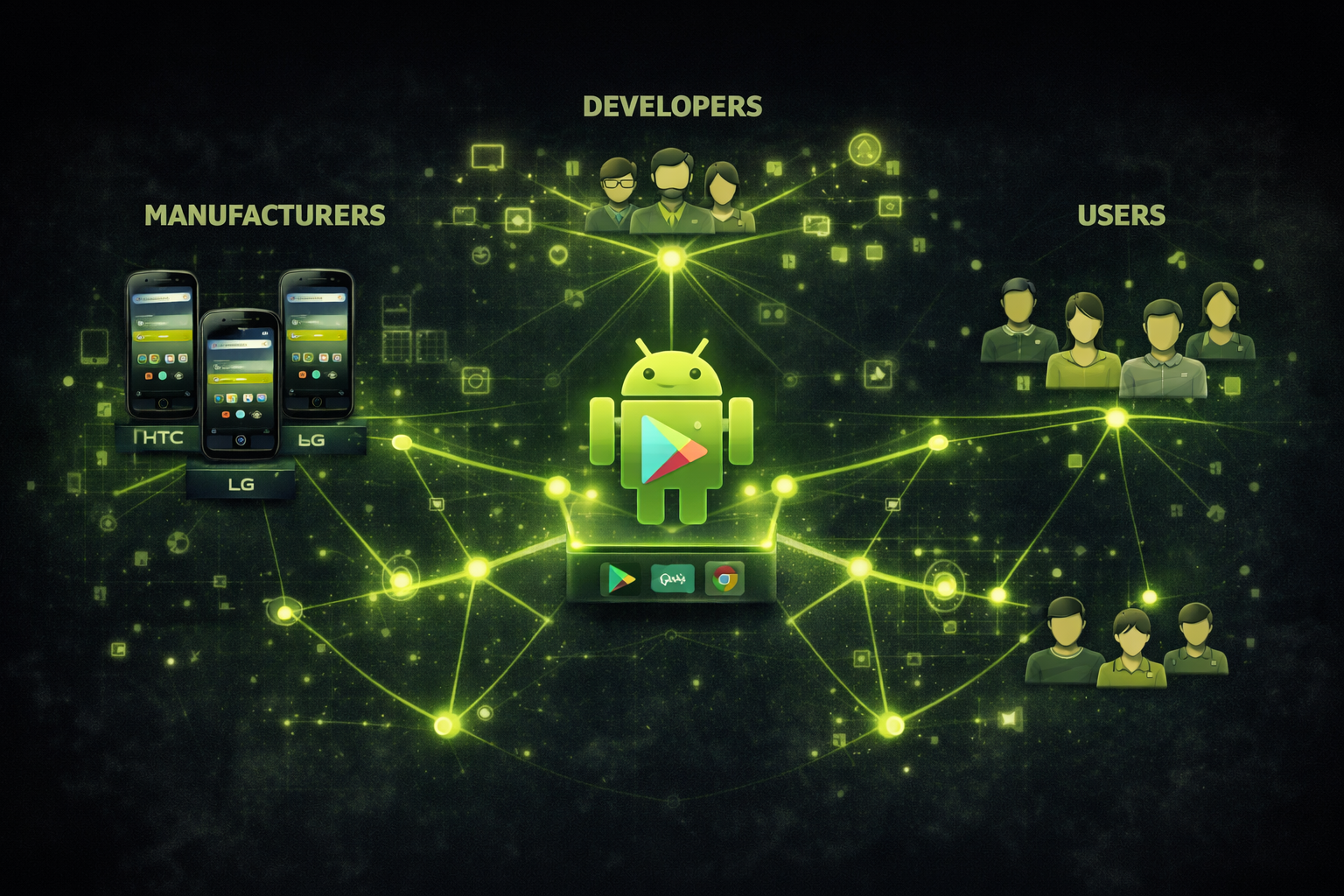
This structure naturally created a powerful network effect. As more manufacturers joined, more devices entered the market, bringing in more users. As the user base grew, developers were increasingly incentivized to target the platform. And as more applications were created, the user experience became richer and more compelling. This virtuous cycle enabled Android to capture market share at an extraordinary pace.
In the end, Android’s success cannot be explained solely by its technical capabilities. It was the result of a carefully designed participation model. A platform is not built by code alone, but by the decisions of those who choose to participate in it. Android understood this principle, and by lowering the barriers for both manufacturers and developers, it succeeded in building a vast and self-reinforcing ecosystem.
The Explosion of the Android Ecosystem and Global Expansion
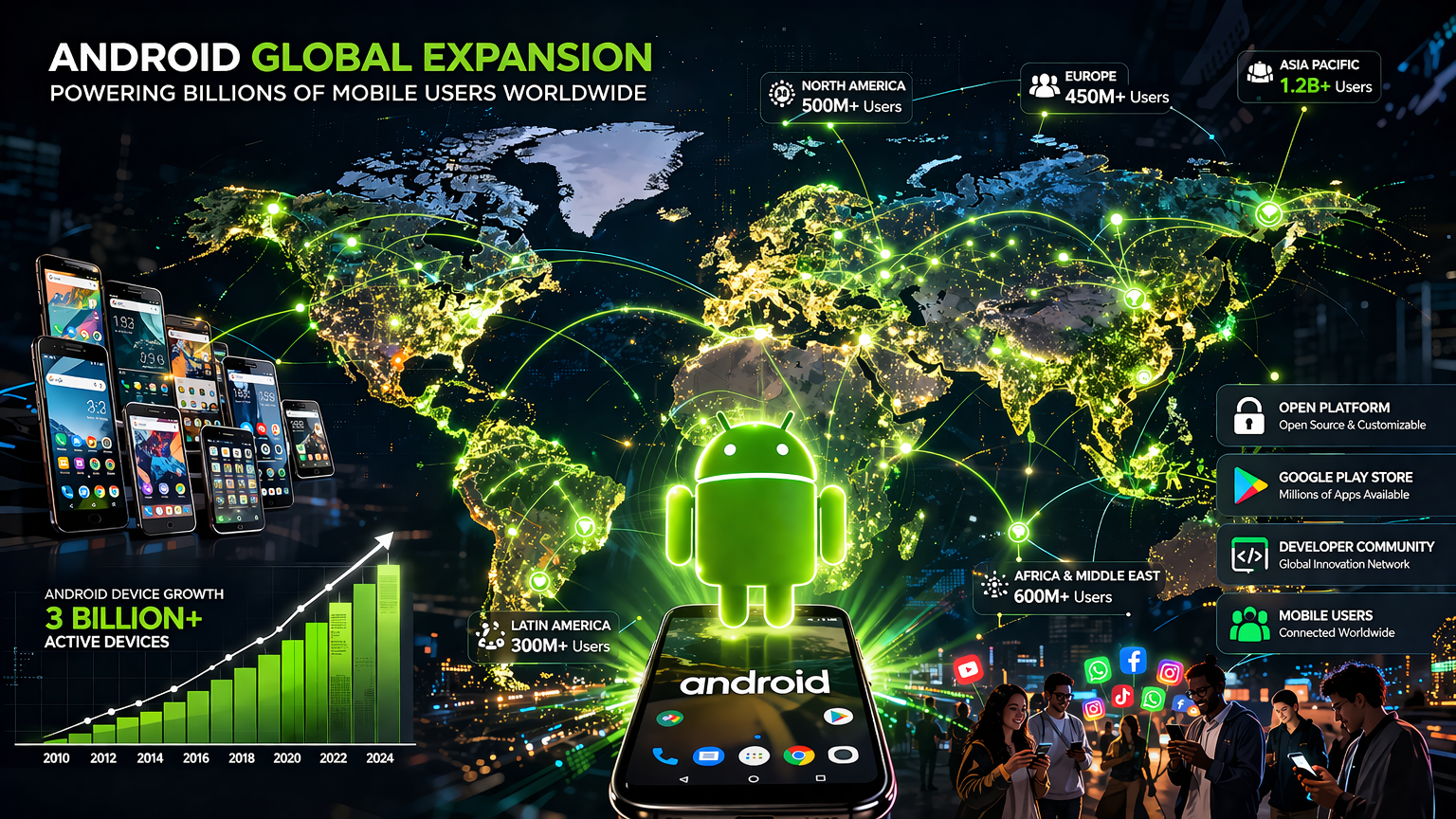
Once the participation structure for manufacturers and developers was established, the expansion of Android accelerated far beyond initial expectations. One of the key reasons for this rapid growth was Android’s ability to support devices across a wide range of price points. Unlike competing platforms that were largely confined to premium devices, Android could run on both high-end smartphones and low-cost hardware. This was a critical distinction, and it became the foundation for Android’s global dominance.
This characteristic had a particularly profound impact in emerging markets. In regions where high-end smartphones were not easily accessible, affordable Android devices enabled millions of people to experience smartphones for the first time. In many cases, Android was not just an alternative—it was the default entry point into the digital world. As a result, billions of users came online through Android devices, fundamentally reshaping how the internet was accessed and used across the globe. This was not merely an increase in market share; it represented a transformation in global digital behavior.
At the same time, the application ecosystem expanded at an explosive rate. The Google Play Store rapidly filled with applications across every category imaginable, from messaging and gaming to navigation, payments, and social networking. Entire industries began to reorganize themselves around mobile-first experiences. Services that were once designed primarily for desktop environments were reimagined for smartphones, and in many cases, mobile became the dominant platform. This shift marked a critical turning point where mobile computing overtook traditional computing as the center of digital interaction.
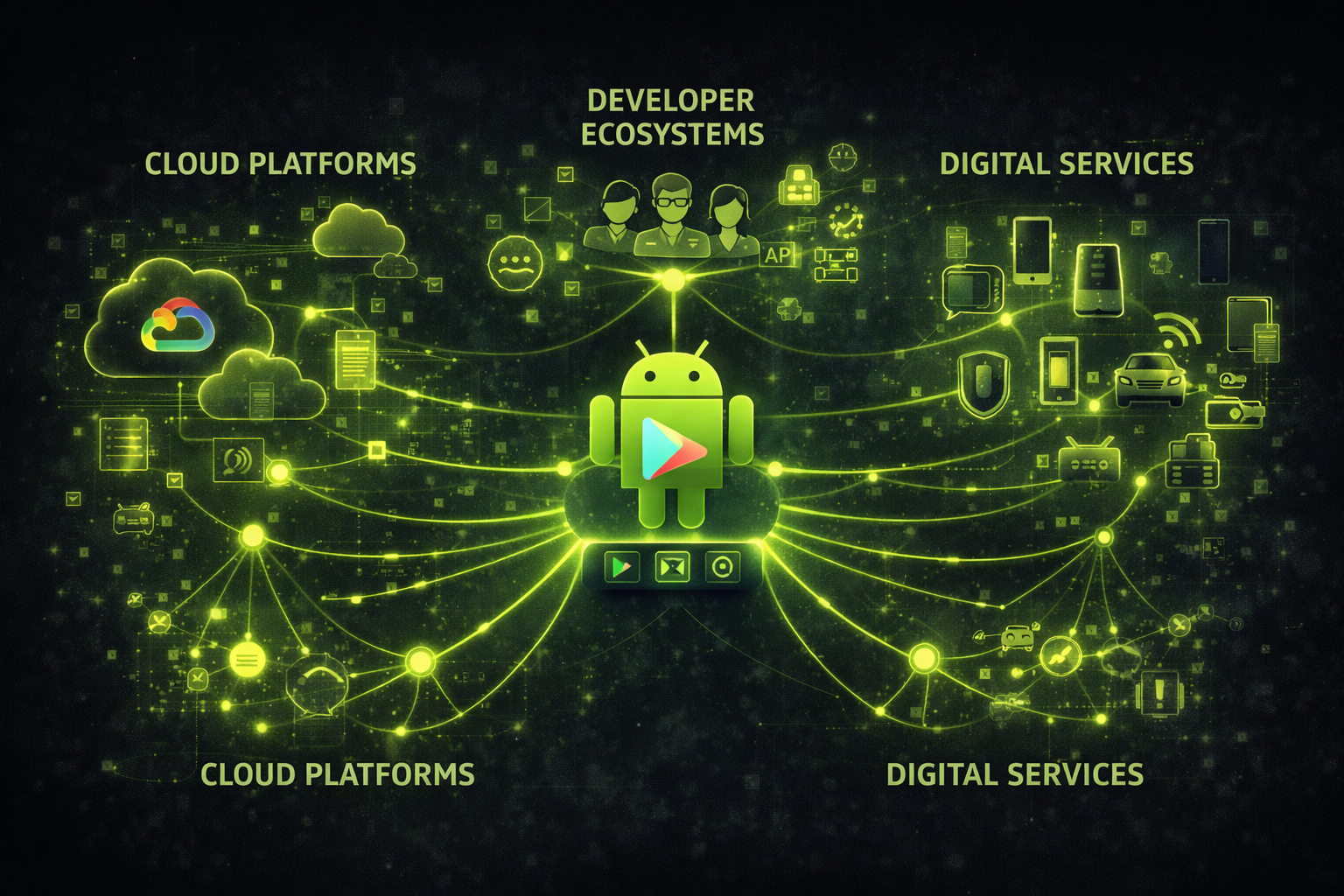
As this expansion continued, Android evolved into something far greater than a mobile operating system. It became an infrastructure that connected devices, users, and services on a global scale. The sheer size and complexity of the ecosystem made it impossible for any single entity to fully control it. Android was no longer just a product—it was a global platform that underpinned modern digital life.
However, this rapid expansion also introduced new challenges. As the number of participants grew, maintaining consistency became increasingly difficult. The very openness that enabled Android’s success also made it harder to enforce uniform standards. The platform’s growth was accompanied by increasing complexity, and this complexity would soon reveal structural limitations.
The Shadow of Android: Fragmentation and Control
As Android evolved into a large-scale open platform, one of the first major issues to emerge was fragmentation. Because multiple manufacturers were free to modify and distribute their own versions of Android, the user experience began to diverge across devices. These differences went beyond visual customization. They affected system behavior, update policies, hardware compatibility, and even security. As a result, what was nominally the same operating system could behave very differently depending on the device.
For developers, this fragmentation introduced significant complexity. Building a single application that worked consistently across a wide range of devices became increasingly challenging. An application that functioned perfectly on one device might encounter issues on another due to differences in system versions or manufacturer-specific modifications. This was not merely an inconvenience; it directly impacted development cost, testing complexity, and overall platform reliability. The openness that allowed Android to grow rapidly also made it difficult to maintain consistency and predictability.
In response to these challenges, Google gradually began to reassert control over key parts of the ecosystem. One of the most important mechanisms for this was Google Play Services. By separating critical functionality from the core operating system and delivering it as a service layer, Google was able to ensure a degree of consistency across devices. This approach effectively introduced a standardized layer on top of a fragmented foundation, allowing developers to rely on a more uniform set of capabilities.
Over time, this led to a more complex and layered structure within Android. While the platform remained open source at its core, many essential features became dependent on Google-controlled services. This created a hybrid model in which openness and control coexisted. Android was no longer a purely open system; it had evolved into a platform where strategic control was exercised through critical service layers.
Ultimately, the limitations of Android emerged from the same factors that enabled its success. By allowing broad participation, the platform achieved rapid growth and global reach. However, this same openness introduced challenges in governance, consistency, and long-term maintainability. Android thus became more than just a successful operating system—it became a case study in how platforms scale, where they encounter friction, and how they attempt to balance openness with control.
What Android Left Behind
Explaining Android’s success merely as “a mobile operating system with high market share” misses the essence. The most important change Android left behind was not a specific technology or feature, but an answer to how platforms should be designed and expanded. Until then, the software industry had largely been product-centric, and companies tended to design strategies around maximizing control over the systems they created. However, Android chose the exact opposite approach. Instead of maintaining control, it increased participation, and instead of maximizing completeness, it prioritized scalability.
This choice did not only impact the mobile market. Many platforms that emerged afterward began to repeat patterns similar to Android. Expanding participation through open source while maintaining influence through core services became a common structure across cloud platforms, data ecosystems, and developer tools. In this sense, Android was not just an operating system, but a prototype of modern platform strategy.
Android also clearly demonstrates that structure matters more than technology. Even with similar technologies, the outcome changes completely depending on how they are distributed and how participants are connected. Android was not a technically perfect system, yet structurally it was an extremely powerful platform. This difference ultimately translated into real-world results in the market.
Another critical change Android introduced was the transformation of the developer’s role. Previously, developers often worked within environments tightly controlled by specific companies or platforms. After Android, it became possible to freely build and distribute services on top of a platform. This was not just a shift in development environments, but a transformation of the entire production structure of the software industry. The emergence of countless startups and services centered around mobile computing was made possible by this shift.
In the end, Android was not a product, but the result of designing an ecosystem. That ecosystem continues to expand even today. The countless mobile services and digital experiences we use are still built on top of this structure. What Android left behind was not code, but a way of expanding the world through platforms.
Leading into the Next Story
Through Android, we can observe an important transition. Software is no longer competing as isolated products, but rather as platforms and ecosystems. And this transition does not end with mobile. In fact, Android represents only the beginning of this shift. The technologies that follow extend this structure even further, often in more radical forms.
This pattern becomes especially evident in the domain of infrastructure and deployment. In the past, running an application required manually configuring servers and environments. Operating systems, libraries, and runtime environments all had to be carefully aligned, making the process complex and error-prone. However, as the concept of platforms extended into infrastructure, new approaches began to emerge to solve these challenges.
At the center of this shift is container technology, and more specifically Docker. Docker introduced a way to package applications together with their execution environments, drastically reducing the complexity of deployment. This was not merely the introduction of a new tool, but, much like Android, an approach that solves problems through platform design.
If Android expanded the developer ecosystem through a mobile platform, Docker addresses deployment and operations through an infrastructure platform. Although these two belong to different domains, they share a fundamental similarity: both expand ecosystems through openness and participation.
Ultimately, a clear pattern emerges. While technology itself continues to grow more complex, the way we manage that complexity is increasingly platform-driven. And these platforms are always designed to attract more participants.
In the next article, we will explore how this pattern unfolds in the infrastructure space.
We will examine the moment Docker emerged, and how it transformed the way software is deployed, continuing the exploration of how platform thinking is reshaping the technology landscape.